St. Mary Parish Louisiana Mardi Gras Festival
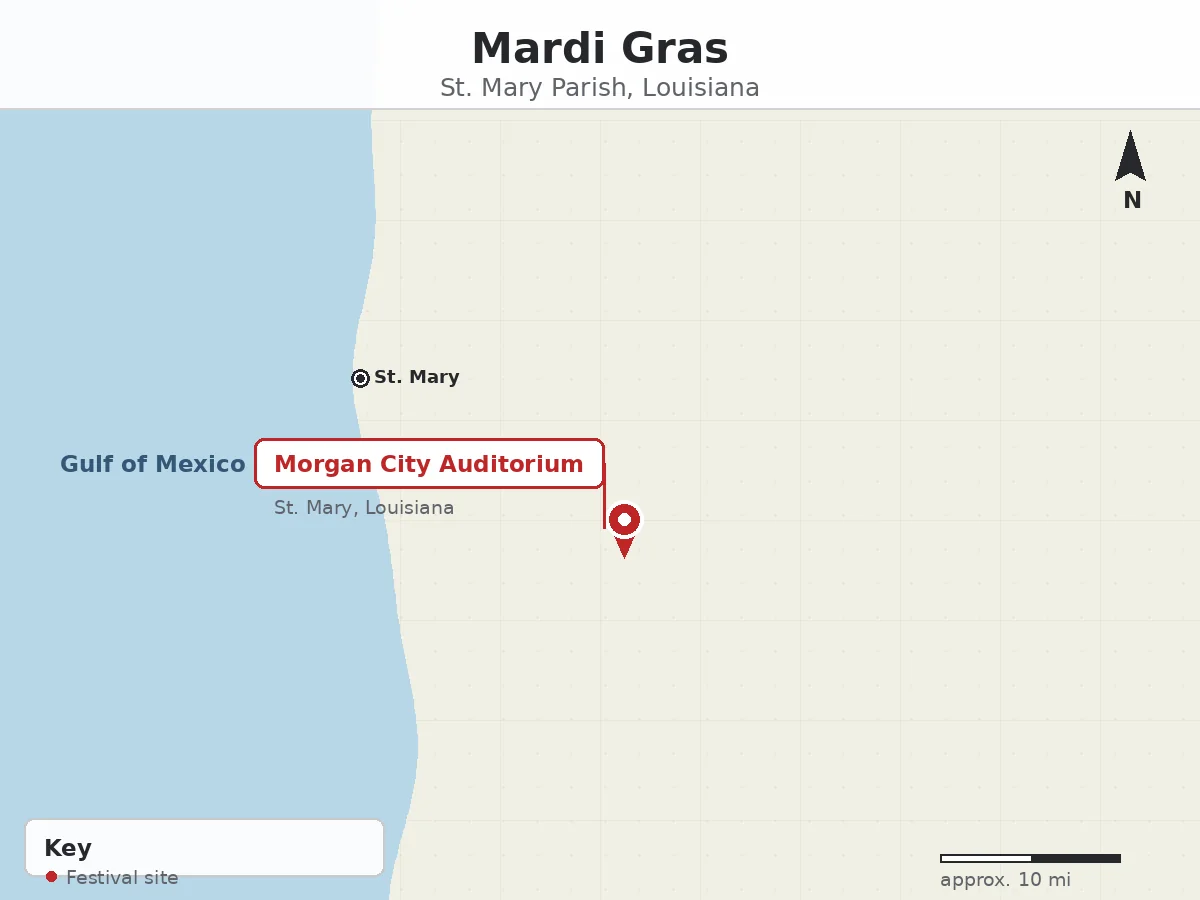
Mardi Gras in Saint Mary Parish does not gather in one place on one day. It rolls through the parish town by town, krewe by krewe, across five February days, and the name on the sheet covers the whole season rather than a single gathering. Morgan City is the main parade town, and its routes run through downtown and end at the Morgan City Auditorium, but parades also roll in Franklin, Baldwin, Patterson, Berwick and Siracusaville. Franklin is the parish seat, while Morgan City carries the heaviest share of the schedule. There is no single organiser and no single gate: each krewe organises its own parade, and the parades are free to watch. The 2026 season ran from Friday 13 February to Tuesday 17 February, Mardi Gras Day, with eight named krewes and two town parades filling the five days. Visitors who come expecting one festival ground will find something looser and older instead — a parish-wide Carnival season built by separate krewes, each with its own history, its own royalty and its own route.

About
The season is best understood as a calendar, not a venue. A parish tourism layer lists the 2026 parades day by day, and a regional magazine layer adds the longer view for the opening night parade. The Krewe of Adonis opens the season in Morgan City on Friday evening, and from there the parades move across the parish: Baldwin and Berwick on Saturday, Morgan City again on Sunday and Monday, then Franklin and Morgan City on Mardi Gras Day itself. Each parade brings floats, throws and marching bands, and each krewe keeps its own character. The Krewe of Hephaestus is the oldest krewe in the parish, with royalty dating to 1914 and parades introduced in 1969. The Krewe of Galatea, established in 1969, is the parish’s first female krewe. The Krewe of Hera is the newest of the named krewes, having debuted its first parade in 2022. The Krewe of Nike is a children’s krewe. No single body runs the season: the parish tourism layer states plainly that each krewe organises its own parade, so the season holds together through shared dates and shared streets rather than through one committee. The 2026 schedule shows the pattern clearly: five days, six towns, eight named krewes, and two town parades, with Morgan City holding parades on four of the five days. That is the honest shape of the event, and the article keeps it that way — a season of separate parades under one parish name, with no single festival invented to tidy it up.
Quick Facts
| Detail | Fact |
| Season | Parish-wide Mardi Gras season of separate krewe parades |
| Main parade town | Morgan City |
| Parish seat | Franklin |
| Other parade towns | Franklin, Baldwin, Patterson, Berwick and Siracusaville |
| 2026 season | Friday 13 February to Tuesday 17 February |
| Mardi Gras Day 2026 | Tuesday 17 February |
| First parade of the season | Krewe of Adonis, Morgan City, Friday 13 February |
| Oldest krewe | Krewe of Hephaestus, royalty dating to 1914 |
| First female krewe | Krewe of Galatea, established 1969 |
| Admission | Parades free to watch |
History
The season’s history lives in the krewes, because there is no single festival to give a founding year to. The Krewe of Hephaestus carries the deepest roots: its royalty dates to 1914, and its parades were introduced in 1969, making it the oldest krewe in the parish. The Krewe of Galatea followed in the same year, 1969, established as the parish’s first female krewe, and that first remains part of how the krewe is described in a state tourism layer. The opening night parade has its own long run: a regional magazine layer says the Krewe of Adonis night parade has drawn crowds for almost forty-five years, which places its pull on Morgan City streets well back into the twentieth century without fixing a precise starting year. The newest chapter belongs to the Krewe of Hera, which debuted its first parade in 2022, a reminder that the season still gains new krewes rather than simply repeating old ones. Between those markers sits a long stretch of parish Carnival life that the layers read do not date parade by parade, and the article does not fill the gaps with guesses. What the record does show is continuity: royalty from 1914, a first female krewe from 1969, a night parade with crowds across almost forty-five years, and a debut as recent as 2022. The season is old in its institutions and young in its newest krewe at the same time.
What to Expect
Parades anchor every day of the season, and each one brings the familiar Carnival furniture: floats, throws and marching bands moving along a town route while crowds line the street. The Krewe of Adonis opens with a night parade in Morgan City on Friday, and the night setting gives the first evening a different feel from the daytime parades that follow. Saturday splits the parish between the Baldwin Mardi Gras Parade and the Krewe of Dionysius in Berwick. Sunday belongs to Morgan City again, with three krewes rolling in one day: the Krewe of Galatea, the children’s Krewe of Nike and the Krewe of Hannibal. Monday brings the Krewe of Amani in Patterson and the Krewe of Hera in Morgan City. Mardi Gras Day itself, Tuesday 17 February in 2026, closes the season with the Franklin Mardi Gras Parade and the Krewe of Hephaestus in Morgan City. Beyond the parades, the Krewe of Hephaestus adds two gatherings of its own: an annual ball on the Saturday before Mardi Gras and a chili party. The children’s krewe gives Sunday a different tone from the rest of the weekend. The Krewe of Nike rolls alongside the Krewe of Galatea and the Krewe of Hannibal in Morgan City, so the Sunday schedule carries a parade built for younger riders in the middle of the day’s three parades. The Krewe of Hephaestus ball, held on the Saturday before Mardi Gras, and its chili party give the season an indoor gathering to set beside the street parades, and both belong to the parish’s oldest krewe. Watching costs nothing — one events layer prints “Free” for the Krewe of Hera parade, and no layer states a price for watching any parade — so the season stays open to anyone who finds a place along a route.
Planning Your Visit
Pick your parades before you pick your town, because the season moves and no single spot covers it all. Morgan City holds the most parades, including the Friday night opener and the Tuesday closing parade, and its routes end at the Morgan City Auditorium, which makes downtown Morgan City the natural base for anyone following the full five days. Franklin, the parish seat, hosts its own parade on Mardi Gras Day, so a visitor who wants the seat town’s celebration should plan for Tuesday. Baldwin and Berwick share Saturday, Patterson hosts the Krewe of Amani on Monday, and Siracusaville is named among the parade towns as well. Arrive early for a viewing place along any route, since the parades are free to watch and the streets fill. Bring a bag for throws, and dress for February weather on the bayou, where an evening parade can turn cool after a mild afternoon. The Krewe of Hephaestus ball falls on the Saturday before Mardi Gras, so anyone hoping to attend a krewe gathering beyond the street should note that date alongside the parade schedule. Above all, treat the five days as a circuit: the season rewards visitors who move with it from town to town rather than waiting in one place.
For a useful comparison, see the St. Mary Parish Louisiana Swamp Pop Festival for another county festival.
Sample Itinerary
A five-day circuit following the 2026 schedule covers the whole season. Friday evening: reach downtown Morgan City in good time for the Krewe of Adonis night parade, the season opener, and watch the floats pass toward the Morgan City Auditorium. Saturday: choose between the Baldwin Mardi Gras Parade and the Krewe of Dionysius in Berwick, or split the day between the two towns. Sunday: stay in Morgan City for a full day of parades — the Krewe of Galatea, the children’s Krewe of Nike and the Krewe of Hannibal all roll there. Monday: catch the Krewe of Amani in Patterson, then return to Morgan City for the Krewe of Hera. Tuesday, Mardi Gras Day: start in Franklin for the Franklin Mardi Gras Parade, then close the season in Morgan City with the Krewe of Hephaestus, the parish’s oldest krewe. Visitors with fewer days should anchor on Morgan City, which holds parades on four of the five days, and add Franklin on Tuesday for the seat town’s parade.
Comparison
A single-site festival gathers its visitors in one place under one organiser, and this season does the opposite on both counts. There is no single ground, no single gate and no single committee; there are six parade towns and eight named krewes, each organising its own parade. The krewes themselves invite comparison. The Krewe of Hephaestus is the oldest, with royalty dating to 1914 and parades from 1969. The Krewe of Galatea, also from 1969, holds the distinction of being the parish’s first female krewe. The Krewe of Hera, which debuted in 2022, is the newest of the named krewes, while the Krewe of Nike is set apart as a children’s krewe. The Krewe of Adonis owns the season’s opening night, with a night parade that has drawn crowds for almost forty-five years. Against a ticketed festival, the season also differs on price: the parades are free to watch, with no gate between the street and the floats. What the season gives up in central organisation it returns in range — five days, six towns and a different krewe character on every route.

Checklist
- Choose which parades to follow from the five-day schedule before travelling
- Base in Morgan City for the fullest coverage, and add Franklin on Mardi Gras Day
- Arrive early for a viewing place along any parade route
- Bring a bag for throws
- Dress for cool February evenings, especially for the Friday night parade
- Note the Krewe of Hephaestus ball on the Saturday before Mardi Gras
- Check which town each parade rolls in — the season moves daily
- Remember the parades are free to watch; no ticket is needed for the street
- Keep the two fenced-out events separate: Lafayette’s festival and New Orleans Carnival are not this season
Beyond
The season’s towns repay a slower look between parades. Franklin, the parish seat, hosts its own Mardi Gras Day parade and anchors the parish’s civic life. Patterson, Baldwin, Berwick and Siracusaville each hold a place on the parade map, and visiting them in turn gives a fuller picture of the parish than any single route can. Morgan City, the main parade town, is where the routes end at the auditorium, and its downtown streets carry the heaviest share of the season. Visitors with more time can follow the parish’s other festival calendar, but they should keep the names straight: the Bayou Teche Black Bear Festival and the Harvest Moon Festival, both in Franklin, are separate events from this season. The Mardi Gras season itself is the parish’s Carnival gathering, and its breadth — six towns, five days, eight named krewes — is the point of it.
Significance
The season matters because it is how Saint Mary Parish keeps Carnival: not as one ticketed gathering but as a shared, parish-wide habit built by separate krewes over more than a century. The Krewe of Hephaestus, with royalty dating to 1914, ties the season to the early twentieth century. The Krewe of Galatea, established in 1969 as the parish’s first female krewe, marks a widening of who organises and leads Carnival in the parish. The Krewe of Hera, debuting in 2022, shows the tradition still renewing itself with new krewes and new royalty. The Krewe of Nike, a children’s krewe, carries the season to its youngest participants. The night parade’s long run adds a third thread: a regional magazine layer says the Krewe of Adonis opener has drawn crowds for almost forty-five years, so the season’s opening night is itself an old habit. Free viewing keeps the parades open to the whole parish, and the movement between six towns keeps the celebration from belonging to any single place. The season’s significance is not in a founding date it does not have, but in this continuity: old krewes and new ones, a seat town and five other parade towns, all rolling through the same five February days.
Frequently Asked Questions
Is there one central festival ground for the whole season?
No. The season is a set of separate krewe parades across six towns, with Morgan City as the main parade town and routes also running in Franklin, Baldwin, Patterson, Berwick and Siracusaville. There is no single ground and no single gate.
Which parade opens the season?
The Krewe of Adonis opens the season in Morgan City on Friday evening, 13 February in 2026. A regional magazine layer says the night parade has drawn crowds for almost forty-five years.
What should a first-time visitor bring to a parade?
A bag for throws and clothing warm enough for a February evening, especially for the Friday night parade. The parades are free to watch, so no ticket is needed for a place along the route.
Do children have a parade of their own?
Yes. The Krewe of Nike is a children’s krewe, and it rolls in Morgan City on Sunday, alongside the Krewe of Galatea and the Krewe of Hannibal.
What to Expect From the Next St. Mary Parish Louisiana Mardi Gras Festival
How often is St. Mary Parish Louisiana Mardi Gras Festival held?
The season returns with the Carnival calendar each year, running across the five days that end on Mardi Gras Day. The 2026 season ran from Friday 13 February to Tuesday 17 February, Mardi Gras Day.
When is the next St. Mary Parish Louisiana Mardi Gras Festival?
The material consulted carries dates for the 2026 season only, from Friday 13 February to Tuesday 17 February, with Mardi Gras Day on Tuesday 17 February. No dates beyond that season appear in the material consulted.
Will the dates change?
Yes. Mardi Gras Day shifts from year to year with the Carnival calendar, so the parade dates shift with it. The five-day shape — opening on Friday and closing on Mardi Gras Day — is the pattern the season follows.
The Saint Mary Parish season closes each year the way it opened: with a krewe on the street, floats passing, throws in the air and a town watching together. Visitors who follow the five days from the Krewe of Adonis on Friday night to the Krewe of Hephaestus on Mardi Gras Day will have seen the parish’s Carnival as it actually is — separate krewes, six towns, one season, and a tradition that keeps renewing itself.