Sabine Parish Louisiana Freestate Festival
Florien is a small town in western Louisiana, and for one weekend each November its festival grounds fill with the sights and sounds of a frontier past that most visitors have only read about in schoolbooks. The Sabine Freestate Festival takes its name from a stretch of history when this corner of the state belonged to no government at all, and it turns that history into three days of Old West shootouts, live music, parades, pioneer demonstrations and community celebration. The sheet title is never printed exactly in the layers read; the event is published as the Sabine Freestate Festival, with one regional newspaper layer printing the variant Sabine Free State Festival.

The western border of Sabine Parish was, between eighteen oh six and eighteen twenty-two, part of Louisiana’s Free State, also called No Man’s Land, an ungoverned strip left in limbo by the boundary dispute between Spain and the United States.
The forty-sixth annual edition runs Friday the sixth of November through Sunday the eighth of November in twenty twenty-six, opening Friday from eight in the morning and closing Sunday at eleven in the evening, with the parade on Saturday at eleven in the morning. The grounds sit in Florien, which is not the parish seat; the seat is Many. The organiser is the Sabine Neutral Strip Historical Foundation, Incorporated.
About
The Sabine Freestate Festival is a three-day community festival held on the festival grounds in Florien, Louisiana, in Sabine Parish. Its subject is the Neutral Strip, the strip of land along the western border of the parish that spent sixteen years outside the control of any government while Spain and the United States argued over where Louisiana ended and Texas began. That period gave the region its lasting nickname, the Free State.
The published name is the Sabine Freestate Festival; one regional newspaper layer prints the variant Sabine Free State Festival, and the two forms are carried unmerged. The sheet title is never printed exactly in the layers read, so it appears on the first line and in the outlook heading, with the published name used everywhere else.
For a useful comparison, see the Sabine Parish Louisiana Tamale Fiesta Festival for another county festival.
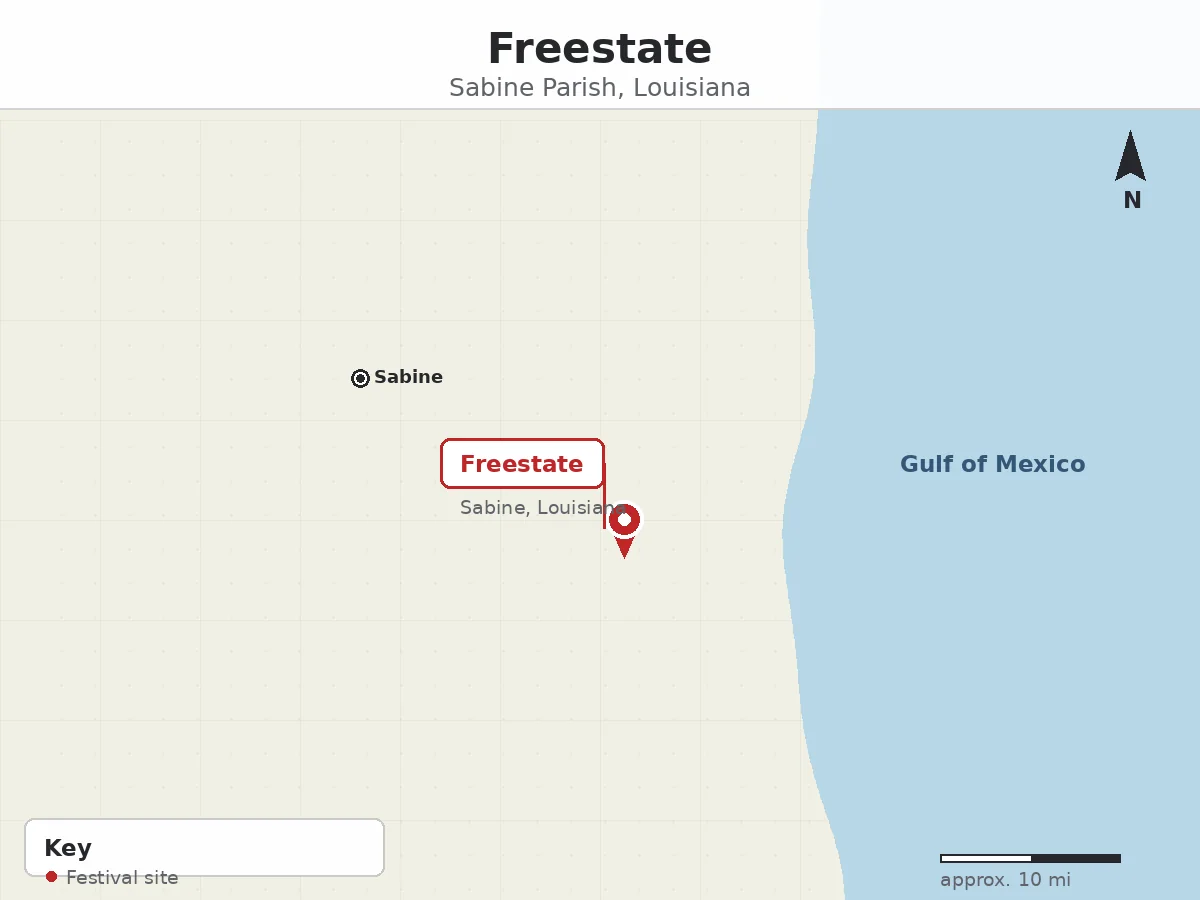
Florien is a small town in the southern part of Sabine Parish, and the festival grounds there host the whole weekend. The parish seat is Many, to the north: the festival belongs to Florien, while the parish government sits in Many. The organiser, the Sabine Neutral Strip Historical Foundation, Incorporated, is run by its members and volunteers.
The weekend is built around living history. Old West shootouts are staged for the crowds, pioneers demonstrate the skills that kept families alive on a frontier with no law and no supply lines, and a treasure hunt sends visitors searching for Midkiff’s Gold, a piece of local legend. Around that historical core sits a full country festival: live music, a parade, a street dance, vendors, a barbecue competition that is now a sanctioned event, a car show, games, a pageant, a trail ride, gospel singing and a community church service.
Quick Facts
| Detail | Information |
| Published name | Sabine Freestate Festival |
| Sheet title | Sabine Parish Louisiana Freestate Festival |
| Host town | Florien, Louisiana |
| Parish seat | Many, Louisiana |
| Venue | Festival grounds in Florien |
| Organiser | Sabine Neutral Strip Historical Foundation, Incorporated |
| Forty-sixth annual edition | Friday sixth of November through Sunday eighth of November, twenty twenty-six |
| Friday opening | Eight in the morning |
| Saturday parade | Eleven in the morning |
| Sunday closing | Eleven in the evening |
History
The history the festival celebrates begins with a line on a map that nobody could agree on. When the United States bought Louisiana, the boundary between the new American territory and Spanish Texas was never fixed, and the land between the Sabine River and the Calcasieu River became a strip claimed by neither side and governed by neither. From eighteen oh six to eighteen twenty-two, the western border of what is now Sabine Parish lay inside that strip, known as Louisiana’s Free State and as No Man’s Land, a place where settlers, traders, outlaws and adventurers lived beyond the reach of any court or sheriff.
The tourism layer that documents the festival’s theme describes the period plainly: an ungoverned strip during the boundary dispute between Spain and the United States. The dispute was settled by treaty, the boundary was fixed at the Sabine River, and the Free State ceased to exist as a legal oddity, but it lived on in local memory and in the identity of the parish. The festival takes that memory and makes it the centre of a public celebration: the shootouts, the pioneer demonstrations and the treasure hunt are its way of telling its own origin story.
Annual billings are carried as printed, and no founding year is derived from them. The forty-sixth annual edition falls in twenty twenty-six. An older tourism newsletter layer attests a November fourth through sixth edition, though the year is not fixed in the layer read, and no year is assigned to it here. The barbecue competition shows how the festival has grown: a local cook-off turned sanctioned event, drawing travelling competitors.
What to Expect
The first thing a visitor notices on the festival grounds is the scale of the history on display. Old West shootouts are staged through the weekend, with re-enactors in period dress playing out the gunfights of a frontier town, and the crowds gather close for the noise, the costumes and the theatre of it. Pioneer demonstrations run alongside, showing the crafts and skills that frontier families relied on, from the tools they used to the ways they cooked, built and survived without shops or services.
Live music fills the grounds across all three days, and the street dance on Saturday evening draws dancers of all ages. The parade steps off on Saturday at eleven in the morning, winding through the festival area with floats, bands, horses and community groups, and the car show gives visitors a slower pleasure, rows of polished vehicles to walk past and talk about with their owners.
The treasure hunt for Midkiff’s Gold is the festival’s most distinctive attraction, sending participants searching the grounds for a prize named after a local legend and tying the weekend back to the Free State years. Children have their own programme of games, and the pageant adds a formal note to the weekend. Food is central, and the barbecue competition is the place to watch it happen. Vendors sell food and crafts, the trail ride takes riders out beyond the festival grounds, and gospel singing and a community church service on Sunday give the weekend a reflective close before the grounds shut at eleven in the evening.
Planning Your Visit
Florien is a small town, and the festival grounds are the centre of the weekend, so the practical advice is simple: arrive early, wear comfortable shoes, and plan to spend the whole day. The forty-sixth annual edition opens Friday the sixth of November at eight in the morning, and the Saturday parade at eleven in the morning is the natural anchor for a visit. Sunday runs through to eleven in the evening, with the community church service and gospel singing among the closing events.
No gate-admission price or free statement appears in any layer read, so this article assumes nothing about entry costs. Minnow-race tickets and vendor booth fees are element and vendor charges, not gate admission, and visitors should check the organiser’s current information before travelling.
Weather in early November in western Louisiana is usually mild, but mornings can be cool and afternoons warm, so layers are the sensible choice. The grounds are outdoors, and the shootouts, demonstrations, parade and trail ride all happen in the open air. Florien is not the parish seat; Many, the seat, lies a short drive to the north.
Sample Itinerary
A first-time visitor could start on Friday morning, when the grounds open at eight, by walking the vendor rows and watching the pioneer demonstrations while the crowds are still thin. Friday is the best day for unhurried conversation with demonstrators and craftspeople.
Saturday is the big day. Arrive before eleven in the morning to find a spot for the parade, then spend the afternoon moving between the Old West shootouts, the car show and the barbecue competition, where the cooking reaches its peak. The treasure hunt for Midkiff’s Gold is worth joining in the afternoon, and the street dance in the evening is the natural end to the day.
Sunday is quieter. The trail ride suits the morning, the games and pageant fill the afternoon, and the gospel singing and community church service close the weekend before the grounds shut at eleven in the evening.
Comparison
Among Sabine Parish festivals, the Freestate Festival stands apart because its subject is history itself. The Zwolle Tamale Fiesta, held in Zwolle, is a food festival built around the tamale and the town’s Spanish and Indigenous heritage, and it is a different event entirely. Other parish festivals celebrate food, music or a single crop; the Freestate Festival celebrates a sixteen-year period when the parish’s western border belonged to no country at all.
The programme shows the same contrast. A food festival is judged by what is on the plate, and a music festival by who is on the stage, but the Freestate Festival is judged by how vividly it brings a vanished frontier to life. The shootouts, the pioneer demonstrations, the treasure hunt and the trail ride put visitors inside the history, while the barbecue competition, the car show and the street dance supply the familiar pleasures of a country festival.
Checklist
- Arrive before eleven on Saturday morning for a good parade spot
- Wear comfortable shoes for a full day on outdoor grounds
- Bring layers for cool mornings and warm afternoons in early November
- Check the organiser’s current information on admission before travelling
- Join the treasure hunt for Midkiff’s Gold
- Watch a pioneer demonstration and ask the demonstrators questions
- Taste the barbecue competition entries and visit the food vendors
- Stay for the Saturday street dance
- Attend the Sunday gospel singing and community church service
- Allow time to visit Many, the parish seat, north of Florien
Beyond the Festival
Florien sits in the southern part of Sabine Parish, and the parish around it is worth exploring once the festival ends. Many, the parish seat, lies to the north, and the drive between the two towns passes through the pine country that defines this part of Louisiana. The Sabine River, now the border with Texas, runs to the west.
The history the festival celebrates is not confined to the festival grounds. The boundary dispute that created the Neutral Strip shaped the whole region, and the parish’s museums, markers and historic sites carry pieces of the same story. The festival also supports the community that hosts it: vendors, craftspeople, musicians, re-enactors and volunteers come from Florien and the surrounding parish, and the weekend is as much a homecoming as a tourist event. Visitors who talk to the people running the stalls will hear family stories that go back generations in the parish.
Significance
The Sabine Freestate Festival keeps alive a piece of American history that could easily be forgotten. The Neutral Strip lasted only sixteen years, from eighteen oh six to eighteen twenty-two, but it left a lasting mark on the identity of Sabine Parish, and the festival is the main public occasion on which that history is told. Without it, the Free State would be a paragraph in a history book; with it, the story is acted out, sung and celebrated before crowds.
The festival also matters to Florien itself. A small town hosting a three-day event with a parade, a sanctioned barbecue competition, a car show and a full programme of living history is doing something ambitious, and the weekend brings visitors, business and attention to a community that might otherwise pass unnoticed. The foundation behind it exists to preserve this history, and the festival is how that work reaches the public.
For the parish, the festival is a statement of identity. Sabine Parish is not defined by a single crop or a single industry, but by a borderland past that made its people independent and self-reliant. That is why the event has lasted into its forty-sixth annual edition, and why it continues to draw visitors who want more than a generic fair.
Frequently Asked Questions
What makes the Sabine Freestate Festival different from other Louisiana festivals?
Its subject is the Neutral Strip, the ungoverned land along the parish’s western border between eighteen oh six and eighteen twenty-two, and the whole programme, from the Old West shootouts to the treasure hunt for Midkiff’s Gold, is built around that history.
Which town hosts the festival, and is it the parish seat?
Florien hosts the festival on its festival grounds. Florien is not the parish seat; the seat is Many, which lies to the north of Florien, and visitors should not confuse the two towns when planning their trip.
What are the dates and hours of the forty-sixth annual edition?
The forty-sixth annual edition runs Friday the sixth of November through Sunday the eighth of November in twenty twenty-six, opening Friday at eight in the morning, with the parade on Saturday at eleven in the morning and the grounds closing Sunday at eleven in the evening.
How is entry priced for the weekend?
No gate-admission price or free statement appears in any layer read, so this article assumes nothing about entry costs. Minnow-race tickets and vendor booth fees are element and vendor charges, not gate admission.
What to Expect From the Next Sabine Parish Louisiana Freestate Festival
How often is Sabine Parish Louisiana Freestate Festival held?
The festival is an annual event, and the forty-sixth annual edition in twenty twenty-six follows the pattern of a November weekend on the festival grounds in Florien, with the parade on Saturday morning.
When is the next Sabine Parish Louisiana Freestate Festival?
The next documented edition is the forty-sixth annual gathering, Friday the sixth of November through Sunday the eighth of November in twenty twenty-six.
Will the dates change?
The festival has long been held in November, and the forty-sixth annual edition is set for the sixth through the eighth of November in twenty twenty-six. An older tourism newsletter layer attests a November fourth through sixth edition without fixing a year, so the November placement holds even though the exact days vary, and visitors should confirm the current edition’s dates with the organiser before travelling.
The Sabine Freestate Festival ends each year the way it begins, with the people of Florien and Sabine Parish celebrating a history that belongs to them alone. The grounds empty, but the story of the Free State stays with the visitors who heard it. For anyone who wants to understand this corner of Louisiana, there is no better place to start than the festival grounds in Florien on a November weekend.