Lafourche Parish Louisiana Laurel Valley Fall Festival
A working sugar cane plantation on the far bank of Bayou Lafourche opens its grounds for one Sunday each autumn. The Laurel Valley Fall Festival takes place at Laurel Valley Plantation, just outside Thibodaux, the parish seat of Lafourche Parish, gathering the parish’s Cajun kitchen traditions, its craft workshops and its agricultural past into a single afternoon on land that still grows cane.

What sets this gathering apart is its setting. Laurel Valley is the largest surviving nineteenth-century sugar cane plantation complex in the United States, and the festival is held inside that surviving fabric. The event began in 1981 to preserve and display the history of south Louisiana, and that aim has stayed at the centre of the day.
About
The Laurel Valley Fall Festival is the autumn half of a two-festival year at Laurel Valley Plantation. The spring gathering, the Laurel Valley Acadian Heritage Spring Festival, was held on the twenty-sixth of April in 2026, from ten in the morning until four in the afternoon, and the fall edition follows the same pattern, a single Sunday in October with the same hours, as recorded for the October 2022 edition. The organiser’s own layer places the fall festival on the second-to-last Sunday in October, while one presentation layer prints it as the third Sunday in October, and the two readings are recorded side by side.
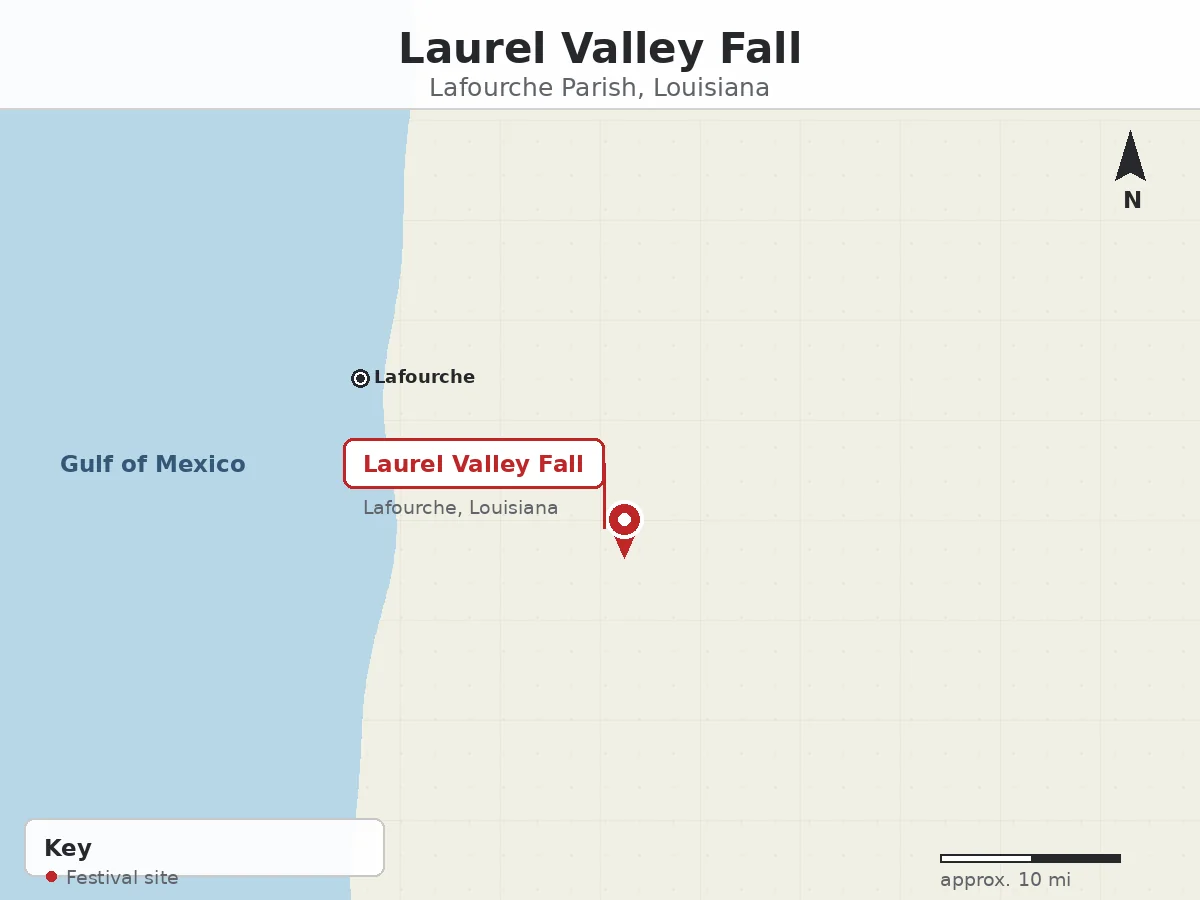
Laurel Valley Plantation sits just outside Thibodaux on the opposite bank of Bayou Lafourche, a short drive from the parish seat. Laurel Valley Village, a non-profit group dedicated to preserving the plantation’s built heritage, organises the festival, and the Laurel Valley Store and Museum holds the festivals on the grounds. The programme is built around what the plantation and the parish do best: local craft makers, Cajun cooks, folk musicians, antique farm equipment demonstrations, live farm animals, heritage displays, homemade preserves, and ironwork and woodwork made by hand.
Quick Facts
| Detail | Information |
| Festival | Laurel Valley Fall Festival |
| Parish | Lafourche Parish, Louisiana |
| Host town | Thibodaux, the parish seat |
| Venue | Laurel Valley Plantation, just outside Thibodaux |
| Organiser | Laurel Valley Village, with the Laurel Valley Store and Museum |
| Season | One Sunday in October each year |
| Hours | Ten in the morning until four in the afternoon |
| Admission | Free, per a 2022 regional news layer |
| First held | 1981 |
| Setting | Largest surviving nineteenth-century sugar cane plantation complex in the United States |
History
The Laurel Valley Fall Festival started in 1981, when the plantation’s keepers opened the grounds to show visitors the history of south Louisiana on a place where that history was still standing. Rather than telling the story of the cane country in a hall, they let people walk through it, watch the old equipment run, taste the food the parish cooks, and meet the makers who keep the old trades alive. The festival’s purpose was preservation from the start, and it has remained a preservation project in festival form.
For a useful comparison, see the Lafourche Parish Louisiana Cajun Heritage Festival for another county festival.
Laurel Valley’s claim to attention rests on survival. It is the largest surviving nineteenth-century sugar cane plantation complex in the United States, and the complex includes the store, the museum and the working buildings that once served the plantation’s labour and its fields. Cane is still grown on the land, so the plantation is not a ruin dressed up for visitors but a working place with a past that can still be seen in use. The autumn date gives the plantation a moment each year to gather the parish around the harvest season and the craft traditions that grew up with the cane.
Over the decades the festival settled into its two-a-year rhythm, with a spring edition and a fall edition sharing the same grounds and the same purpose. The spring festival was held on the twenty-sixth of April in 2026, and the fall edition was recorded on a Sunday in October 2022, from ten in the morning until four in the afternoon. The organiser’s own layer describes the pattern as one festival in spring, on the last Sunday in April, and one in fall, on the second-to-last Sunday in October, while one presentation layer prints the fall date as the third Sunday in October. The festival has never moved away from the plantation that gives it its reason to exist.
What to Expect
A Sunday at the Laurel Valley Fall Festival begins at the gate with the plantation spread out ahead, and the first decision is where to wander first. The store and museum anchor the grounds, and the stalls, demonstrations and animal pens spread out from there across the open land. Craft makers work at tables and benches where visitors can watch a piece take shape, and the ironwork and woodwork on display carry the marks of hand tools rather than factory lines. Homemade preserves sit in rows of jars, and the makers behind them are glad to talk about the fruit and the recipe.
Food is the other centre of the day, and the Cajun kitchen tradition is served without fuss. Cooks from the parish bring the dishes the region is known for. Visitors can eat standing by a stall or find a shaded spot on the grass, and the food is best approached as part of the wandering rather than as a separate stop: taste something, walk on to a demonstration, and come back for another plate when the music draws a crowd to the next corner of the grounds.
Folk music plays through the day, acoustic and unhurried, with players who know the parish’s tunes and the dances that go with them. Antique farm equipment demonstrations are one of the day’s most distinctive features, giving visitors a direct look at how the cane fields were worked before modern machines took over. The people running the machines explain what each piece did and how it fitted into the plantation’s working year. Live farm animals stand in pens nearby, and heritage displays tell the plantation’s story in panels, photographs and objects drawn from the place itself. The festival is free to enter, per a 2022 regional news layer, so the day can be taken at whatever pace suits the visitor.
Planning Your Visit
The festival runs for a single Sunday in October, from ten in the morning until four in the afternoon, so the day is short and the grounds are best approached with a simple plan. Arrive early if the craft rows matter to you, because the makers’ best pieces tend to find buyers before midday, and the morning light suits the outdoor demonstrations. If food is the priority, the middle of the day is the liveliest time on the grounds, with the cooking stalls at full stretch and the music drawing the largest crowds.

Thibodaux is the parish seat and the nearest town of any size, and the plantation sits just outside it on the opposite bank of Bayou Lafourche, so most visitors will come through Thibodaux on the way in. Allow time for the crossing and for parking on the plantation grounds, and wear shoes suited to uneven ground. The festival is held outdoors, so sun protection and water matter. Entry is free, per a 2022 regional news layer, which leaves the budget for food, preserves and craft purchases, and it is worth carrying cash as well as a card, since some of the smaller makers and food stalls may prefer it. Because the fall date is printed in two different ways in the layers read, visitors should confirm the year’s date with the organiser’s own listing before travelling.
A Sample Itinerary
Arrive at ten in the morning, when the gates open, and start at the store and museum, where the plantation’s story is laid out and the day’s layout makes sense. Spend the first hour in the heritage displays and the museum rooms before the crowds thicken. From there, walk the craft rows while the makers are still setting out their freshest work, and stop to watch the ironwork and woodwork taking shape at the benches. By late morning, move toward the antique farm equipment demonstrations, where the old machines are running and the handlers are explaining the work. Take lunch from the Cajun cooking stalls around midday, eat on the grass within earshot of the folk music, and let the afternoon settle into a slower rhythm. In the early afternoon, return to the craft rows for the homemade preserves and any pieces you passed over in the morning, then find a shaded spot for the music. Leave the last hour for a final walk around the grounds and a last stop at the store before the four o’clock close.
How It Compares
Lafourche Parish holds more than one autumn festival, and the Laurel Valley Fall Festival is the quietest of them in character. The Thibodeauxville Fall Festival, held in downtown Thibodaux, fills the historic streets along Bayou Lafourche with vendors, stages and a rubber duck race, drawing a larger, busier crowd into the town centre. Laurel Valley, by contrast, keeps its visitors on plantation ground outside the town, and its programme is smaller, slower and more closely tied to the place itself. Street crowds belong to Thibodaux; craft and farming at work belong to Laurel Valley.
The French Food Festival in Larose centres on Cajun cooking at the Larose Civic Center, with sauce piquante, etouffee, jambalaya and gumbo at the heart of the day. Laurel Valley serves Cajun food too, but food is one strand of its programme rather than the whole of it, sharing the grounds with craft, music, equipment demonstrations and heritage displays. The Cajun Heritage Festival, also in Larose, centres on woodcarving and the decoy show, which gives it a single craft focus that Laurel Valley spreads across several trades. Each parish festival has its own centre of gravity, and Laurel Valley’s is the plantation itself.
Checklist
- Confirm the year’s Sunday date with the organiser’s own listing before travelling, since the layers read print the fall Sunday two ways.
- Arrive near ten in the morning to see the craft rows at their freshest.
- Wear shoes suited to grassy, uneven ground and bring sun protection.
- Carry water and a hat for the outdoor afternoon.
- Bring cash as well as a card for the smaller makers and food stalls.
- Allow time to cross Bayou Lafourche from Thibodaux and to park on the grounds.
- Plan lunch around the Cajun cooking stalls in the middle of the day.
- Leave an hour for the antique farm equipment demonstrations.
- Visit the store and museum first, so the heritage displays make sense.
- Save time at the end of the day for preserves and craft purchases before the four o’clock close.
Beyond the Festival
Thibodaux rewards a longer stay, and the festival’s Sunday hours leave the rest of the weekend open. The parish seat sits on Bayou Lafourche, and its historic downtown streets are worth a walk on their own. The bayou itself is the parish’s spine, and a drive along it in either direction passes through the small communities that grew up with the cane fields. Visitors who come for the festival and stay for the weekend can use Thibodaux as a base and spend the Saturday or the Monday exploring the parish at a slower pace. The spring edition at Laurel Valley, the Laurel Valley Acadian Heritage Spring Festival, is the natural companion to the fall day, with the same grounds and the same purpose in April.
Why It Matters
The Laurel Valley Fall Festival matters because it keeps a working landscape open to the public in a form that teaches by showing rather than by telling. The largest surviving nineteenth-century sugar cane plantation complex in the United States could easily have become a closed monument. Instead, the festival puts the place to work once a year in the way it was always worked: with makers at benches, cooks at stalls, machines running, animals in pens and music in the air. The preservation that Laurel Valley Village exists to carry out is not a matter of freezing the buildings in time, but of keeping the skills, the food and the trades alive around them.
The festival also matters to the parish because it gives the cane country a gathering that belongs to the land itself rather than to a town square or a civic centre. Thibodaux has its own festivals, Larose has its own, and each of them serves its community well, but Laurel Valley is the one place where the setting is the subject. Visitors who come for the craft or the food leave having seen the plantation, and visitors who come for the plantation leave having tasted the parish’s cooking and heard its music. That exchange is the festival’s real work, one Sunday each autumn since 1981, on ground that still grows cane.
Frequently Asked Questions
What makes the Laurel Valley gathering different from other parish festivals?
The setting is the difference. The festival is held on Laurel Valley Plantation, the largest surviving nineteenth-century sugar cane plantation complex in the United States, and the programme is built around the plantation’s own heritage: craft, antique equipment, live animals, heritage displays and Cajun food.
Which Sunday in October does the fall festival fall on?
The organiser’s own layer places the fall festival on the second-to-last Sunday in October, while one presentation layer prints it as the third Sunday in October. Confirm the year’s exact date with the organiser’s own listing before travelling.
Does the festival ask visitors for money at the gate?
Entry is free, per a 2022 regional news layer. No other admission statement appears in the layers read, so food, preserves and craft purchases are the costs to plan for.
When did the Laurel Valley gathering begin?
The festival started in 1981, when the plantation’s keepers opened the grounds to preserve and display the history of south Louisiana. It has run since then as part of a two-festival year, with a spring edition and a fall edition.
What to Expect From the Next Lafourche Parish Louisiana Laurel Valley Fall Festival
How often is Lafourche Parish Louisiana Laurel Valley Fall Festival held?
The festival is held on one Sunday in October each year, as the autumn half of the organiser’s two-festival year, with a spring edition on the last Sunday in April.
When is the next Lafourche Parish Louisiana Laurel Valley Fall Festival?
The next edition falls on a Sunday in October, running from ten in the morning until four in the afternoon at Laurel Valley Plantation. Confirm the exact Sunday with the organiser’s own listing.
Will the dates change?
The festival’s pattern has been steady: one Sunday in October, daylight hours, on the plantation grounds. The only uncertainty in the layers read is which Sunday of October the fall edition takes.
The Laurel Valley Fall Festival is a small day on a large piece of land, and its size is part of its charm. One Sunday each October, the gates of a working sugar cane plantation open to makers, cooks, musicians and visitors.