Iberia Parish Louisiana Delcambre Shrimp Festival
The smell of shrimp on a grill reaches visitors before they see the grounds, and that is exactly how the Delcambre Shrimp Festival has announced itself for generations. In a small Louisiana town built around its canal and its catch, the festival turns five August days into a celebration of the work that feeds the parish. Boats line the water, cook-off tents send up smoke, and the midway fills with families who have come back year after year. The published name of the event is the Delcambre Shrimp Festival, and that is the name the record uses. The title at the top of this article is a filing title only; no layer read prints it as the event’s name, so the body below uses the published name and notes the difference openly. Delcambre calls itself the Shrimp Capital of the World, and the festival is the week when the town proves the point in front of the crowds that gather along the canal.
About
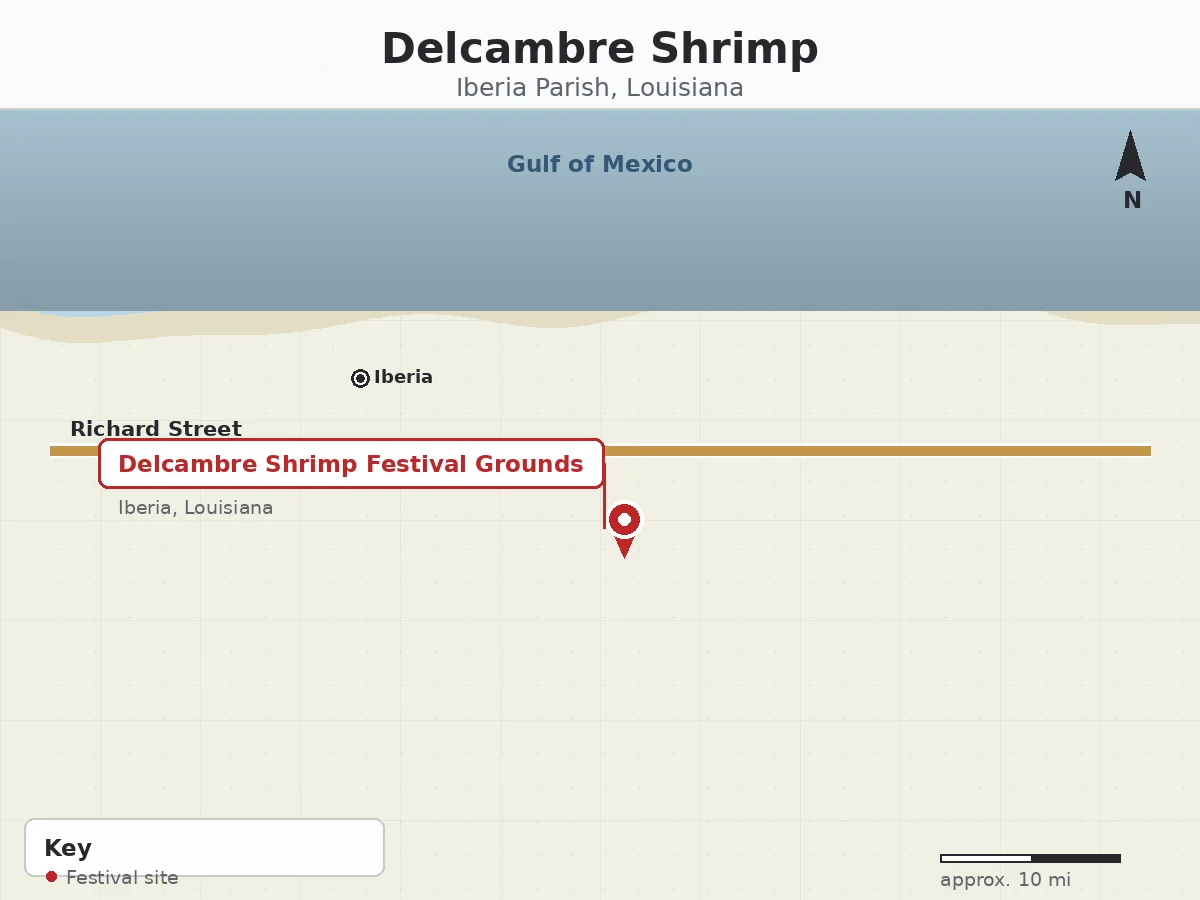
The Delcambre Shrimp Festival is a five-day community festival held in Delcambre, a town in Iberia Parish, Louisiana. Its home is the Delcambre Shrimp Festival Grounds, around South Richard Street near East Main Street and Highway 14, on the banks of the Delcambre Canal. The canal is the working waterway where shrimp boats tie up, where the boat parade passes, and where the Blessing of the Fleet takes place, and the food court, the carnival rides, the stages and the cook-off tents all sit within easy walking distance of one another.
Delcambre is not the parish seat. That distinction belongs to New Iberia, the larger town to the east, while Delcambre carries the parish’s shrimping identity. The festival began as a fundraiser in 1950, and the early days were known as the Iberia Parish Shrimp Festival and Agricultural Fair. The name was officially changed to the Delcambre Shrimp Festival in 1974, and the shorter name has held ever since. No organiser name form is documented in the layers read, so this article names none. The festival runs Wednesday through Sunday on the third full weekend in August, a rhythm the town has kept for decades.
Quick Facts
| Detail | Information |
| Published name | Delcambre Shrimp Festival |
| Host town | Delcambre, Louisiana |
| Parish seat | New Iberia, not Delcambre |
| Venue | Delcambre Shrimp Festival Grounds, on the Delcambre Canal |
| First held | 1950, as a fundraiser |
| Earlier name | Iberia Parish Shrimp Festival and Agricultural Fair |
| Name changed | 1974, to Delcambre Shrimp Festival |
| Usual timing | Third full weekend in August, Wednesday through Sunday |
| Latest edition | 74th annual, 12–16 August 2026 |
| Signature events | Shrimp cook-off, boat parade, Blessing of the Fleet |
History
The Delcambre Shrimp Festival began in 1950 as a fundraiser, in a town whose livelihood already depended on the shrimp boats working the canal and the Gulf beyond it. In those early years the event was known as the Iberia Parish Shrimp Festival and Agricultural Fair, a name that joined the shrimp harvest to the farming life of the parish. The town’s identity, though, kept pulling toward the water, and in 1974 the name was officially changed to the Delcambre Shrimp Festival.
The annual billings tell the story of a long, steady run. The 66th annual edition was originally set for 17 August and was delayed to 19 August by flooding, a reminder that a festival built on a canal lives with the water in every sense. The 70th annual edition ran 18–22 August 2021, the 72nd ran 14–18 August 2024, the 73rd ran 13–17 August 2025, and the 74th ran 12–16 August 2026, each one Wednesday through Sunday on the third full weekend in August.
For a useful comparison, see the Grant Parish Louisiana Dogwood Festival for another county festival.
Delcambre is printed in a travel-magazine layer as the Shrimp Capital of the World, a billing the town wears with pride and the festival exists to justify. The claim rests on the fleet itself: the boats that work out of the canal, the docks that line the water, and the families whose seasons are measured by the catch.
What to Expect
A visit to the Delcambre Shrimp Festival runs across five days, Wednesday through Sunday, and the days build on one another. Wednesday opens the grounds gently, with the carnival rides turning and the food court filling. By the weekend the festival is at full strength. The shrimp cook-off draws teams and tasters, the queens’ pageants bring their own crowds, and the fais-do-dos fill the dance floor with couples moving to Cajun and zydeco music.
The boat parade is one of the festival’s defining sights. Decorated shrimp boats move along the Delcambre Canal past the grounds, carrying crews and families and the colours of the fleet, and the crowd gathers at the water’s edge to watch them pass. The Fisherman’s Mass and the Blessing of the Fleet give the weekend its solemn centre, a moment when the town asks for safety and a good catch for the boats that will work the season ahead. The parade on land, with its floats and marching groups, brings the town itself into the celebration.
Visitors should expect a working-town festival rather than a polished resort fair. The grounds sit on the canal bank, the food is the point as much as the music, and the pace suits families who want to wander between the cook-off tents, the food court, the rides and the stages without rushing. The shrimp appears in every form the town knows how to cook it.
Planning Your Visit
Delcambre sits in Iberia Parish in south Louisiana, and the festival’s August timing brings the full heat and humidity of a Gulf summer. Visitors should dress for outdoor weather, carry water, and plan for shade between the midday sun and the evening programmes. The festival grounds lie around South Richard Street near East Main Street and Highway 14, on the banks of the Delcambre Canal. Arriving early in the day gives the best view of the canal and the boat parade, while the evenings suit visitors who want the music and the fais-do-dos without the afternoon heat.
No general gate price is stated in any layer read, so this article takes no position on the gate as a whole. One detail is fenced to a single year: there was no gate fee on Wednesday or Thursday in the 2024 edition. That detail belongs to 2024 alone and should not be carried forward as a promise for any other year. Before travelling, visitors should check entry arrangements with the organisers instead of guessing at a price or at free entry. Comfortable shoes matter, since the day is spent on foot between the canal bank, the food court and the stages.

A Sample Itinerary
A good Saturday at the Delcambre Shrimp Festival starts with a morning arrival at the grounds, in time to walk the canal bank before the crowds thicken and to watch the boats tied up along the water. Mid-morning suits a slow circuit of the food court, where the shrimp cook-off tents and the food vendors offer the festival’s best argument for coming. Lunch comes from the food court, eaten where the music carries across the grounds, and the early afternoon is a natural moment for the carnival rides and games.
As the afternoon turns to evening, the crowd gathers for the boat parade along the canal, and then for the live Cajun and zydeco music that carries the festival into the night. A Sunday visit has a different flavour: the Fisherman’s Mass and the Blessing of the Fleet give the final day its quiet centre, and the closing hours suit a last walk through the grounds and a last plate from the food court before the festival packs away for another year.
A Comparison
Delcambre’s shrimp festival belongs to a familiar Louisiana pattern, the single-harvest festival that turns a working catch into a weekend of music, food and parade. Other parishes celebrate their own harvests in the same spirit, and the pattern is easy to recognise: a town-centre venue, a cook-off, queens, vendors and a stage. What sets the Delcambre event apart is the water at its centre. The canal is not a decoration. It is the workplace of the fleet, the route of the boat parade, and the setting of the Blessing of the Fleet, and the festival’s five-day shape gives the town room to honour the catch properly.
The size sets it apart from the biggest Louisiana festivals. Delcambre’s gathering is a town festival, not a regional fair, and its charm lies in that modesty. The grounds hold the whole event within a short walk, the programme is built around the boats and the kitchens rather than around distant headliners, and the visitors who return year after year do so because the festival still feels like the town’s own weekend. The seventy-plus annual billings give the event a depth that newer festivals cannot match.
Checklist
- Check the festival dates and entry arrangements with the organisers before travelling, since no general gate price is stated in the layers read.
- Arrive early on Saturday for the boat parade and the best canal-side viewing spots.
- Dress for August heat and humidity, and carry water for a day outdoors.
- Bring comfortable shoes for a day spent on foot around the grounds and the canal bank.
- Carry both cash and a card for the food court, the vendors and the carnival rides.
- Keep younger children in view around the carnival rides and the canal bank.
- Stay for the evening music and the fais-do-do after the daytime programme.
- Allow time for the Fisherman’s Mass and the Blessing of the Fleet on the closing day.
Beyond the Festival
Delcambre rewards visitors who look past the festival grounds. The canal itself is the town’s main street in every sense that matters, lined with docks and boats, and a walk along the water puts the festival in its proper setting: the fleet at rest between trips, the town gathered to honour it, and the working life that keeps the tradition alive. New Iberia, the parish seat a short drive east, offers a quieter contrast, with its historic streets and its own place in the parish’s story.
Visitors with more time can explore the wider region of south Louisiana, where small towns each carry their own festivals and their own harvest traditions. The Delcambre festival fits naturally into such a trip, offering a weekend that is rooted in one place and one catch rather than a generic fairground experience.
Significance
The Delcambre Shrimp Festival matters because it shows how a working town keeps its identity in public. The festival began as a fundraiser in 1950, and its purpose has stayed steady across more than seven decades: to celebrate the shrimp harvest, to support the community that depends on it, and to give the town a weekend in which neighbours meet neighbours along the canal. The name change of 1974, from the Iberia Parish Shrimp Festival and Agricultural Fair to the Delcambre Shrimp Festival, marked the moment the event stopped describing the parish in general and started describing the town in particular.
The Blessing of the Fleet carries its own meaning. It is a public prayer for safety and for a good catch, offered for the boats and the crews who will work the season ahead, and it ties the festival’s celebration to the real risks of the work. The boat parade carries a different meaning: the fleet on display, decorated and proud, moving past the crowds that depend on it.
Frequently Asked Questions
What makes the boat parade different from the parade on land?
The boat parade moves along the Delcambre Canal past the festival grounds, with decorated shrimp boats carrying crews and families, while the parade on land brings floats and marching groups through the town streets. The boat parade is the one that could only happen in Delcambre, because only here does the fleet pass within a few steps of the food court and the stages.
Which days of the festival suit a first-time visitor best?
Saturday offers the fullest programme, with the cook-off, the pageants, the boat parade, the live Cajun and zydeco music and the fais-do-do all in one day. Wednesday and Thursday open the grounds more gently, and Sunday carries the Fisherman’s Mass and the Blessing of the Fleet. A visitor who can spare two days should take Saturday for the celebration and Sunday for the quieter closing.
How did the festival get its present name?
The event began in 1950 as the Iberia Parish Shrimp Festival and Agricultural Fair, a name that joined the shrimp harvest to the farming life of the parish. In 1974 the name was officially changed to the Delcambre Shrimp Festival, and the shorter name has held ever since, tying the event plainly to the town and to the catch.
What should a visitor know about the canal setting before arriving?
The festival grounds sit on the banks of the Delcambre Canal, around South Richard Street near East Main Street and Highway 14, and the canal shapes the whole weekend. The boat parade passes along the water, the Blessing of the Fleet takes place at the water’s edge, and the boats tied up along the canal are part of the scenery.
What to Expect From the Next Iberia Parish Louisiana Delcambre Shrimp Festival
How often is Iberia Parish Louisiana Delcambre Shrimp Festival held?
The Delcambre Shrimp Festival is held once a year, on the third full weekend in August, Wednesday through Sunday. The billings in the record run from the 66th annual edition through the 74th annual edition in 2026, and the five-day shape has held across those years.
When is the next Iberia Parish Louisiana Delcambre Shrimp Festival?
Nothing in the layers read sets a date for a later edition. The most recent edition documented here was the 74th annual, held 12–16 August 2026. Visitors interested in a future edition should watch for announcements from the festival’s organisers, since they are the natural source for news of any later date.
Will the dates change?
The festival’s August placement has held across the editions in the record, with the third full weekend in August the usual home for the five-day run. One edition was delayed by flooding, moving from 17 August to 19 August, which shows that the water can still shift a date.
The Delcambre Shrimp Festival came home again in August 2026 for its seventy-fourth year, and the town that welcomed it back had not forgotten what it was for. A cook-off, a boat parade, a blessing, music and a closing dance filled the grounds along the canal, and the shrimp boats beyond the food court gave the weekend its meaning.