East Baton Rouge Parish Louisiana Lebanese Festival
The smell of saj bread browning on a hot griddle drifts across a library lawn in Baton Rouge, and for one Saturday in October it turns a familiar corner of the city into a small piece of Lebanon. The Baton Rouge Lebanese Festival began in 2023 as a new celebration of Lebanese heritage, and in only four editions it has grown from a single afternoon at a neighbourhood cafe into a full day at the Main Library at Goodwood. The festival is young, but the community behind it is not: the local Lebanese community has been part of Louisiana life for about one hundred and forty years, and the festival gives that long presence a public stage. Food sits at the centre of the day, with falafel, saj, kibbeh and other dishes served alongside Lebanese and Arabic DJ music, dabke folk dancing, live band performances, craft and thrift stalls, children’s games, a tabbouleh showdown and a backgammon competition, and heritage exhibits.
About
The Baton Rouge Lebanese Festival is a one-day cultural festival held in Baton Rouge, the parish seat of East Baton Rouge Parish and the capital of Louisiana. Its published names are the Lebanese Festival and the Baton Rouge Lebanese Festival, and the sheet title at the top of this article is also printed as the event’s name. The festival is presented by St. Sharbel Maronite Catholic Church of Baton Rouge, a Maronite Catholic parish whose mission is also printed as the host and publisher form of the event. The church’s congregation carries the Lebanese heritage the festival celebrates, and the festival grew directly out of that community rather than out of a commercial promoter or a tourism board.
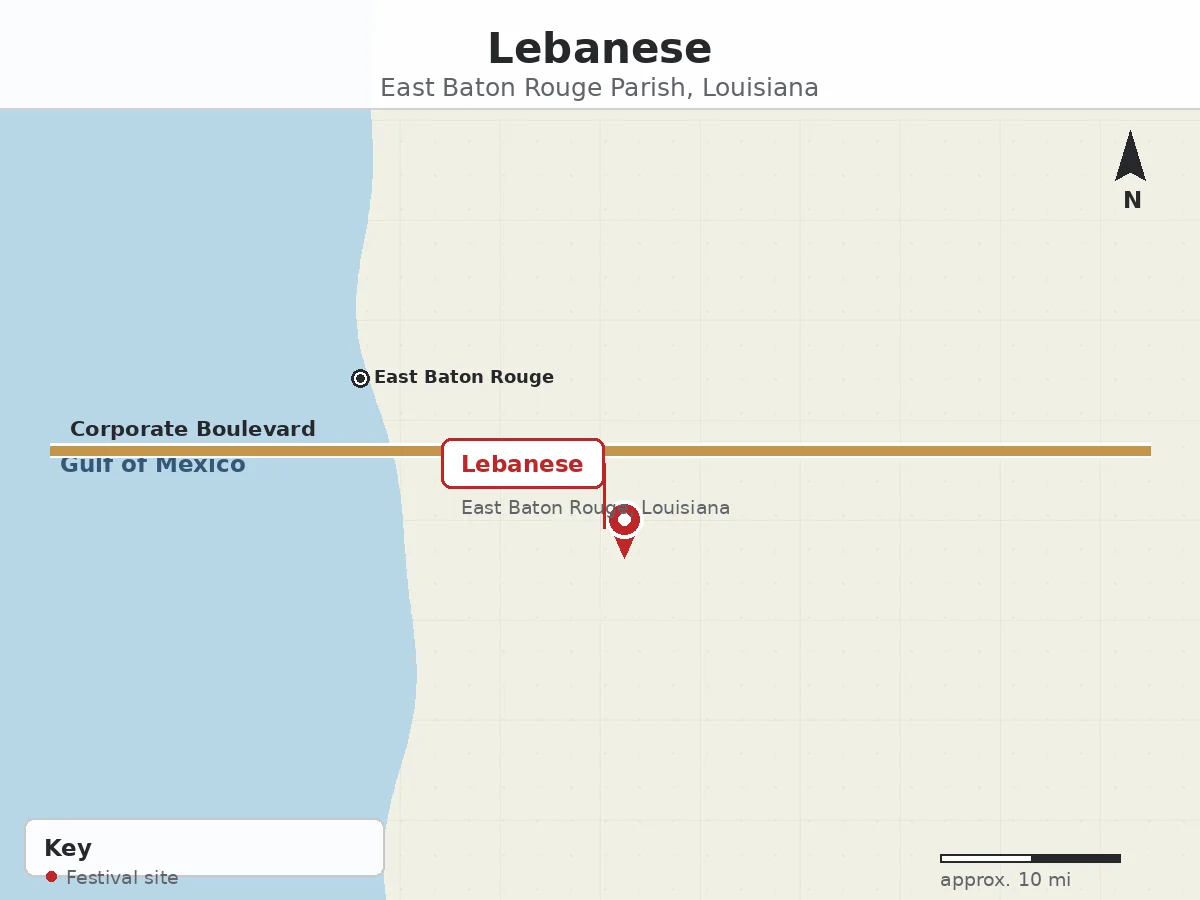
The venue has changed once in the festival’s short life. The first edition, in 2023, was held at Serop’s Cafe on Corporate Boulevard in Baton Rouge. From the second edition onward the festival moved to the Main Library at Goodwood, a public library campus with open lawns, indoor space and parking that suits a larger crowd. The 2024, 2025 and 2026 editions were all held there.
Quick Facts
| Detail | Information |
| Published name | Baton Rouge Lebanese Festival |
| Host town | Baton Rouge, Louisiana |
| Parish seat | Baton Rouge |
| Venue | Main Library at Goodwood |
| First venue | Serop’s Cafe on Corporate Boulevard |
| Presenter | St. Sharbel Maronite Catholic Church of Baton Rouge |
| First held | Saturday 14 October 2023 |
| Latest edition | Saturday 24 October 2026 |
| Admission | Free |
| Charitable gift | A portion of net proceeds to St. Jude |
History
The Baton Rouge Lebanese Festival was launched in 2023 as a new festival celebrating Lebanese heritage. Its first edition took place on Saturday 14 October 2023 at Serop’s Cafe on Corporate Boulevard in Baton Rouge, a cafe setting that matched the scale of a first-year event organised by a single parish community. Admission to the festival was free from the start, and unlimited game play for children was offered at a small charge that year, an element charge rather than a gate admission. The first edition set the pattern the festival still follows: Lebanese food at the centre, music and dancing through the day, children’s games, and exhibits that explain the heritage behind the celebration.
The second annual edition followed on Saturday 5 October 2024 at the Main Library at Goodwood, running from eleven in the morning to nine in the evening. The third annual edition was held on Saturday 4 October 2025, again at the library. The fourth edition took place on Saturday 24 October 2026 at the same library, from eleven in the morning to eight in the evening, with free admission confirmed in advance.
For a useful comparison, see the East Baton Rouge Parish Louisiana Soul Food Festival for another county festival.
The deeper history behind the festival reaches much further back. The local Lebanese community has been in Louisiana for about one hundred and forty years, a presence that began with early immigrants and grew through family businesses, churches and neighbourhoods across the state. The festival presents itself plainly as a new event, launched in 2023, that celebrates a heritage far older than the festival itself.
What to Expect
A day at the Baton Rouge Lebanese Festival runs from late morning into the evening, and the food comes first for most visitors. Falafel, saj, kibbeh and other Lebanese dishes are served from stalls across the grounds, and the cooking is the heart of the festival rather than a side attraction. Saj bread is made to order on a hot griddle, and the smell of it carries across the lawn. Visitors who arrive early find the shortest lines at the food stalls, and the menu rewards a slow wander, with dishes to sample in small portions before settling on a full plate.
Music and dancing fill the day alongside the food. Lebanese and Arabic DJ music plays through the afternoon, live band performances take the stage, and dabke folk dancing brings the traditional line dance of the Levant onto the lawn. Children’s games keep younger visitors busy through the afternoon. Two competitions give the day a playful edge: a tabbouleh showdown, in which cooks compete over the chopped parsley and bulgur salad, and a backgammon competition, a game that is as much a part of Lebanese social life as the food. Exhibits on St. Sharbel and Lebanon stand near the stalls, explaining the heritage behind the celebration.
Planning Your Visit
The festival is held on a Saturday in October, and the Main Library at Goodwood offers a practical base for the day. The library campus has open lawns for the stalls and stage, indoor space for exhibits, and parking nearby, which makes it easier to plan a visit with children or with older relatives. Arriving near the opening time gives the best choice at the food stalls and the easiest parking, while the afternoon brings the fullest programme of music and dancing. The festival runs into the evening, so visitors who come later still find the stage active and the food stalls serving.
Admission is free, and the only spending most visitors need to budget for is food, crafts and the children’s games. Comfortable shoes matter, since the day is spent on foot between the food stalls, the stage, the exhibits and the craft area. October in Baton Rouge is usually warm, so light clothing, sun protection and water are worth bringing, and a light layer helps once the sun drops toward evening.
A Sample Itinerary
A good Saturday starts with an arrival near the opening time, in time to walk the grounds before the crowds build. Begin at the food stalls, where saj bread is made to order and the falafel and kibbeh are freshest early in the day. Take a plate to a spot on the lawn and eat while the first music plays, then wander through the craft and thrift stalls.
Midday suits the heritage exhibits, which are best visited when the lawn is busiest and a quieter corner is welcome. After the exhibits, find a place near the stage for the dabke folk dancing, and stay for the live band performances that follow. The afternoon is the right time for the competitions: watch the tabbouleh showdown, then look in on the backgammon competition, where the play is serious and the crowd around the boards is part of the entertainment. Children can spend the afternoon at the games area while adults browse the stalls.
As the afternoon turns to evening, return to the food stalls for a second round, since the menu rewards a second tasting. The evening brings the last live band performances, and the festival closes with the lawn still full.
A Comparison
Baton Rouge hosts several parish festivals through the year, and the Lebanese Festival holds a distinct place among them. Many of the city’s festivals are built around a single Louisiana crop or a single musical tradition, and their programmes follow a familiar pattern of food, music and vendors. The Lebanese Festival follows a similar shape, but its subject is different: it celebrates a heritage community rather than a harvest or a genre. The organising body is a parish church rather than a tourism board or a trade group.
That difference shows in the scale of the event. The Lebanese Festival is a one-day gathering on a library lawn, not a multi-day fairground, and its charm lies in that modesty. Visitors looking for a vast midway or a long list of headline acts will find a quieter day here, and that is the point. The festival honours a community and its cooking at a scale where the community itself remains visible. The move from Serop’s Cafe to the Main Library at Goodwood in its second year shows the festival growing without losing that character.
Checklist
- Confirm the festival date and hours with the organisers before travelling, since the October Saturday has moved between early and late in the month.
- Arrive near the opening time for the shortest food lines and the easiest parking.
- Bring cash and a card for food, crafts and children’s games, since admission itself is free.
- Wear comfortable shoes for a day spent on foot around the library lawn.
- Plan for warm October weather, with sun protection, water and a light layer for the evening.
- Visit the heritage exhibits for the story behind the celebration.
- Watch the dabke folk dancing and stay for the live band performances.
- Look in on the tabbouleh showdown and the backgammon competition.
Beyond the Festival
Baton Rouge rewards visitors who look past the library lawn. As the parish seat and the state capital, the city carries the parish’s government buildings, museums, riverfront and neighbourhoods, and a festival weekend is a good moment to see the city at its liveliest. The Main Library at Goodwood sits in a residential part of the city, and the streets around it offer eating places and shops that carry the same neighbourhood character as the festival itself. Downtown Baton Rouge, a short drive away, offers the riverfront, the old and new state capitols, and museums that put the city’s history in a wider frame.
Visitors with more time can explore the wider region of south Louisiana, where small towns each carry their own festivals and food traditions. The festival’s youth is part of its appeal: visitors who come in its early years are watching a tradition take shape.
Significance
The Baton Rouge Lebanese Festival matters because it gives a long-standing community a public celebration of its own. The local Lebanese community has been in Louisiana for about one hundred and forty years, and for most of that time its presence was visible mainly through family businesses, churches and neighbourhoods rather than through a festival. The launch of the festival in 2023 changed that. It gave the community a day on the calendar, a stage for its music and dancing, and a table for its food, and it invited the wider city to share in all of it.
The festival also matters because of how it is organised. It is presented by a parish church, and its programme reflects the church’s community rather than a commercial agenda. A portion of the net proceeds is donated to St. Jude, which ties the celebration to a charitable purpose beyond the day itself. A separate Middle Eastern-themed gala that also benefits the same children’s charity is a different event entirely. The festival stands on its own: a young event, honestly new, celebrating a heritage far older than itself.
Frequently Asked Questions
What dishes should a first-time visitor try at the festival?
Falafel, saj and kibbeh are the dishes the festival itself names, and they make a good first tasting. Saj bread is made to order on a hot griddle, so it is best eaten fresh from the stall. The menu rewards a slow wander, with small portions to sample before settling on a full plate.
How did the festival move from a cafe to a library?
The first edition in 2023 was held at Serop’s Cafe on Corporate Boulevard, a cafe setting that matched the scale of a first-year event. From the second edition onward, in 2024, the festival moved to the Main Library at Goodwood, a public library campus with open lawns, indoor space and parking that suits a larger crowd. The 2024, 2025 and 2026 editions were all held at the library.
What is dabke, and why does it matter to the festival?
Dabke is the traditional line dance of the Levant, and it is one of the festival’s centrepieces. Dancers of different ages join the same line, and part of the pleasure of watching it is seeing a community dance together rather than watching a single performer. The dance sits alongside the DJ music and live band performances, and it gives the festival a form of participation that food alone cannot offer.
What else is there to do besides eating and listening to music?
The programme includes craft and thrift stalls, children’s games, a tabbouleh showdown, a backgammon competition and heritage exhibits. The competitions give the day a playful edge, and the exhibits offer a quieter corner where the heritage behind the celebration is explained. The library building itself offers indoor space and a place to rest.
What to Expect From the Next East Baton Rouge Parish Louisiana Lebanese Festival
How often is East Baton Rouge Parish Louisiana Lebanese Festival held?
The festival has been held once in each year since its launch, with editions in 2023, 2024, 2025 and 2026. Each edition has fallen on a Saturday in October, though the exact Saturday has moved between early and late in the month.
When is the next East Baton Rouge Parish Louisiana Lebanese Festival?
A fifth edition has not been dated in the material covered here. The most recent edition documented here was held on Saturday 24 October 2026 at the Main Library at Goodwood in Baton Rouge. Visitors interested in a future edition should watch for announcements from the presenting church.
Will the dates change?
The festival’s dates have moved within October across its four editions. The first edition was held on 14 October 2023, the second on 5 October 2024, the third on 4 October 2025 and the fourth on 24 October 2026, so the Saturday has fallen in both early and late October. October has remained the festival’s month throughout, even as the chosen Saturday has shifted.
The Baton Rouge Lebanese Festival began in 2023 as a new celebration of a heritage about one hundred and forty years old, and in four editions it has grown from a cafe afternoon into a full day on a library lawn. Food, music, dancing, games and exhibits fill the Saturday, admission is free, and a portion of the proceeds goes to a children’s charity. The festival is young, and it says so plainly. What it offers is not a long tradition of its own but a community’s decision to celebrate its heritage in the open, and to invite the whole city to the table.