East Baton Rouge Parish Louisiana Book Festival
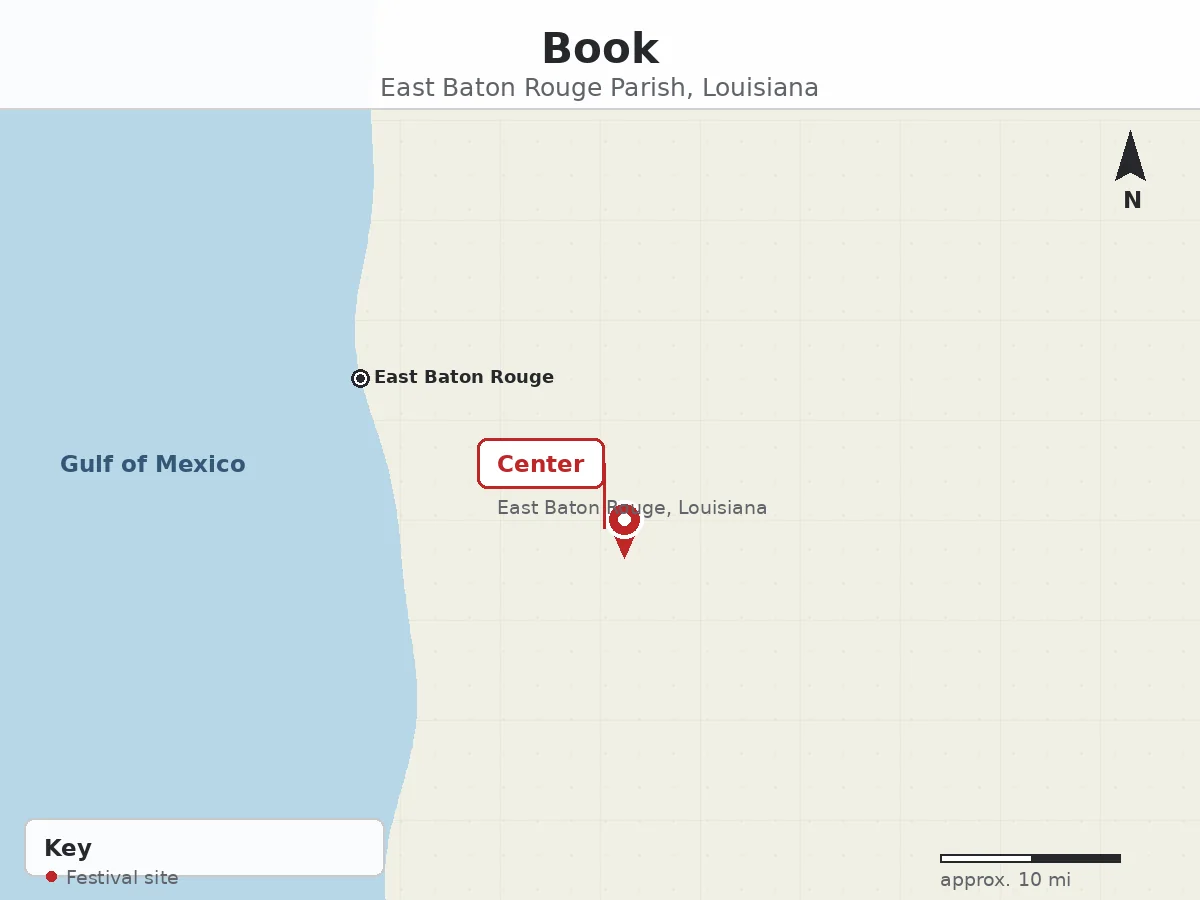
Downtown Baton Rouge fills with readers on a late October Saturday, and the crowd gathers around the State Library of Louisiana and the Capitol Park Museum for a day built entirely around books. The Louisiana Book Festival, the event behind the sheet title above, turns Capitol Park into an open-air reading room, with authors talking about their work, children meeting storybook characters, and visitors moving between panel rooms, signing tables and the lawns outside. The sheet title at the top of this article is the working title under which the event is filed, but no layer read prints the sheet title as the name of the event, so the body of this article uses the published name, the Louisiana Book Festival, throughout and explains the difference honestly. Baton Rouge is the parish seat of East Baton Rouge Parish and the capital of Louisiana, and the festival uses the State Library, the museum and the park together. Admission is free and open to the public, and about twenty thousand people attend.

About
The Louisiana Book Festival is a book festival held in downtown Baton Rouge, Louisiana, at the State Library of Louisiana, the Capitol Park Museum and the surrounding Capitol Park area. Its published name is the Louisiana Book Festival, and that is the name the organiser’s own release and the layers read use. The festival is run by the State Library of Louisiana, and the Louisiana Center for the Book, which was established in the State Library of Louisiana in nineteen ninety-four, stands behind the event. That date belongs to the Center, not to the festival, and this article keeps the two apart. The most recent edition documented here took place on Saturday, October 31, 2026, from nine in the morning until four in the afternoon, and it was billed the twenty-second annual festival. The programme brings together more than two hundred authors, poets and presenters across more than twenty genres, with panels, discussions, readings and book signings, a Young Readers Pavilion and a Kids Orchestra programme called Books and Music.
Quick Facts
| Detail | Information |
| Published name | Louisiana Book Festival |
| Host town | Baton Rouge, Louisiana |
| Parish seat | Baton Rouge, also the state capital |
| Venue | State Library of Louisiana, Capitol Park Museum and Capitol Park |
| Organiser | State Library of Louisiana |
| Most recent edition | Saturday, October 31, 2026 |
| Billing | Twenty-second annual festival |
| Authors and presenters | More than two hundred across more than twenty genres |
| Admission | Free and open to the public |
| Attendance | About twenty thousand |
History
The Louisiana Book Festival grows out of the Louisiana Center for the Book, which was established in the State Library of Louisiana in nineteen ninety-four. The Center’s establishment is a matter of record, and it gives the festival its institutional home, but it is not a founding year for the festival itself, and this article does not present it as one. The festival’s own billing supplies the history that can be stated with confidence. The edition held on Saturday, October 31, 2026, was billed the twenty-second annual festival, and that billing is recorded here exactly as printed, without turning it into a founding year by arithmetic. A November first downtown edition is attested in a December 2014 parish library newsletter layer, which places the festival in the city more than a decade before the most recent edition. A 2025 edition is attested by publisher layers referring to last year’s Louisiana Book Festival in twenty twenty-five. The festival has stayed in downtown Baton Rouge, at the State Library, the Capitol Park Museum and the surrounding park, and its shape has stayed steady: a free public day of authors, panels, readings, signings and children’s programming. The Tales from the Oaks Children’s Book Festival, a school-based event in April, is a different event.
What to Expect
A visit to the Louisiana Book Festival runs from nine in the morning until four in the afternoon, and the day is dense with choice. More than two hundred authors, poets and presenters take part across more than twenty genres, and a state tourism guide layer puts the count of featured writers at more than one hundred and fifty. The two counts come from different layers and are recorded here unmerged, as printed, and either way the scale is the same: a visitor cannot see everything, and the day rewards choosing a few sessions. Panels and discussions run through the day, readings let visitors hear writers in their own voices, and book signings let readers meet authors face to face and carry a signed copy home.
Younger visitors have a full programme of their own. The Young Readers Pavilion brings storybook characters into the festival, and the parish library and the Kids Orchestra Books and Music programme give children music and reading together in one place. The One Book, One Festival discussion, marking the fiftieth anniversary of a nineteen seventy-six novel, gives the whole festival a shared book to talk about. About twenty thousand people attend, and the festival spreads across several buildings and the open ground between them, with food and book stalls filling the spaces between sessions.
For a useful comparison, see the De Soto Parish Louisiana Trail of Treasure Festival for another county festival.
Planning Your Visit
Baton Rouge is the capital of Louisiana and the parish seat of East Baton Rouge Parish, and the festival sits in its downtown, at the State Library of Louisiana, the Capitol Park Museum and the surrounding Capitol Park area. Visitors should plan around the festival’s hours, nine in the morning until four in the afternoon, and the fact that the programme runs across several venues at once. Reading the day’s schedule before arriving helps, since panels, readings and signings overlap. Arriving early gives the best choice of sessions and the shortest signing lines.
Admission is free and open to the public, so there is no ticket to buy at the gate, and visitors should treat any ticket-page price range found in a roundup layer as something else entirely, not as a charge for entering the festival. Comfortable shoes matter, because the day means walking between the library, the museum and the park, and standing in signing lines. Books bought at the festival are the natural souvenir, so bringing a bag helps. Families with children should plan time at the Young Readers Pavilion and the Books and Music programme, which run alongside the adult sessions. Parking near Capitol Park fills early, so an early arrival repays itself.
A Sample Itinerary
A good day starts with an early arrival at Capitol Park, in time to walk the grounds before the first panels begin and to pick up the day’s schedule. Begin at the State Library of Louisiana, where the morning panels set the tone, and choose one discussion to sit through in full rather than drifting between rooms. Mid-morning suits a reading or two and a stop at the signing tables while the lines are still short. Late morning is a natural moment for the Young Readers Pavilion if children are along.
Lunch comes from the food stalls in the park, eaten outdoors. The afternoon can be spent between the Capitol Park Museum and the library, moving from a panel to a signing and back again, with time to browse the book stalls in between. The One Book, One Festival discussion, marking the fiftieth anniversary of a nineteen seventy-six novel, makes a good afternoon anchor. As four in the afternoon approaches, the festival winds down, and a last pass through the signing tables or the stalls is the way to close the day, with a signed book or two to carry home.

A Comparison
Louisiana holds many festivals, and most of them celebrate a crop, a dish, a season or a sound. The Louisiana Book Festival belongs to a smaller family, the festivals built around reading and writing. Where a harvest festival fills its grounds with food stalls and music stages, this festival fills its rooms with authors and its lawns with readers, and where a music festival measures its day in sets and encores, this one measures its day in panels, readings and signings. The crowd is quieter, the conversations are longer, and the thing people carry home is a book rather than a plate.
Within the world of book festivals, the Louisiana event stands out for its setting and its scale. Holding the festival at the State Library, the Capitol Park Museum and the surrounding park puts it at the centre of the state capital, with the library itself as the host rather than a rented hall. About twenty thousand attendees make it a large gathering by the standards of book festivals, and the free admission keeps it open to anyone who wants to come. The Young Readers Pavilion and the Books and Music programme give it a family character, and the One Book, One Festival discussion gives the day a shared thread.
Checklist
- Read the day’s schedule before arriving, since panels, readings and signings overlap.
- Arrive early for the best choice of sessions and the shortest signing lines.
- Bring comfortable shoes for walking between the library, the museum and the park.
- Carry a bag for books bought and signed during the day.
- Plan time at the Young Readers Pavilion and the Books and Music programme if children are along.
- Remember that admission is free and open to the public, with no ticket at the gate.
- Allow time for parking near Capitol Park, which fills early on festival day.
- Save an afternoon slot for the One Book, One Festival discussion.
- Dress for an outdoor October day, with layers for the morning.
- Keep the festival’s hours in mind: nine in the morning until four in the afternoon.
Beyond the Festival
Baton Rouge rewards visitors who look past Capitol Park. As the capital of Louisiana and the parish seat of East Baton Rouge Parish, the city carries the state’s political and cultural life in its downtown streets, and a festival weekend is a good moment to see the city at its liveliest. The Capitol Park area itself invites a walk, with the State Library and the museum standing beside the park, and the Mississippi River not far away. The city’s food, music and neighbourhoods give a visitor plenty to do after the festival closes. Visitors with more time can explore the wider region of south Louisiana, where small towns each carry their own festivals and their own traditions, and the Louisiana Book Festival fits naturally into such a trip.
Significance
The Louisiana Book Festival matters because it puts reading at the centre of a public day in the state capital. A festival built around books treats readers as a community worth bringing together in one place, and authors as neighbours worth meeting face to face. The State Library of Louisiana, as the festival’s organiser and home, gives the day an institutional weight that a rented venue could not, and the Louisiana Center for the Book, established in the State Library in nineteen ninety-four, gives it a lineage that reaches back more than three decades. Free admission means the day belongs to anyone who walks into Capitol Park.
The festival also matters for Baton Rouge itself. A city that hosts about twenty thousand readers, with more than two hundred authors, poets and presenters across more than twenty genres, shows itself as a place where books are a public concern rather than a private habit. The Young Readers Pavilion and the Books and Music programme carry that concern forward, giving children their own door into the festival and their own reason to think of reading as something done together, in public.
Frequently Asked Questions
What makes the Louisiana Book Festival different from other Louisiana festivals?
Most Louisiana festivals celebrate a crop, a dish, a season or a sound, while this festival celebrates books and reading. Its programme is built from panels, discussions, readings and book signings, with more than two hundred authors and presenters across more than twenty genres, and its setting is the State Library, the Capitol Park Museum and the surrounding park in downtown Baton Rouge. Admission is free, and about twenty thousand people attend.
Which parts of the day suit younger visitors best?
The Young Readers Pavilion, with its storybook characters, is the centre of the children’s programme, and the parish library and the Kids Orchestra Books and Music programme give younger visitors music and reading together. These run alongside the adult sessions, so families can plan a morning at the pavilion and an afternoon moving between the library and the museum. Book signings also suit children who have a favourite author to meet.
How should a first-time visitor choose between the many overlapping sessions?
Reading the day’s schedule before arriving is the best preparation, since panels, readings and signings overlap across the library, the museum and the park. Choose a few sessions that matter most and let the rest go. Arriving early gives the best choice, and the signing tables and book stalls fill the gaps between chosen sessions.
Is there any charge to enter the festival?
Admission is free and open to the public, per the organiser’s own release and multiple layers, and there is no ticket at the gate. A ticket-page price range that appears in one roundup layer is not a charge for entering the festival. Books, food and other items bought during the day are the visitor’s own spending.
What to Expect From the Next East Baton Rouge Parish Louisiana Book Festival
How often is East Baton Rouge Parish Louisiana Book Festival held?
The festival is billed as an annual event, and the twenty-second annual billing in twenty twenty-six sits alongside a November first downtown edition attested in twenty fourteen and a twenty twenty-five edition attested by publisher layers. The record shows a festival that returns each autumn to downtown Baton Rouge.
When is the next East Baton Rouge Parish Louisiana Book Festival?
No later date has been fixed in the layers read. The most recent edition documented here was held on Saturday, October 31, 2026, from nine in the morning until four in the afternoon at the State Library, the Capitol Park Museum and the surrounding park. Visitors interested in a future edition should watch for announcements from the State Library of Louisiana, the natural source for news of any later date.
Will the dates change?
The festival’s dates have sat in the autumn across the editions documented here, with a November first edition attested in twenty fourteen and an October thirty-first edition in twenty twenty-six. That pattern points to a late October or early November placement, but it does not fix a permanent date, and any later edition could sit on a different autumn weekend.
The Louisiana Book Festival closes each year at four in the afternoon, and the crowd drifts out of Capitol Park carrying signed books and new reading lists. A day spent among authors, panels, storybook characters and fellow readers leaves Baton Rouge a little more full of books than it was in the morning.