Calcasieu Parish Louisiana Mardi Gras Festival
Lake Charles does not pack its Mardi Gras into a single weekend or a single fairground. The celebration that carries the sheet title above is a season, and the honest way to describe it is as a season. The published name for that season is Mardi Gras of Southwest Louisiana, and the same celebration is also printed as Lake Charles Mardi Gras. The sheet title itself, with its parish prefix and its trailing word Festival, is never printed in the layers read, so this article uses the published names in the body and keeps the sheet title only where the record requires it, on the first line and in the closing outlook. What the visitor finds is a run of linked events that opens on 12th Night in early January and builds through February to Fat Tuesday. The season belongs to the whole city rather than to one gate, one ticket and one field.
About
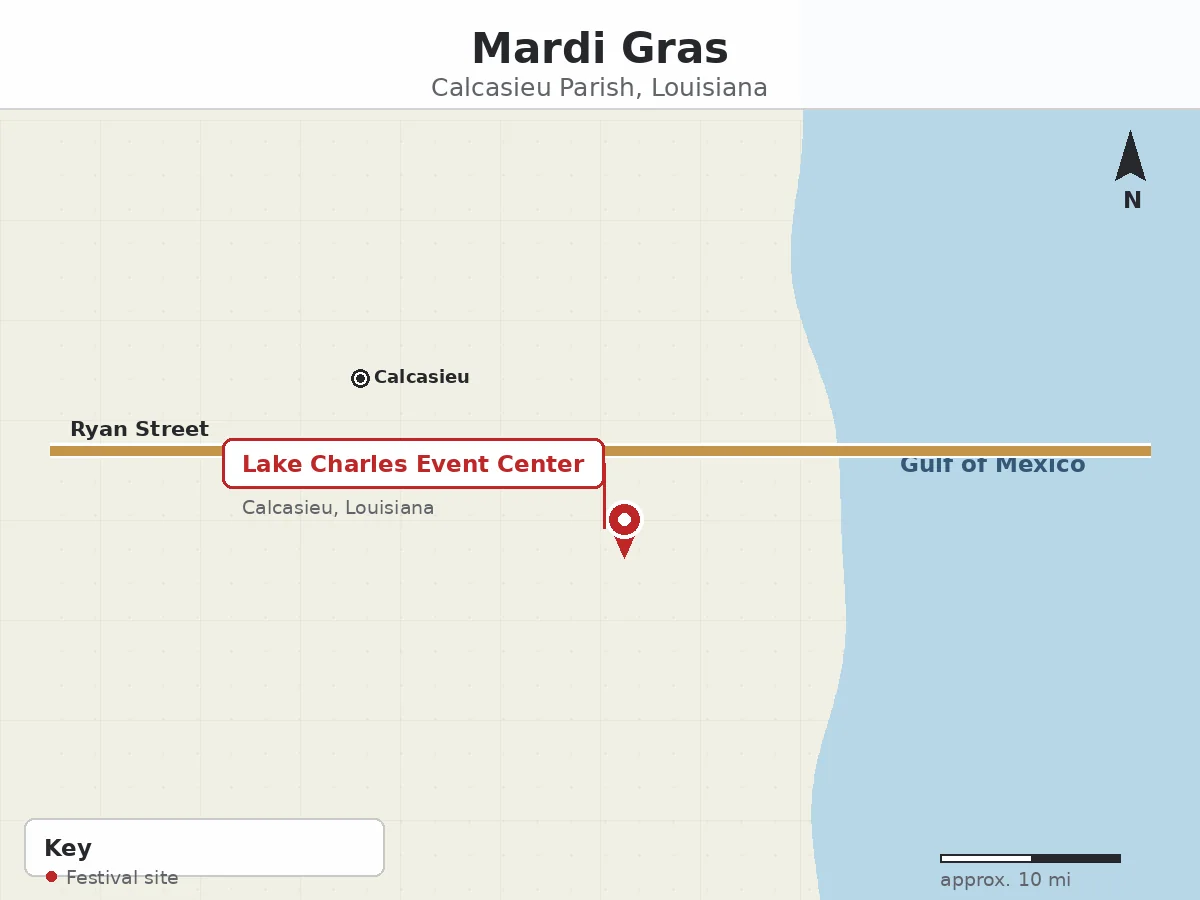
Mardi Gras of Southwest Louisiana is the organiser and brand name printed in the organiser, tourism and local layers, and no other organiser form is printed. The season is centred on Lake Charles, the parish seat of Calcasieu Parish, and its events move between a small number of familiar places rather than settling in one venue. The Lake Charles Event Center hosts the 12th Night opener, Ryan Street carries the Krewe of Krewes Parade on Fat Tuesday, and downtown Lake Charles holds the rest of the season’s street life. The season’s components are separate gatherings, best understood as parts of one season rather than as separate festivals. The Merchant’s Parade, the gumbo cook-off, Children’s Day, the Royal Gala, the Zydeco dance, and the Krewe of Krewes Parade each have a place in the calendar. There is no single gate and no single admission position for the season, because the street parades are public and free to watch by nature, while a small number of indoor components carry their own charges.
Quick Facts
| Item | Detail |
| Published name | Mardi Gras of Southwest Louisiana, also printed as Lake Charles Mardi Gras |
| Host town | Lake Charles, the parish seat of Calcasieu Parish |
| Organiser | Mardi Gras of Southwest Louisiana |
| Season shape | A season of parades and events, not a single festival |
| 2026 season opener | 12th Night, January third, six in the evening, Lake Charles Event Center |
| 2026 Fat Tuesday | February seventeenth, Krewe of Krewes Parade on Ryan Street at five in the evening |
| 2026 parade scale | More than sixty krewes and floats in the Krewe of Krewes Parade |
| Venues | Lake Charles Event Center, Ryan Street and downtown Lake Charles |
| Admission | Street parades free to watch; no general admission position stated for the season |
| Signature food event | World Famous Cajun Extravaganza and Gumbo Cook-off, February fourteenth, 2026 |
History
No founding year is stated for the Mardi Gras of Southwest Louisiana season in the layers read, and this article claims none. The season is documented as a living pattern rather than as a dated origin story, and the record gives dates for its components rather than a birth year for the whole. The 12th Night opener marks the start of the season, with a gathering at the Lake Charles Event Center that sets the calendar in motion. The Merchant’s Parade follows, then the gumbo cook-off, Children’s Day, the Royal Gala and the Fat Tuesday parade, each in its turn. The Krewe of Krewes Parade is the largest single gathering in the season, with more than sixty krewes and floats rolling down Ryan Street. The krewes are separate organisations, each with its own members, its own floats and its own traditions, and the season exists because they all parade in the same weeks. The Mardi Gras Museum of Imperial Calcasieu, housed at the Central School Arts and Humanities Center in Lake Charles, holds the area’s Mardi Gras costumes, and that museum is background to the season rather than part of its history. The 2026 season is the best documented in the layers read, with dated components from the third of January to the seventeenth of February, and it is the season this article follows.
What to Expect
Expect a season that changes its shape from week to week. The 12th Night opener at the Lake Charles Event Center is an evening gathering, a formal start rather than a parade, and it suits visitors who want to see the season begin without the crowds of Fat Tuesday. The Lake Charles Mardi Gras Parade and Zydeco Dance, documented for the eighth of February in 2026, pairs a parade with music and dancing. The Merchant’s Parade on the thirteenth of February rolls in the evening, at seven. The World Famous Cajun Extravaganza and Gumbo Cook-off on the fourteenth of February is the season’s food centrepiece. Children’s Day on the fifteenth of February turns the focus to families, and the Royal Gala on the sixteenth is the season’s formal evening. Fat Tuesday on the seventeenth of February is the climax, with the Krewe of Krewes Parade rolling down Ryan Street at five in the evening, more than sixty krewes and floats passing in a long line. The parades are public and free to watch, and the best vantage is simply a place along the route with room to stand. The gumbo cook-off rewards an early arrival, when the pots are full and the lines are shortest. No single day shows the whole season, and the visitor who comes for two or three separate events will carry away a fuller picture than the visitor who comes for one.
Planning Your Visit
Plan around the calendar rather than around a single date, because the season stretches across six weeks. Pick the components that suit your party before you travel, and give each one its own evening or afternoon. The 12th Night opener suits a short first visit, since it is a single evening at one venue. The Merchant’s Parade and the Krewe of Krewes Parade suit visitors who want the street itself, and Ryan Street is the place to be for the Fat Tuesday parade. Families with children should aim for Children’s Day and the daytime portions of the parade calendar. The Royal Gala is a ticketed indoor evening, so treat it as a separate booking from the free street events and do not expect to walk in from the parade. The gumbo cook-off is a tasting event as much as a contest, so arrive hungry and early. Parking and walking are part of the plan on parade days, since streets close and the best spots fill early. Bring layers for February evenings, when the air cools after sunset, and bring a bag for throws. No general admission position is stated for the season, so do not budget for a gate charge, and treat any ticketed component on its own terms. Check the current year’s calendar before travelling, because the season’s dates move with the Carnival calendar and the days of the week shift from year to year.
For a useful comparison, see the Caddo Parish Louisiana Let the Good Times Roll Festival for another county festival.
Sample Itinerary
A good first season can be built from three visits. Arrive for 12th Night at the Lake Charles Event Center on the third of January, and spend the evening learning the shape of the season. Return in the second week of February for the Lake Charles Mardi Gras Parade and Zydeco Dance on the eighth, and stay for the music and dancing after the parade has passed. Come back for the final stretch, beginning with the Merchant’s Parade on the evening of the thirteenth, then the gumbo cook-off on the fourteenth. Spend the fifteenth at Children’s Day if you are travelling with children. Reserve the sixteenth for the Royal Gala if you want the formal side of the season, and keep the seventeenth free for Fat Tuesday itself. On Fat Tuesday, arrive on Ryan Street well before five in the evening, find a place with room to stand and a clear view of the floats, and stay for the full Krewe of Krewes Parade, which runs long with more than sixty krewes and floats.
Comparison
The season differs from a single-site festival in almost every way that matters to a visitor. A single-site festival has one gate, one field and one set of hours, and the visitor’s day is shaped by that fence. The Mardi Gras of Southwest Louisiana season has no fence, no single gate and no single field, and the visitor’s season is shaped by a calendar instead. The 12th Night opener and the Royal Gala are indoor gatherings, while the parades belong to the street and to anyone standing on it. The gumbo cook-off sits between the two, a tasting event that is open and social without being a parade. Within the season, the components differ from one another just as much. The Merchant’s Parade is an evening parade with a business flavour, shorter and sharper than the Fat Tuesday parade. The Krewe of Krewes Parade is the longest and largest, with more than sixty krewes and floats, and it carries the weight of the whole season. Children’s Day is the gentlest, built for families and for younger visitors. The Zydeco dance is the most musical, with dancing rather than watching at its centre. A visitor who understands these differences can choose well, pairing a loud parade with a quiet tasting.
Checklist
- Pick your components before you travel, and give each one its own day or evening
- Arrive on Ryan Street well before five in the evening for the Fat Tuesday parade
- Bring a bag for parade throws and layers for cool February evenings
- Arrive early at the gumbo cook-off, when the pots are full and the lines are short
- Treat the Royal Gala as a separate ticketed evening, not part of the free street events
- Keep Children’s Day in mind if you are travelling with younger visitors
- Check the current year’s Carnival calendar before travelling, since dates move year to year
Beyond the Season
Lake Charles rewards the visitor who stays past the parades. The Mardi Gras Museum of Imperial Calcasieu, housed at the Central School Arts and Humanities Center, holds the area’s Mardi Gras costumes, and a visit there gives the season a longer view, showing how the colours, the beadwork and the krewe traditions have grown across the years. Downtown Lake Charles is the season’s home ground, and its streets and eating places are worth a slow walk on a non-parade day. The lakefront gives the city its name and its setting, and an afternoon beside the water is a good counterweight to a parade evening. The gumbo cook-off points to the region’s cooking, and the restaurants of Lake Charles carry that cooking through the rest of the year, so a visitor who tastes gumbo at the cook-off can keep tasting it for days afterwards. The season is the reason many visitors come, but the city and the parish are the reason many of them stay a little longer.
Significance
The season matters because it is made by the city itself, krewe by krewe, rather than imported for a weekend. More than sixty krewes and floats in the Krewe of Krewes Parade means more than sixty separate groups of neighbours, co-workers and families, each keeping its own traditions and each adding its own float to the line. The gumbo cook-off matters in the same way, turning a regional dish into a contest and a shared meal at once. Children’s Day matters because it brings the next generation into the season early, giving younger visitors their own day. The Royal Gala matters because it gives the season a formal evening. The 12th Night opener matters because it marks the start, giving the season a beginning that the whole city can share. Together, the components add up to a celebration that belongs to Lake Charles and to Calcasieu Parish. The season does not try to match New Orleans, and it should not be judged against it. Its scale is its own, its streets are its own, and its strength is the number of local hands that keep it going year after year.
Frequently Asked Questions
Which day carries the biggest parade in the Lake Charles season?
Fat Tuesday carries the biggest parade. In 2026, the Krewe of Krewes Parade rolled down Ryan Street on the seventeenth of February at five in the evening, with more than sixty krewes and floats. The Merchant’s Parade and the Zydeco dance parade are smaller gatherings earlier in the season.
Do I need a ticket to watch the parades?
No ticket is needed to watch the street parades, which are public and free to watch by nature. A small number of indoor components carry their own charges, and the Royal Gala is the clearest example, so treat any ticketed evening as a separate booking.
What happens on 12th Night?
12th Night is the season opener, held at the Lake Charles Event Center. In 2026 it fell on the third of January at six in the evening. It is an evening gathering that starts the season rather than a parade, and it suits visitors who want to see the season begin and to pick up the calendar for the weeks that follow.
Can children take part in the season, or is it only for adults?
Children have their own place in the season. Children’s Day, documented for the fifteenth of February in 2026, is built for families, and the daytime portions of the parades suit younger visitors as well.
What to Expect From the Next Calcasieu Parish Louisiana Mardi Gras Festival
How often is Calcasieu Parish Louisiana Mardi Gras Festival held?
The season returns each year, opening on 12th Night in early January and running through February to Fat Tuesday. Its dates move with the Carnival calendar, so the exact days shift from year to year, but the shape stays the same.
When is the next Calcasieu Parish Louisiana Mardi Gras Festival?
The next season follows the Carnival calendar after the 2026 season, which ran from the third of January to the seventeenth of February, 2026. The opener falls on 12th Night in early January, and Fat Tuesday falls in February.
Will the dates change?
Yes, the dates change from year to year, because the season follows the Carnival calendar and Fat Tuesday moves. The order of the components stays steady, with 12th Night first and the Krewe of Krewes Parade on Fat Tuesday last, but the calendar days for each component shift, and the current year’s published calendar is the guide to follow.
The Mardi Gras of Southwest Louisiana season is best taken as a whole, across its six weeks, rather than as a single day. Its parades, its gumbo cook-off, its children’s day, its gala and its Zydeco dance each show a different side of Lake Charles, and the visitor who follows the calendar from 12th Night to Fat Tuesday will see the city at its most open and its most itself.