Muhlenberg County Kentucky Squash and Gobble Arts Bazaar and Fall Festival
Greenville’s autumn fixture hides behind a small crowd of names. The city government layer prints the longest of them, “Squash and Gobble Arts Bazaar & Fall Festival”, which matches the form this catalogue carries. The tourism body’s events layer trims the styling to “Squash & Gobble Arts & Crafts Festival”, the vendor paperwork shortens it again to plain “Squash & Gobble”, and travel-guide layers settle on “Squash and Gobble Festival”. Four spellings circle a single downtown day. Beneath the naming tangle the record is comparatively generous: two dated editions carrying hours, a vendor count and a free-admission statement, an announced Saturday in October of two thousand twenty-seven, and one stray radio billing that calls the gathering an eleventh annual without saying in which year. The Greenville Tourism Commission stands behind the vendor terms, while the city keeps the date on its own calendar of special events. What follows lays out each layer’s contribution in that layer’s own wording, keeps every spelling unmerged, and leaves the September pattern and the October announcement standing side by side.

About
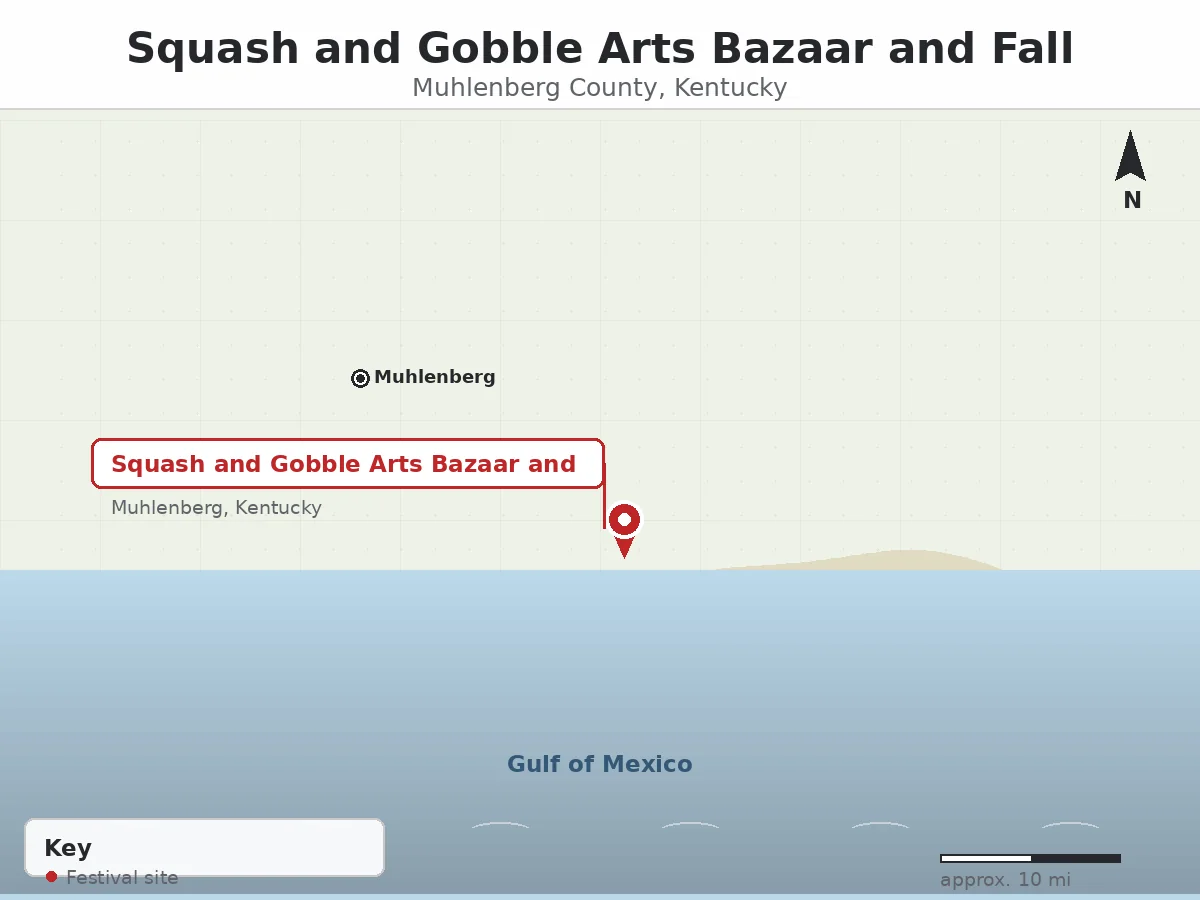
Begin with the names, because the sources never settle on one. The city government layer’s “Squash and Gobble Arts Bazaar & Fall Festival” is the fullest form and the one this article’s title follows. The tourism body’s events layer prefers “Squash & Gobble Arts & Crafts Festival”, swapping the bazaar wording for crafts. The shortest styling, “Squash & Gobble”, appears in the tourism body’s own prose and on the organiser’s vendor form. Travel-guide layers take yet another path with “Squash and Gobble Festival”. None of these is treated here as a correction of the others; each is reported where its layer uses it. The organising hand is unusually clear for a small-town festival. The organiser’s vendor agreement layer declares its terms “established by the Greenville Tourism Commission (GTC)”, and the same layer characterises Squash & Gobble as a one-day, outdoor, rain-or-shine occasion. The city government layer adds the event to the city’s own calendar of special events, a municipal endorsement printed alongside the commission’s paperwork. Place is equally firm. Greenville is the seat of Muhlenberg County on the city government layer’s showing, and a state reference layer’s county formation table confirms the standing, so the bazaar belongs to the county’s seat town and fills its downtown.
Quick Facts
| Item | Detail |
| Fullest printed name | Squash and Gobble Arts Bazaar & Fall Festival |
| Tourism layer’s styling | Squash & Gobble Arts & Crafts Festival |
| Shortest printed form | Squash & Gobble |
| Host town | Greenville, Muhlenberg County, Kentucky |
| County standing | Greenville is the seat of Muhlenberg County |
| Setting | Downtown Greenville |
| Organiser in the vendor terms | Greenville Tourism Commission |
| Edition documented in full | Saturday the twentieth of September, two thousand twenty-five |
| That day’s hours | Eight in the morning to three in the afternoon |
| That day’s admission | Completely free, per the tourism layer |
History
Deep roots are claimed for many festivals; this record claims almost none, and the gap deserves plain statement. No layer consulted states a founding year for Squash & Gobble, and none of the dated editions carries an anniversary number that could substitute for one. The single billing that gestures at age comes from a radio-station layer, one of whose older posts advertises an “11th Annual “Squash & Gobble”” in Greenville. The post’s own year is not fixed in the text read, so the billing floats free of the timeline: it proves the event had already been running long enough, whenever that post appeared, to count eleven runnings, and it cannot be converted into a first year without inventing the arithmetic’s starting point. What the timeline does hold is a recent, well-lit stretch. The tourism body’s events layer documents Saturday the twentieth of September, two thousand twenty-five in full particular — hours, vendors, demonstrations, music, parking, free entry — and a local newspaper layer from the following September treats the approaching festival as the annual downtown event, with visitors expected, a matter-of-fact tone that suggests an established fixture rather than a novelty. The two thousand twenty-six edition follows on the nineteenth of September, and the announced two thousand twenty-seven date breaks the pattern by moving to October. Continuity across those three years is documented; everything earlier rests on one undated radio phrase.
What to Expect
Downtown Greenville itself is the ground plan: the tourism body’s events layer and the organiser’s vendor agreement layer both place the bazaar there, outdoors, and the vendor agreement adds that it runs rain or shine on a single day. Scale comes from the two thousand twenty-five layer, which counts over two hundred craft, artisan and food vendors gathered for that edition, a figure carried here for that year alone. Among the stalls the same layer sets live grist corn mill demonstrations, an old milling practice performed in the street, together with local produce offered for sale. Sound runs on a longer fuse than the market. The two thousand twenty-five layer gives the festival’s hours as eight in the morning to three in the afternoon, yet lists live music from ten in the morning to ten in the evening; both timings are reproduced as printed, unreconciled, so a visitor in that year might reasonably have found the stalls packing away while the music played on. Getting in and out is part of the design: shuttle parking is listed among that edition’s arrangements, a practical answer to a small downtown absorbing a county-scale crowd. Admission that year, the layer states in terms, was completely free.
Planning Your Visit
Anchor the trip on what each layer actually promises, and no more. The completely free admission attaches to the two thousand twenty-five edition in the tourism body’s events layer; a radio-station layer, in its own year, likewise calls the event free for the family. Two layers pointing the same way make a free gate plausible for the announced two thousand twenty-seven edition, but plausibility is not a printed promise, and this article will not promote one into the other. Check the current events layer before travelling. Money still changes hands inside the grounds: over two hundred vendors sell crafts, artisan goods, food and produce, and the fees named in the organiser’s vendor agreement fall on stallholders who rent space, not on visitors at the edge of the street. Practicalities follow from the vendor agreement’s own description — one day, outdoors, downtown, rain or shine — so footwear and clothing should suit a full day on pavement in whatever weather the date brings. The shuttle parking documented for two thousand twenty-five is worth looking for again, since downtown Greenville was not built for two hundred vendors and their customers arriving at once. Directory layers carry the tourism commission’s street address and postal box for anyone who needs them; those details are noted here by existence only.
For a useful comparison, see the Muhlenberg County Kentucky Hawgs, Bogs and Brews Festival for another county festival.
A Day at the Bazaar, Hour by Hour
**Eight in the morning.** Come downtown as the stalls open and the grist mill demonstrations begin, while the streets are still easy to walk and the full row of vendors stands complete.
**Ten in the morning.** Follow the music as it starts; the two thousand twenty-five layer times the live performances from this hour, and the bazaar crowd thickens around them.
**Midday.** Work the food vendors and the local produce stalls, then take a second, slower circuit of the craft and artisan tables with the morning’s favourites marked for return.
**Three in the afternoon.** The bazaar’s printed closing hour arrives; gather the day’s purchases and make for the shuttle parking before the downtown clear-out peaks.
**Evening.** The two thousand twenty-five layer lets the music run to ten at night, long past the stalls, so lingering for the later sets is a choice that year genuinely offered.
How It Stands Among Greenville’s Other Dates
Comparison begins inside the same calendars, because Greenville keeps several distinct celebrations that share nothing but a town. Saturdays on the Square, the Twilight Antique Car Show and Freedom Fest each appear on the same city and tourism calendars as Squash & Gobble, and each is a separate event with its own date; nothing from their programmes is borrowed here. A second confusion lurks in the festival-guide layer, which lists a Delta Blues and Heritage Festival for a different Greenville in the very weekend the two thousand twenty-six Squash & Gobble appears; that listing belongs to another town of the same name and is no part of this record. Set against its own editions, the festival’s character emerges instead: a September Saturday in two thousand twenty-five and two thousand twenty-six, hundreds of vendors, heritage milling demonstrated live, and free entry — followed by an announced edition that abandons September for mid-October. Among Greenville’s dates it is the harvest-season market day, distinct in kind from the car show’s chrome and the square’s recurring Saturdays.
Checklist
- Confirm the current year’s date on the tourism body’s events layer before setting out, since the announced edition moved month.
- Arrive near the eight o’clock opening to walk the vendor rows before the midday crowd builds.
- Bring cash and card for crafts, artisan goods, food and local produce, even though entry was free in the documented editions.
- Dress for a full outdoor day downtown, because the vendor agreement promises the event runs rain or shine.
- Locate the shuttle parking early rather than circling downtown streets near the grounds.
- Keep the afternoon’s end in mind: the bazaar closes at three, even when the music is listed later.
- Save the commission’s directory details before travelling if vendor or access questions need asking ahead.
Beyond the Bazaar
The record around the festival is mostly other pieces of paper. The vendor agreement that announces the two thousand twenty-seven date is written for stallholders, and reading it as a visitor is a reminder that the day’s colour rests on hundreds of small businesses agreeing terms with the Greenville Tourism Commission months in advance. The city’s calendar of special events places the bazaar among the municipality’s recognised occasions, and directory layers preserve the commission’s street address and postal box as the standing point of contact. Greenville’s wider calendar, as the fence-outs above show, carries its own separate fixtures across the year, each documented on its own terms. What a visitor finds beyond the bazaar stalls — the ordinary life of a county seat on a Saturday — no layer here describes, and this section leaves it undescribed rather than decorate the edges with scenery the sources never supplied.
Significance
Judged strictly by its paper trail, the festival matters to Greenville in three ways. First, scale: an edition drawing over two hundred craft, artisan and food vendors into a small downtown is a significant trading day for the county seat, whatever the weather. Second, access: admission stated as completely free in the tourism layer, and echoed by the radio layer’s free-for-the-family wording, removes the gate as a barrier and turns the whole downtown into the venue. Third, craft memory: the live grist corn mill demonstrations carry an older agricultural skill into a modern street market, giving the bazaar a heritage anchor that pure retail would lack. The newspaper layer’s calm assumption, in the following September, that the festival would return and visitors would come, may be the plainest significance of all — an event woven into the town’s expectations. None of this requires a founding myth, and the record offers none.
Frequently Asked Questions
Why does one festival answer to four different names?
Because the layers divide. The city government layer prints the longest form, “Squash and Gobble Arts Bazaar & Fall Festival”, the tourism body’s events layer uses “Squash & Gobble Arts & Crafts Festival”, the tourism body and vendor form shorten it to “Squash & Gobble”, and travel-guide layers write “Squash and Gobble Festival”. This article keeps each spelling where its layer put it.
Which year’s edition is the fully documented one?
The two thousand twenty-five edition, held on Saturday the twentieth of September. The tourism body’s events layer gives its hours, its count of over two hundred craft, artisan and food vendors, the grist mill demonstrations, local produce, live music, shuttle parking and completely free admission, all fenced to that year.
Does the eleventh annual billing reveal when the festival began?
No. A radio-station layer’s older post bills an “11th Annual “Squash & Gobble””, but the post’s year is not fixed in the text read, so the count cannot be walked back to a founding year. The billing is reported as a billing, and no start date is derived from it.
What should a vendor know that a visitor need not?
That the organiser’s vendor agreement sets the terms, declared “established by the Greenville Tourism Commission (GTC)”, and that its fees are charges on stallholders. The same form layer announces the two thousand twenty-seven date, Saturday the sixteenth of October, eight in the morning to three in the afternoon, downtown.
What to Expect From the Next Muhlenberg County Kentucky Squash and Gobble Arts Bazaar and Fall Festival
How often is Muhlenberg County Kentucky Squash and Gobble Arts Bazaar and Fall Festival held?
The documented editions stand a year apart, on single Saturdays: the twentieth of September in two thousand twenty-five and the nineteenth of September in two thousand twenty-six, with the next edition announced for two thousand twenty-seven. The vendor agreement describes a one-day event, so each running is a single downtown day rather than a weekend.
When is the next Muhlenberg County Kentucky Squash and Gobble Arts Bazaar and Fall Festival?
The organiser’s vendor agreement form layer announces Saturday the sixteenth of October, two thousand twenty-seven, from eight in the morning to three in the afternoon in downtown Greenville. That announcement is recorded as printed; it comes from the paperwork for stallholders rather than from a general events listing.
Will the dates change?
They already have, on paper. Two documented editions sit in September, while the announced two thousand twenty-seven edition moves to the sixteenth of October, a shift this article reports without explanation because the layers offer none. Whether the October date holds, or September reclaims the festival afterwards, rests with future layers.
Closing
Squash & Gobble’s file is fuller than most small festivals manage: named organiser, dated editions, hours, vendor counts, a free-admission statement and even the next date announced in advance on a vendor form. Its puzzles are equally plain — four names, a music schedule that outruns the market, an eleventh annual billing pinned to no year, and a September habit interrupted by an October announcement. Kept separate, those facts make an honest portrait of a county seat’s harvest bazaar, and that is the portrait this article has tried to leave standing.