Hopkins County Kentucky Dawson Springs Barbecue and Homecoming Festival
Late July in Dawson Springs belongs, by the surviving record, to barbecue smoke, church food booths and people coming home. The event at the centre of this article pairs a town barbecue with a homecoming, and it reaches print most completely under the combined name Dawson Springs Barbecue and Homecoming, carried by a festival-guide layer. Other layers shorten the name in their own ways, and none of them prints the long county title used here. What follows stays inside that record: a dated newspaper account from two thousand fourteen, a run of July listings reaching to two thousand twenty-six, and a university archive that treats the town’s barbecue as an annual tradition worth documenting.
About
The name needs care before anything else, because the layers do not agree on a single form. A festival-guide layer prints Dawson Springs Barbecue and Homecoming, the combined wording that pairs the meal with the homecoming. Elsewhere the same town’s event surfaces as Dawson Springs BBQ Festival, and another layer calls it the Annual Dawson Springs BBQ. These forms are left standing side by side here rather than merged, since no layer read prints the sheet’s exact full title with its county prefix and trailing word Festival. The combined festival-guide form is the one that matches the combined name in the title, and the case for treating these as one event rests on that guide layer, reinforced by the archive and newspaper material described below.
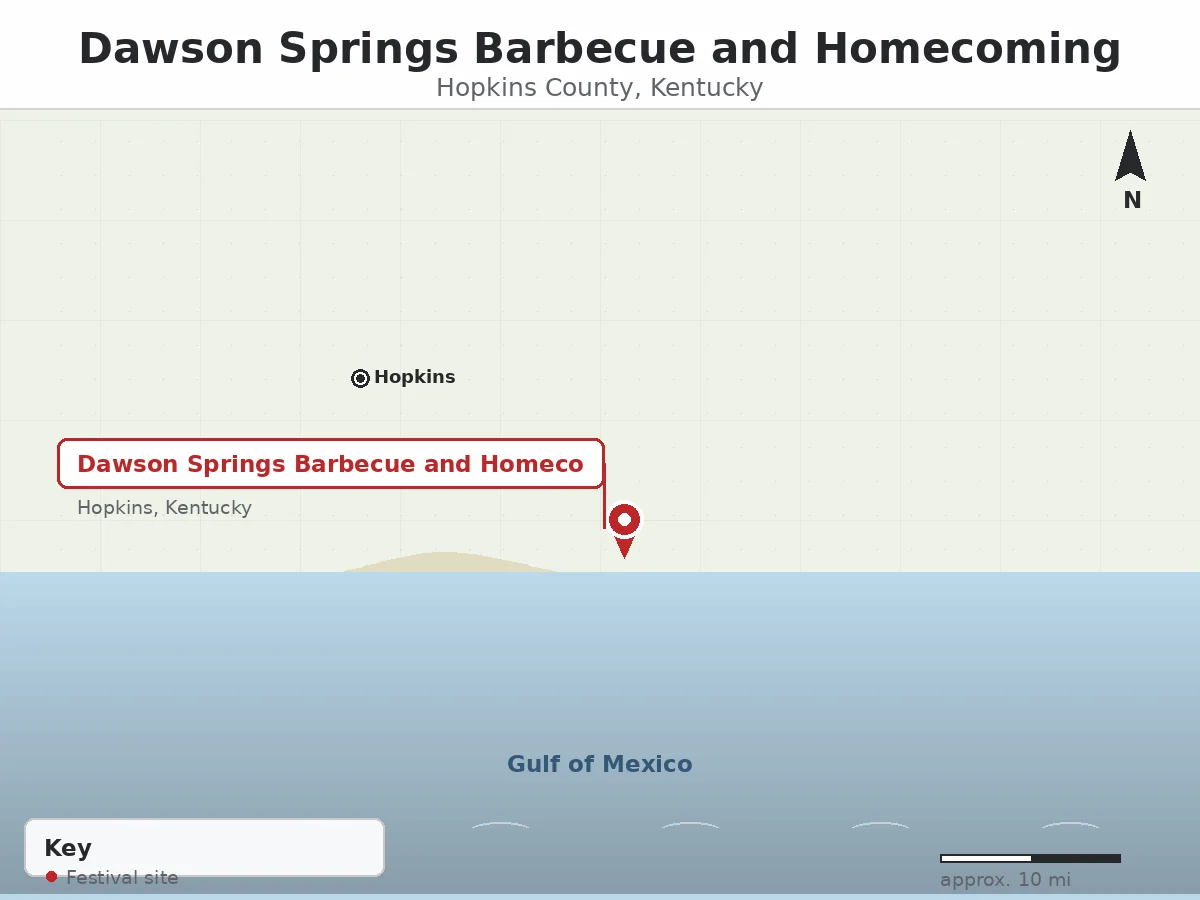
Dawson Springs sits in Hopkins County in western Kentucky. It is not the county seat; a reference layer confirms that Madisonville holds that role. The setting, as a ticket-platform location layer describes it and as the town newspaper’s account of booths in town supports, is downtown Dawson Springs arranged as a street fair. Who runs the barbecue is a question the credible record leaves open. No organiser is named in the layers relied on here. A local newspaper layer from two thousand fourteen mentions chamber involvement in planning July events and looking for vendors, yet that passing mention has not been adopted as an organiser attribution for the barbecue itself, and this article does not present the chamber as the organising body.
Quick Facts
| Item | Detail |
| Published combined name | Dawson Springs Barbecue and Homecoming |
| Other printed forms | Dawson Springs BBQ Festival; the Annual Dawson Springs BBQ |
| Host town | Dawson Springs, Kentucky |
| County | Hopkins County |
| County seat | Madisonville, not Dawson Springs |
| Setting | Downtown streets arranged as a street fair |
| Earliest particularised coverage | Friday the twenty-fifth of July, two thousand fourteen |
| Recent listed editions | July editions in two thousand twenty-two, two thousand twenty-three, two thousand twenty-four, two thousand twenty-five and two thousand twenty-six |
| Organiser | None named in the credible layers read |
| Admission | No gate price stated in any credible layer read |
History
A founding year appears in none of the layers read, and this article supplies none. What the record does support is duration of a looser kind. A university folklife archive layer preserves documentation of the Dawson Springs, Kentucky Annual Barbecue Festival, which tells a reader two things: the barbecue was established enough to attract folklife documentation, and the word annual belongs to the archive’s own description of it. That description is recorded here as the archive’s wording, not converted into a start date, a first edition or a count of years.
The earliest edition with particulars attached comes from the town’s own newspaper layer, reporting Friday the twenty-fifth of July two thousand fourteen. By that account the Dawson Springs Barbecue filled the town with church and community food booths, among them a funnel cake stand, and the layer carries booth photography from the day. The picture that emerges is of a food-centred gathering built out of local groups rather than a single presenting organisation, which fits the absence of any named organiser elsewhere in the record.
For a useful comparison, see the Hopkins County Kentucky Harvest Fest at Mahr Park Festival for another county festival.
The homecoming half of the combined name is harder to pin to a single document. It arrives with the festival-guide layer, which attaches Barbecue and Homecoming to the recent run of editions, while the older material speaks simply of the barbecue. Whether the homecoming wording marks a renaming, an added emphasis or a long-standing pairing the guide merely records, the layers read do not say, and the honest position is to note the combined name where it is printed and the shorter names where they are printed. After two thousand fourteen the trail turns from reporting to listing: the festival-guide layer carries the event forward each July, and the archive’s annual description stands behind the run as context.
What to Expect
Barbecue comes first, and the clearest flavour of it is the two thousand fourteen newspaper account: church and community groups running food booths downtown, with a funnel cake stand among them. A visitor picturing the event should picture a town feeding itself and its guests from booths rather than a single catered spread. The ticket-platform location layer adds a barbecue luncheon to that picture, and because that layer is treated as corroboration only, the luncheon is best understood as supporting detail rather than the backbone of the programme.
Around the food, the same location layer describes a downtown street fair with vendors and live music. Again the wording matters: this layer corroborates the shape of the day, a street fair in the middle of town, without supplying schedules, performer names or a programme order, and none are invented here. Programme particulars for this festival are genuinely sparse. No layer read names a headline act, lists contest categories, prints a parade route or gives opening and closing times for any edition. A reader who wants the texture of the day has the booths, the luncheon, the vendors and the music, and should treat anything more specific as unconfirmed until a current local listing appears. The homecoming element, by its nature, is about who attends as much as what is staged: former residents returning, families gathering, and a town presenting itself to its own people in the middle of summer.
Planning Your Visit
The strongest planning fact in the record is the calendar pattern. Every dated edition after the two thousand fourteen newspaper coverage sits in the second half of July: the twenty-second of July in two thousand twenty-two, the twenty-ninth in two thousand twenty-three, the twenty-sixth in two thousand twenty-four, the twenty-fifth in two thousand twenty-five, and a two-day span, the twenty-fourth to the twenty-fifth, in two thousand twenty-six. Anyone planning around the event should watch for a late-July date and confirm the exact day through current local listings before travelling, because the guide layer’s listings are the main source and the precise day has moved within that window from year to year.
Money is the honest unknown. No credible layer read states a gate price, and this article takes no position on admission in either direction. Food booths are run by church and community groups, so a visitor should be ready to pay for food as it is bought, in the ordinary way of a street fair, without assuming anything about entry itself. Downtown Dawson Springs is the setting, so the day is spent on foot among the booths once you arrive in the town centre. Because Dawson Springs is not the county seat, travellers passing through Madisonville on county business are in a different town from the festival; the barbecue belongs to Dawson Springs itself. Summer heat in late July is a practical consideration for any outdoor Kentucky street fair, and shade, water and a unhurried pace are sensible preparations for a day built around outdoor food booths.
A Sample Day at the Barbecue
Begin in the morning by walking the downtown streets while the booths are being set out, taking in the street-fair layout before the luncheon crowd gathers. Late morning suits a first pass along the church and community food booths, noting which groups are serving and what the funnel cake stand is offering. Make the barbecue luncheon the centre of the day, eaten slowly in the middle of town. Early afternoon can go to the vendors and the live music described in the location layer, with time left unstructured for the homecoming side of the event, the conversations and reunions that a homecoming crowd generates. Return to the booths later in the day for anything missed, and let the evening close without a schedule, since the record gives no closing programme to plan around.
The Record Compared Across Its Layers
Set the three kinds of evidence beside one another and each contributes something the others lack. The two thousand fourteen newspaper layer is the only source with a reporter’s eye on a specific day: a named weekday, booths in town, photography. It proves the barbecue existed in concrete form on that Friday, yet it never uses the homecoming wording. The festival-guide layer works in the opposite direction, strong on names and dates, thin on texture: it supplies the combined Dawson Springs Barbecue and Homecoming name and five consecutive July listings, but no description of any single day. The university folklife archive contributes neither a date nor a programme; its value is the framing of the barbecue as an annual tradition significant enough to document. Read together, the layers support one event with a combined name, a late-July habit and a community-booth character. Read separately, each would leave a misleading gap, which is why the short forms, Dawson Springs BBQ Festival and the Annual Dawson Springs BBQ, are treated as names for the same town barbecue rather than rival events, while barbecue festivals in other Kentucky towns are given no weight here at all.
Visitor Checklist
- Confirm the current year’s late-July date in a current local listing before making travel plans
- Bring a way to pay for food at church and community booths, since meals are bought as you go
- Carry water and plan for summer heat during an outdoor street-fair day
- Allow unhurried time downtown rather than scheduling the day tightly
- Check whether any current listing names an organiser or contact for vendor questions
- Treat any admission claim found elsewhere with caution unless a credible current source states it
- Keep the funnel cake stand in mind when choosing where to eat first
Beyond the Barbecue
The festival’s homecoming character makes it a doorway into Dawson Springs itself. A homecoming weekend is when a small town is most fully itself: downtown streets in use, local groups visible at their booths, and former residents measuring the place against memory. A visitor who comes for the barbecue gets that version of the town rather than a staged attraction. Hopkins County beyond the town line is administered from Madisonville, the county seat, so a trip that combines county errands with the festival crosses between the two communities. The record used here names no other Dawson Springs events alongside the barbecue, and none are borrowed to fill the picture; the barbecue and its homecoming stand on their own as the town’s documented July occasion.
Why This Festival Matters
The significance of the Dawson Springs barbecue lies in how it is built. Church and community booths are not decoration on the event; by the earliest particularised account they are the event, which means the festival doubles as a yearly inventory of the town’s voluntary life. The university archive’s decision to document the barbecue as a folklife subject underlines the point: this is the kind of recurring, food-centred gathering through which a small town keeps its customs in circulation. The homecoming wording in the combined name completes the picture, tying the meal to return and reunion. For Hopkins County, the barbecue gives Dawson Springs a documented annual occasion of its own, distinct from the county seat’s calendar, and that distinctness is part of its value.
Frequently Asked Questions
Under which names does the Dawson Springs barbecue appear in print?
A festival-guide layer prints the combined name Dawson Springs Barbecue and Homecoming. Other layers print Dawson Springs BBQ Festival and the Annual Dawson Springs BBQ, and a university archive records the Dawson Springs, Kentucky Annual Barbecue Festival. The forms are recorded as printed rather than merged into one official name.
Which dates anchor the recent run of editions?
The festival-guide layer lists the twenty-second of July two thousand twenty-two, the twenty-ninth of July two thousand twenty-three, the twenty-sixth of July two thousand twenty-four, the twenty-fifth of July two thousand twenty-five, and the twenty-fourth to the twenty-fifth of July two thousand twenty-six, each under the combined name.
Who is responsible for putting on the event?
No organiser is named in the credible layers read. A two thousand fourteen newspaper layer mentions chamber involvement in planning July events and seeking vendors, but that mention is not adopted here as an organiser attribution for the barbecue itself.
What food is actually documented at the festival?
The two thousand fourteen newspaper account documents church and community food booths, including a funnel cake stand. A ticket-platform location layer, used as corroboration only, adds a barbecue luncheon within a downtown street fair with vendors and live music.
What to Expect From the Next Hopkins County Kentucky Dawson Springs Barbecue and Homecoming Festival
How often is Hopkins County Kentucky Dawson Springs Barbecue and Homecoming Festival held?
The festival-guide layer shows an edition in every July from two thousand twenty-two through two thousand twenty-six, and the archive and newspaper layers describe the barbecue as an annual homecoming tradition. On that documented pattern the event recurs each summer, in the second half of July.
When is the next Hopkins County Kentucky Dawson Springs Barbecue and Homecoming Festival?
No layer read confirms a date beyond the edition listed for the twenty-fourth to the twenty-fifth of July two thousand twenty-six. If the recent pattern holds, the following edition would fall in late July of the next year, but that is an inference from the run of listings, not a date any source here states.
Will the dates change?
They already have, within limits. Across the five listed editions the day moved from the twenty-second to the twenty-ninth to the twenty-sixth to the twenty-fifth of July, and then widened into a two-day span. The month and the late-July position stayed constant while the exact day shifted, so movement within that window is the reasonable expectation.
Closing
The Dawson Springs Barbecue and Homecoming survives in print as a thin but consistent record: a combined name from a festival-guide layer, five consecutive July listings, one well-described Friday in two thousand fourteen, and an archive that treats the town’s barbecue as a tradition worth keeping. Nothing in that record supports a founder, a founding year or a named organiser, and this article has invented none. What it supports is a community feeding itself and its returning families in downtown Dawson Springs each late July, and that, plainly stated, is the festival.