Shawnee County Kansas Renaissance Festival
Topeka had no renaissance festival of its own until very recently, and the event that filled the gap arrived with unusual speed. The festival documented in the layers read was announced in the autumn of two thousand twenty-four, opened its gates for the first time in June of two thousand twenty-five, returned for a second season a year later, and in between spun off a spring edition devoted to Viking celebration. It is a young event, built on a small first-year budget, and its published record is short but specific: two summer seasons at a North Topeka event center, a named lead organizer, a costumed ball on the eve of the second season, and a programme heavy with jousting, live combat and birds of prey. Readers should know at the outset that no layer read prints the county-prefixed title carried at the top of this page. The event is published under its city name, and the article that follows keeps that published record intact, describing the festival as the layers themselves present it rather than smoothing their differences away.

About
Every credible layer names the event the Topeka Renaissance Festival. The organiser’s own social video layer bills it more fully as the Topeka Renaissance Festival – Summer Festival, and a listing layer gives the spring spin-off as the Topeka Renaissance Festival – Viking Celebration. Those forms are recorded here unmerged, because the layers use them for different stagings of the same young festival, and none of them carries the county prefix used in the sheet title above. Topeka hosts the event, and Topeka is both the seat of Shawnee County and the capital of Kansas.
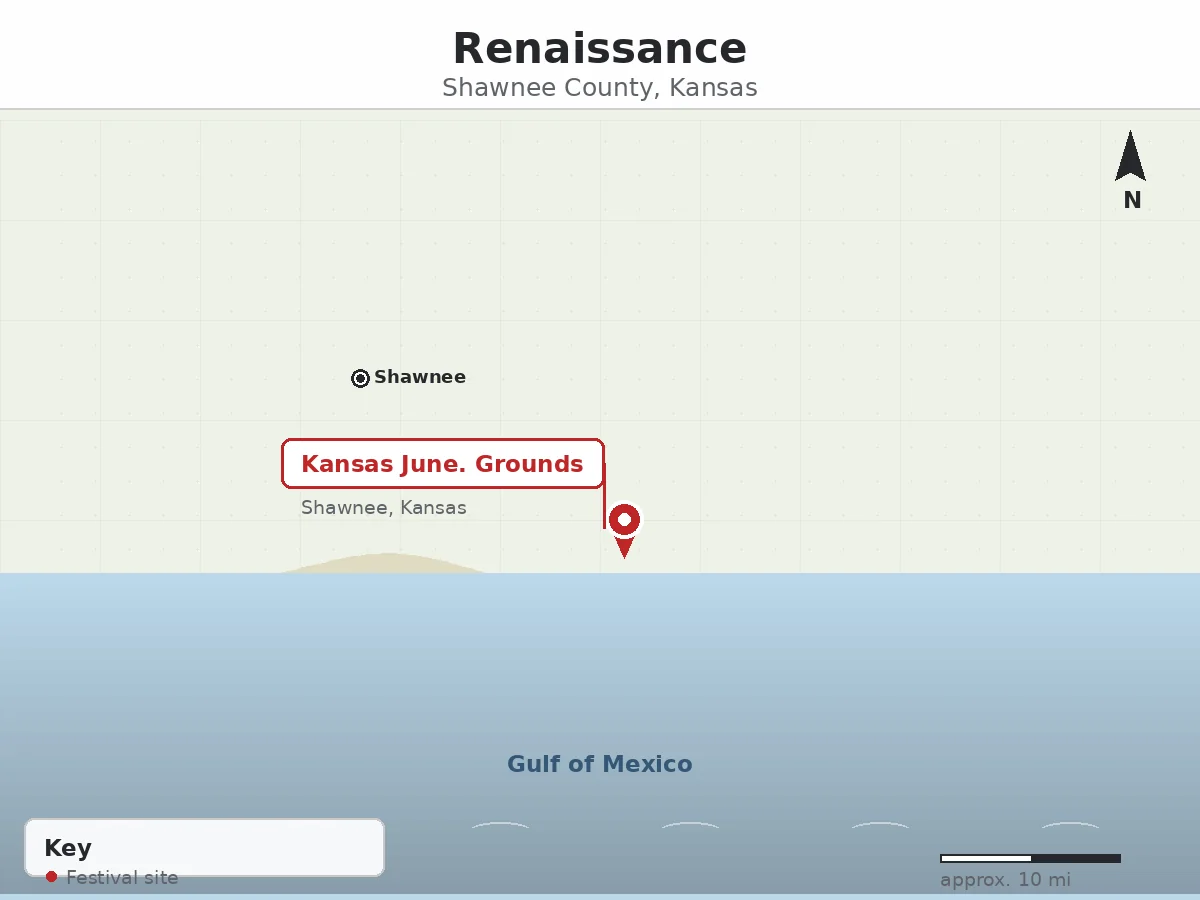
The grounds are the Woodshed Event Center in North Topeka, announced in the organiser’s own entertainment form as the Woodshed Marketplace grounds. A local television news layer, that entertainment form and a review layer agree on the venue, describing indoor halls and about twelve acres of grounds. One tourism itinerary layer instead places the festival at the Washburn University Memorial Union. That claim stands unreconciled against the three layers above and is not adopted here. On organisation, a local television news layer names Angela Kearney as lead organizer, and the organiser trades under the festival’s own name and site. No incorporated organiser name appears anywhere in the layers read, and listing layers print a street address for the venue that is noted by existence only and never reproduced.
Quick Facts
| Item | Record |
| Published name | Topeka Renaissance Festival |
| Summer billing | Topeka Renaissance Festival – Summer Festival |
| Host town | Topeka, seat of Shawnee County and state capital |
| Venue | The Woodshed Event Center, North Topeka |
| Grounds | Indoor halls and about twelve acres |
| Lead organizer | Angela Kearney, named by a local television news layer |
| First season | Friday the twentieth to Sunday the twenty-second of June, two thousand twenty-five |
| Second season | Saturday the thirteenth and Sunday the fourteenth of June, two thousand twenty-six |
| Spin-off edition | Viking Celebration, March two thousand twenty-six |
| Gate price | No gate price is printed in the layers read |
History
The festival’s history is brief because the festival itself is new. A local television news layer covered its announcement in October of two thousand twenty-four, when organisers projected between five thousand and eight thousand attendees and promised more than one hundred vendors. The organiser’s own entertainment form calls the venture a brand-new festival and speaks candidly of a small first-year budget, which makes the scale of that first staging the more striking: the debut ran across three days at the Woodshed grounds with jousting and a pirate-themed bar among the advertised draws. A regional tourism layer lists that first season more narrowly, on the twenty-first and twenty-second of June, and the two date forms are left standing side by side, exactly as printed.
Growth came quickly. Before the second summer season opened, the festival mounted a Viking Celebration at the same venue on Friday the twentieth and Saturday the twenty-first of March, two thousand twenty-six, a spin-off billed under the festival’s own name by a listing layer. The second season itself followed in June, and a review layer describes it plainly as the festival’s second season, confirming that the event had moved within a single year from experiment to returning fixture.
For a useful comparison, see the Shawnee County Kansas IrishFest Festival for another county festival.
What to Expect
Jousting and live combat headline the entertainment in every layer that describes the programme. Around those centrepieces the organiser’s social layer, a review layer and the local television coverage assemble a wide field of attractions: birds of prey, fire performers, live drumming, archery and axe throwing ranges, horse and pony rides, and a living-history and Viking encampment. Four stages were billed for the second season, two of them indoors, which spreads performances between the halls and the open grounds. Families are catered for with a petting zoo, face painting, henna work and hair braiding, while merchants and food vendors fill out the lanes. One element is reserved for grown-ups: an adults-only pirate bar, trailed in the very first announcement and carried into the programme layers, alongside a VIP tent. The flavour is participatory rather than museum-like, a fairground of demonstrations and contests of skill instead of a pageant watched from a fence line.
Planning Your Visit
Tickets are handled through the festival’s own site, where the organiser’s social layer advertises early-bird pricing, and tickets are also available at the gate on the day. Anyone budgeting from the published record should note its limits honestly. The single price printed anywhere in the layers read is fifteen dollars, and that figure belongs to the Flinthaven Fae Ball, the costumed evening event held on the Friday before the second season. It is a component price for one evening, not the festival’s gate, and no daytime admission figure is stated in the material examined, so visitors should confirm current ticket prices through the festival’s own pages before travelling. The second season ran from ten in the morning to six in the evening on both days, a compact window that rewards an early arrival. Because two of the four billed stages sit inside the venue’s halls, part of the programme sits under a roof, a practical comfort in a Kansas June. Grounds of about twelve acres are walkable in a day, leaving time to return to favourite performers for a second set.
A Sample Day at the Festival
Arrive at the Woodshed grounds as the gates open at ten in the morning and walk the merchant lanes first, while the crowds are thin and the vendors have time to talk about their craft. Take in a birds of prey demonstration before midday, then watch the jousting, which the layers consistently place at the centre of the bill. Lunch from the food vendors leaves the afternoon free for the living-history encampment, where the Viking displays reward a slower look, and for a turn at the archery or axe throwing ranges. Children will pull toward the petting zoo, the pony rides and the face painting, so leave room after lunch for those before a late performance on one of the indoor stages. Finish with a second pass through the encampment as the light softens, and be at the gate by the six o’clock close. Anyone holding a ticket for the Friday evening ball should treat that night as a separate outing, with its own cost and its own costume.
How It Compares
The obvious comparison is the Kansas City Renaissance Festival at Bonner Springs, in neighbouring Wyandotte County, the region’s long-running renaissance festival. The Topeka event is its junior in every measurable way: two seasons old, gathered on about twelve acres, and built around four stages rather than a permanent village. That youth cuts both ways, since a smaller ground can be covered comfortably in one day and the programme layers read as a single coherent bill rather than a sprawling schedule. A different neighbour, the Flint Hills Shakespeare Festival near Saint Marys in Pottawatomie County, states expressly that it is not a renaissance festival at all, and it plays no part in this comparison beyond that disclaimer. Searchers should also beware a content-farm essay that mixes the Kansas City event with Topeka sightseeing; it was read during research for this article and disowned in full, and none of its claims is used anywhere here.
A Visitor Checklist
- Confirm the current season’s dates and ticket arrangements through the festival’s own site before setting out.
- Arrive near the ten o’clock opening to see the merchant lanes before the grounds fill.
- Give the jousting a fixed place in the day rather than fitting it around other acts.
- Set aside time for the living-history and Viking encampment, not only the stages.
- Carry a separate budget for food, since the layers read print no prices for the lanes.
- Treat the Friday evening ball as its own event, with the fifteen dollar price printed for it in a review layer.
- Leave the adults-only pirate bar to the grown-ups and plan the petting zoo and pony rides for younger visitors.
Beyond the Festival Days
The festival’s year no longer ends with its summer weekend. The Viking Celebration in March of two thousand twenty-six shows the organisers testing a second season in spring, under a billing that keeps the festival’s name while narrowing its theme, and the Flinthaven Fae Ball adds a formal, costumed evening in front of the summer gates. Sitting in the state capital gives the event a catchment wider than Shawnee County alone, and its North Topeka grounds place it within an easy drive of the surrounding counties whose residents previously had only the longer-established festival near Kansas City to attend. The organiser’s own social video layer reaches for a grander frame by styling the summer staging the Topeka Renaissance Festival – Summer Festival, language that suggests ambitions of a recurring seasonal series rather than a single annual weekend, though the layers read document only the editions described in this article.
Why a Young Festival Matters
A brand-new festival that survives its first season is common enough; one that announces a spin-off before its second season opens is rarer. The record here shows deliberate, staged growth: a debut mounted on a small budget, an expected crowd in the thousands, then a themed spring edition and an evening ball added within the year. For Topeka, the event gives the capital a festival identity of its own in a genre long dominated locally by the much older fair near Kansas City. For Shawnee County, it anchors a June weekend of costumed tourism in North Topeka, drawing vendors, performers and visitors onto grounds that now host the festival twice in a single year. Whether that pace holds is a question the coming seasons will answer, but the foundations documented so far are specific, dated and consistent across independent layers.
Frequently Asked Questions
Why does the name on the festival’s own pages differ from the title of this article?
The sheet that commissioned this article files the event under a county-prefixed title, but every layer read publishes the festival under its city name, the Topeka Renaissance Festival, with longer billings for its summer and Viking stagings. The article keeps the sheet’s filing title at the top while describing the event under the name its organisers actually use.
What is the Flinthaven Fae Ball, and what does it cost?
The ball is a costumed evening event held on the Friday before the second summer season, running from six to eleven in the evening at the same Woodshed grounds. A review layer prints its price at fifteen dollars, the only price stated anywhere in the layers read, and that figure covers the ball alone rather than admission to the festival days.
Can visitors simply turn up and buy tickets on the day?
Yes, according to the organiser’s social layer, which advertises early-bird pricing through the festival’s own site and confirms that tickets are also available at the gate. What that layer and every other source examined leave unstated is the daytime gate price itself, so the cost of walking up remains a detail to confirm directly before the weekend.
Is the Viking Celebration a separate festival from the summer event?
A listing layer bills it as the Topeka Renaissance Festival – Viking Celebration, carrying the festival’s own name with a themed subtitle, and it ran at the same Woodshed venue in March of two thousand twenty-six. On that record it is best understood as a spin-off edition of the same young festival rather than an unrelated event borrowing the name.
What to Expect From the Next Shawnee County Kansas Renaissance Festival
How often is Shawnee County Kansas Renaissance Festival held?
The documented pattern is a summer season each year so far, with the first festival in June of two thousand twenty-five and the second in June of two thousand twenty-six, plus a single spring spin-off in March of two thousand twenty-six. Two summers establish a rhythm rather than a long tradition, and the record supports describing the summer festival as a returning yearly event in its early years.
When is the next Shawnee County Kansas Renaissance Festival?
No third season date appears in the layers read, and this article will not invent one. Both documented summer seasons fell in June, the first announced the previous October, so the festival’s own site is the place to watch for the next announcement, with mid-June the month the short record points toward.
Will the dates change?
In modest respects, the shape of the weekend has shifted already. The first season ran three days, Friday to Sunday, in the local television account, while a regional tourism layer listed only its Saturday and Sunday; the second season settled on a Saturday and Sunday with a Friday evening ball in front of it, and a festival-guide layer gives that season’s dates differently again. A young festival adjusting its footprint between seasons is unremarkable, and the safest assumption is that format and dates alike may shift.
A Fixture Still Taking Shape
Two summer seasons, a spring spin-off and a ball do not make an institution, but they do make a start with dates, names and particulars that independent layers agree on. The Topeka Renaissance Festival has given Shawnee County a costumed weekend of its own, run by a named organiser on North Topeka grounds, and the record of its second season suggests a team intent on growing carefully rather than quickly. The next announcement will show whether the June weekend hardens into a fixture, and this record will be worth revisiting when it does.