Sedgwick County Kansas Pride Festival
Wichita’s annual Pride celebration brings a parade, a drag pageant and an afternoon festival under one downtown roof, and the Sedgwick County Kansas Pride Festival is the name this series gives to an event its own organisers publish simply as the Wichita Pride Festival. That distinction matters, and this article keeps it visible: no layer read for this piece prints the county-prefixed title, while the shorter published forms appear across the organiser’s own site, a city tourism layer and a regional pride guide. What the record does support, richly, is the event itself — a recurring celebration in the Sedgwick County seat, anchored at the Century II Performing Arts and Convention Center, with dated editions across four consecutive years and a programme that pairs a courthouse parade with an indoor festival of entertainers, food and local vendors.
About
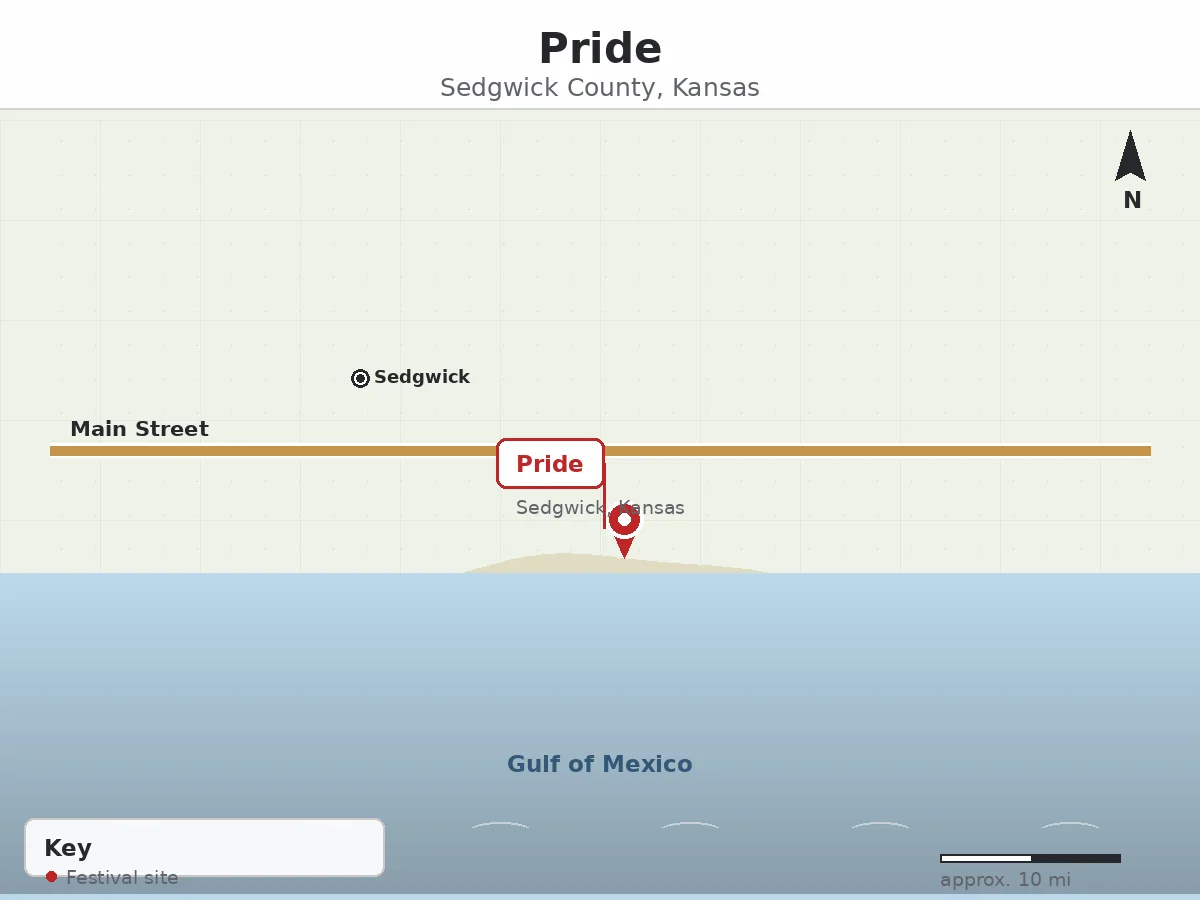
The celebration belongs to Wichita, the seat of Sedgwick County, and its geography is compact. The parade forms up at the Old Sedgwick County Courthouse, travels down Main Street and finishes at Century II, where the festival itself unfolds in the Exhibition Hall. Three published name forms circulate and are kept separate here rather than blended: the organiser’s own site and the tourism and guide layers use “Wichita Pride Festival”; the organiser’s site also uses the shorter “Wichita Pride”; and event-listing layers bill the day as the “Pride Parade and Festival”. Behind those names stand two organiser forms, likewise unmerged — “Wichita Pride, Inc.” on the organiser’s own site and “Wichita Pride” in the listing layers. The venue record also carries two hall names that stay unmerged here: the organiser’s own site and the city tourism layer place the festival in the Exhibition Hall at Century II, while the two thousand twenty-five account moves the festival portion into the Expo Hall at the same complex. Both names belong to one downtown centre, but the layers use them for different years, and this article follows the layers rather than smoothing the difference away. The organiser describes an annual festival, and the dated record bears that out, with editions documented in two thousand twenty-three, two thousand twenty-four, two thousand twenty-five and two thousand twenty-six.
Quick Facts
| Detail | What the record shows |
| Host city | Wichita, seat of Sedgwick County |
| Published names | Wichita Pride Festival; Wichita Pride; Pride Parade and Festival |
| Organiser forms | Wichita Pride, Inc.; Wichita Pride |
| Main venue | Century II Performing Arts and Convention Center, Exhibition Hall |
| Parade route | Old Sedgwick County Courthouse down Main Street to Century II |
| Documented editions | Two thousand twenty-three through two thousand twenty-six |
| Two thousand twenty-five date | Sunday the eighteenth of May |
| Two thousand twenty-six dates | Friday the twenty-sixth and Saturday the twenty-seventh of June |
| Admission evidence | A Pride button was required for the two thousand twenty-four festival, per one listing layer |
History
The honest starting point for this festival’s past is a gap. No layer read for this article states a founding year, so none is adopted here, and the temptation to back-count from anniversary language is resisted throughout. The fullest historical colour comes from the two thousand twenty-five edition, which the organiser billed as its Emerald Anniversary year; that billing is recorded exactly as printed and is not converted into a number of years anywhere in this piece. What the organiser’s own site does describe is an annual festival whose parade and festival moved to a Saturday in late June after a successful move — a scheduling change the site presents as settled practice rather than experiment. The dated spine of the record runs from a university layer’s note of a parade and festival on the twenty-fifth of June two thousand twenty-three, set within a month of Pride programming, through the courthouse parade of June two thousand twenty-four and the May edition of two thousand twenty-five, to the two-day late-June shape announced for two thousand twenty-six. The two thousand twenty-three reference is worth pausing on, because it arrives through a university layer rather than the organiser or the tourism listings, and it places the parade and festival inside a month of Pride programming rather than on a single civic weekend. That framing widens the festival’s documented footprint without adding a single invented date, and it forms the earliest point on the record’s spine.
What to Expect
The weekend opens, in its fullest documented form, with the Pride Drag Pageant on the Friday evening inside the Century II Exhibition Hall, as the regional pride guide and the city tourism layer describe the two thousand twenty-six edition. Saturday belongs first to the parade: it steps off at half past eleven in the morning from the Sedgwick County Courthouse and follows Main Street to Century II, a route the listing layers also give for two thousand twenty-four. Inside the hall, the festival runs from noon to four in the afternoon in the two thousand twenty-six account, with live entertainers, food and drink, and a marketplace of local vendors, per the city tourism layer. Around that core, a community calendar layer lists a faith service, an adult after-party and an Equality Kansas rally in the surrounding Pride weekend listings; those belong to the wider weekend rather than to the festival programme itself, and this article keeps that fence intact. The May two thousand twenty-five edition rearranged that shape without abandoning it: the parade still ran, the festival still gathered at Century II, but the hall changed to the Expo Hall and the month changed to spring. Anyone picturing the event should therefore picture a portable format — courthouse steps, a Main Street route and a convention hall — rather than a fixed room on a fixed weekend.
Planning Your Visit
Begin with the year, because this festival has not kept a fixed month. The two thousand twenty-five edition fell on Sunday the eighteenth of May, with the festival portion moved into the Expo Hall at Century II, while two thousand twenty-four and two thousand twenty-six both landed on the last Saturday of June. Anyone travelling in should confirm which pattern the coming year follows before booking around a date. On admission, the evidence is narrow and year-specific: a listing layer for two thousand twenty-four states that a Wichita Pride button was required to attend the Pride Festival, with buttons purchasable at Century II. No layer read prints a price for that button, and no layer states an admission position for any other year, so treat entry arrangements as something to check afresh each season rather than a settled policy. The organiser’s site offers a contact form route for questions, which is the channel the record itself provides. Getting to the parade start is part of the day rather than a preliminary to it, because the courthouse grounds are where the celebration visibly assembles. Arrive early enough to watch the form-up, and remember that the festival’s indoor portion begins only once the parade has delivered its crowd to Century II, which in the two thousand twenty-six account means a noon start inside the Exhibition Hall.
For a useful comparison, see the Sedgwick County Kansas Juneteenth ICT Festival for another county festival.
A Sample Itinerary
A workable shape for the Saturday, drawn from the two thousand twenty-six account, starts at the courthouse end of Main Street before half past eleven, in time to watch the parade form up and set off. Follow the route’s direction downtown once the parade passes, and be at Century II for the festival’s noon opening in the Exhibition Hall. Give the vendor marketplace the early afternoon, when the hall is at its busiest, and keep the final hour for the live entertainers before the four o’clock close. Visitors arriving for the full weekend can add the Friday-evening drag pageant at the same hall, which the guide layers place ahead of the parade day.
How It Compares
Two neighbouring names deserve clear separation. People’s Pride ICT appears in the regional pride guide as a separate Wichita event, and it is never merged with the Wichita Pride Festival in this article; sharing a city and a season does not make two celebrations one. Further afield, the same guide carries Dodge City PrideFest, which belongs to a different town altogether. Closer to home, the festival’s own internal variety can mislead: the pageant, the parade and the hall festival are components of one Wichita Pride weekend, whereas the faith service, after-party and rally sit in surrounding listings and should not be folded into the festival’s programme when describing it. Even those surrounding listings play a definitional role, since their presence in a community calendar rather than in the organiser’s own programme is exactly what keeps the festival’s boundaries honest.
A Visitor Checklist
- Confirm the month and the exact dates for the year you plan to attend
- Reach the Old Sedgwick County Courthouse before the parade steps off
- Check whether a Pride button is required for entry in the current year
- Plan the downtown walk from Main Street to Century II after the parade
- Leave room in the afternoon for food and drink inside the marketplace
- Decide whether the Friday-evening pageant belongs in your weekend
- Use the organiser’s contact form route for anything the listings leave open
Beyond the Festival
Wichita rewards a longer stay around the festival weekend. The parade route itself traces the civic heart of the county seat, from the Old Sedgwick County Courthouse along Main Street toward the Century II complex, so simply walking that route outside festival hours gives a visitor the lay of the city’s ceremonial centre. The university layer’s record of a parade and festival set within a month of Pride programming in two thousand twenty-three also hints that the celebration sits inside a broader season rather than a single weekend, and travellers with flexible dates can ask, through the organiser’s contact route, what else clusters around the parade days in a given year. The courthouse itself anchors any longer visit. A building that lends its steps to the parade each year does double duty as a seat of county government and a ceremonial stage, and seeing it on an ordinary weekday, outside the festival’s noise, rounds out what the parade day only shows in passing.
Why It Matters
For Sedgwick County, the festival’s significance lies partly in its address. A celebration that forms up at the county courthouse and processes down the city’s main street claims the most public ground a county seat has, and the organiser’s framing of the two thousand twenty-five edition as an Emerald Anniversary year signals an institution that understands itself as long-running, even though the layers read stop short of printing a founding year. The button requirement recorded for two thousand twenty-four, the pageant’s place on the Friday evening and the marketplace of local vendors together sketch a festival that organises itself as a community fixture rather than a one-off gathering. There is also a quieter significance in how completely the event can be documented without embellishment. Four consecutive years of dated editions, named halls, a stated step-off time and a recorded entry requirement give the festival a paper trail that many larger celebrations would envy, and that trail is what allows an article like this one to describe the day in detail while inventing nothing.
Frequently Asked Questions
Why does the name at the top of this article differ from the published ones?
The layers read use three forms without merging them: “Wichita Pride Festival” on the organiser’s own site and in tourism and guide layers, “Wichita Pride” as a shorter form on the organiser’s site, and “Pride Parade and Festival” in event-listing layers. The county-prefixed title at the top of this article is the series name; no layer read prints it.
When does the parade step off, and where does it start?
In both the two thousand twenty-four listing account and the two thousand twenty-six guide account, the parade steps off at half past eleven in the morning. It forms up at the Sedgwick County Courthouse — the old courthouse in the earlier account — and follows Main Street down to Century II.
What changed for the May edition in two thousand twenty-five?
That edition stepped away from the late-June pattern entirely, falling on Sunday the eighteenth of May, and the festival portion moved into the Expo Hall at Century II rather than the Exhibition Hall named for other years. The organiser billed the year as its Emerald Anniversary year, a billing this article records without translating it into a count of years. The parade, notably, kept its courthouse start even in the year the festival changed halls and months, which makes the route the most stable element in the whole record.
Is People’s Pride ICT part of the same celebration?
No. The regional pride guide lists People’s Pride ICT as a separate Wichita event, and this article treats it as one throughout. The same guide’s Dodge City PrideFest belongs to a different town, and neither event should be folded into the Wichita Pride Festival’s record.
What to Expect From the Next Sedgwick County Kansas Pride Festival
How often is Sedgwick County Kansas Pride Festival held?
The organiser describes an annual festival, and the dated record supports a yearly rhythm, with editions documented in two thousand twenty-three, two thousand twenty-four, two thousand twenty-five and two thousand twenty-six. That run spans two different months and two different halls, so the yearly rhythm is firmer in the record than any particular date or room attached to it.
When is the next Sedgwick County Kansas Pride Festival?
The layers read document editions through Saturday the twenty-seventh of June two thousand twenty-six and print no later date. The timing of the next edition therefore rests on the organiser’s own announcements, most reliably checked through the organiser’s site and its contact form route.
Will the dates change?
They already have. Two thousand twenty-five moved the celebration to a Sunday in May, while two thousand twenty-four and two thousand twenty-six kept a late-June Saturday, and the organiser’s site describes the late-June move as the settled outcome of a successful change. A future shift is possible, so the month deserves checking every year.
Closing
Taken as a whole, the record describes a well-documented Wichita institution whose only real mysteries are the ones this article refuses to solve by invention: the county-prefixed name belongs to the series, the founding year belongs to nobody’s printing, and everything else — the courthouse steps, the Main Street route, the pageant, the buttons, the marketplace — stands on dated, checkable layers. For a reader planning a trip, the practical residue is simple: trust the route, the hall complex and the yearly rhythm, verify the month, and let the organiser’s own channels answer whatever the listings leave open.