Morris County Kansas Washunga Days Festival
Each June, Council Grove marks the height of summer with a two-day community celebration that the published record knows simply as Washunga Days. The county seat of Morris County hosts the gathering across Neosho Riverwalk Park, while the Kaw Nation Intertribal Powwow runs alongside it at Allegawaho Park, giving the weekend a character that blends a small-town street festival with a living thread of Kaw heritage. The organiser’s tourism pages bill the event for the third full weekend in June, and the fullest account in the record describes the edition of Friday the nineteenth and Saturday the twentieth of June two thousand twenty-six, complete with a free opening Community Night, a Saturday morning parade down Main Street, live music, a car show and a vendor fair. Anyone reading ahead will also meet a wrinkle or two in the sources: published accounts disagree about what admission costs, and one festival guide prints slightly different dates for the same year. This article keeps those disagreements visible rather than smoothing them away, because they are part of what the record actually says.
About
The name on every substantial layer is Washunga Days, without the word Festival attached. The organiser’s tourism pages use that form, a listings layer uses it, and a heritage layer uses it too. An older spelling, Wah-shun-gah Days, survives in the inscription of a historical marker, a reminder that the name has been carried in more than one written shape over time. A single travel article phrases the event as Washunga Days Festival, but that wording belongs to the article alone; the research treats it as a weak layer and does not adopt it as the event’s name. The celebration honours Washunga, whom a tribal layer identifies as a chief of the Kaw Tribe after their move to Indian Territory, and that naming choice shapes everything from the powwow programme to the way the weekend presents itself to visitors.
Responsibility for the weekend is described in two unmerged ways. The event pages themselves are published by DESTINATION : Council Grove, the city’s tourism bureau, printed exactly in that form. A heritage-trail layer tells the story differently, saying the Council Grove Area Trade & Tourism Association empowers a diverse group of community members to create the festival. Both accounts stand as printed; neither is folded into the other, and the article does not invent a single corporate organiser behind them. What the layers agree on is the setting. Council Grove is the county seat of Morris County, a point reference layers confirm, and the main grounds are Neosho Riverwalk Park in town, with the powwow element held separately at Allegawaho Park.
Quick Facts
| Item | Detail |
| Published name | Washunga Days |
| Older spelling on a marker | Wah-shun-gah Days |
| Host town | Council Grove, the Morris County seat |
| Main grounds | Neosho Riverwalk Park |
| Powwow venue | Allegawaho Park |
| Fullest documented edition | Friday the nineteenth and Saturday the twentieth of June, two thousand twenty-six |
| Announced following edition | The eighteenth and nineteenth of June, two thousand twenty-seven |
| Standing placement | The third full weekend in June |
| Admission picture | Conflicting published accounts, set out below |
| Parade | Saturday morning on Main Street, stepping off at ten |
History
The deepest roots the record offers are in the name itself. Washunga led the Kaw Tribe in the years after the tribe’s removal to Indian Territory, according to a tribal layer, and the celebration takes its title from him. That single fact does much of the historical work for the weekend: it explains why an intertribal powwow sits at the heart of the programme rather than at its edges, and why the event reads as a commemoration as much as a fair. The marker inscription preserving the Wah-shun-gah Days spelling shows that the community has rendered the chief’s name in print for a long while, in a form closer to an older transliteration.
How old the festival itself is, the layers never pin down. A heritage-trail layer states that Washunga Days has been a Council Grove tradition for more than three decades, and that claim is recorded here as exactly that: one layer’s claim, offered without a founding date beside it. No source in the record names a first year, a founding committee or an inaugural edition, and this article derives none from the three-decades remark. Readers should therefore treat the event’s age the way the evidence presents it, as a long-running local tradition whose precise starting point the published material leaves open, while its namesake reaches back into the nineteenth century history of the Kaw people in this region.
For a useful comparison, see the Montgomery County Kansas End of Summer Bash Festival for another county festival.
What to Expect
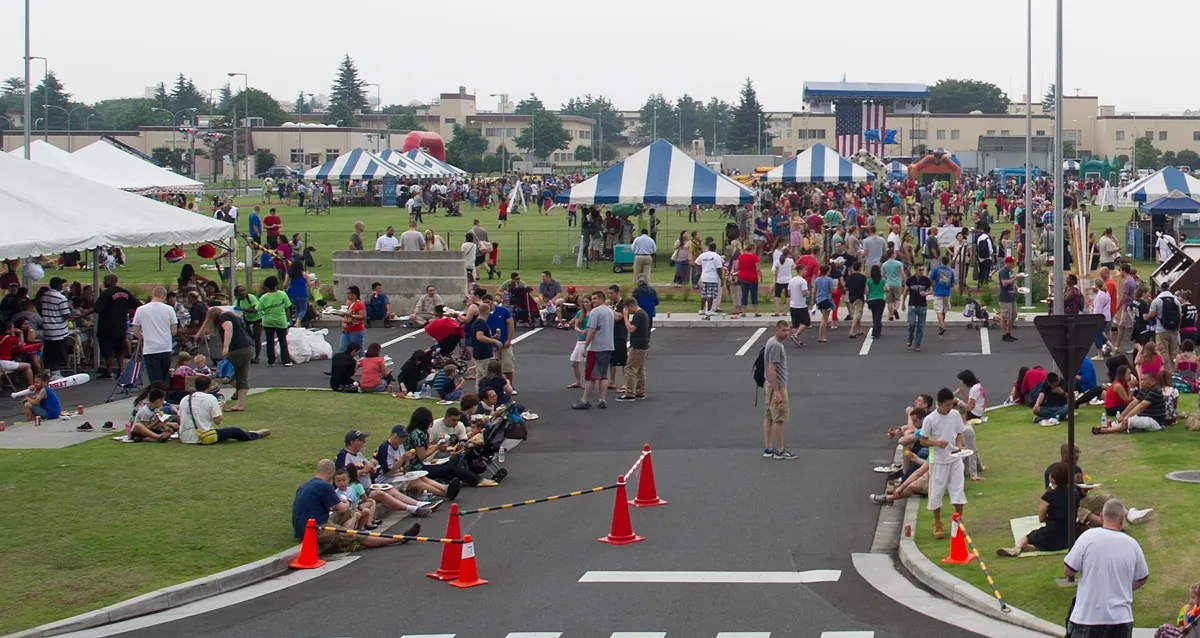
The two days divide naturally between the riverwalk grounds and the powwow circle. At Neosho Riverwalk Park, the organiser’s pages describe live music across stages, a car show, activities for children, food vendors and a vendor fair, the programme backbone of a conventional summer festival. Saturday’s live music is the one element fenced behind admission wristbands in the organiser’s account, a detail that matters for the admission discussion below. A street dance also appears among the programme elements, and fireworks close out the description offered by the heritage-trail layer; the fireworks belong to that layer’s telling specifically, and are credited to it rather than stated as organiser-confirmed fact.
Across town at Allegawaho Park, the Kaw Nation Intertribal Powwow occupies both days of the documented two thousand twenty-six edition, running on the Friday and the Saturday alongside the riverwalk programme. Friday evening belongs to Community Night at the main grounds, which the organiser bills as free. Saturday morning brings the parade down Main Street, stepping off at ten in the morning; in two thousand twenty-six the parade carried its first-ever theme, printed as America 250, a small milestone the organiser’s pages note with evident pride. Taken together, the weekend offers two festivals braided into one set of dates, and visitors drift between them.
Planning Your Visit
Money is the point on which the published record argues with itself, so plan with both versions in mind. The organiser’s tourism pages state that wristbands are required only for the Saturday night music at Neosho Riverwalk Park, and that every other activity is free and open to the public, with Friday’s Community Night billed as free outright. A listings layer, by contrast, states flatly that admission tickets are twenty-five dollars, and gives the weekend hours as Friday to Saturday, ten in the morning until midnight. The two accounts are recorded here unmerged; neither is endorsed over the other, and a visitor who budgets for the wristband-or-ticket version will not be caught out if the listings layer proves closer to the gate reality.
Separate from any gate question, entering the parade itself carries its own fees on the organiser’s entry form: ten dollars by a stated deadline and twenty dollars afterwards, with registered veterans’ groups entered free in two thousand twenty-six. Those are competitor entry charges, not public admission, and they say nothing about what a spectator pays. Dates deserve the same care as money. The organiser places the event on the third full weekend in June and documents the nineteenth and twentieth of June for two thousand twenty-six, yet a festival-guide layer lists that same year on the eighteenth and nineteenth, marked with an asterisk its own key defines as an unconfirmed date. Trust the organiser’s pages for the days, and treat the guide’s listing as an early, unverified sketch.
A Sample Itinerary
Friday rewards an unhurried arrival. Begin at Allegawaho Park, where the powwow opens the weekend, then cross to Neosho Riverwalk Park as evening settles for Community Night, the free opening gathering on the main grounds. Graze the food vendors for supper, walk the vendor fair while the light lasts, and let the street dance carry the evening as far as your energy allows.
Saturday starts with the parade. Find a spot on Main Street before ten in the morning and watch the procession go by under its theme of the year. From there the riverwalk grounds fill the middle of the day: the car show for a slow wander, the children’s activities for families, and the food vendors again for lunch. Return to Allegawaho Park for an afternoon session of the powwow, then come back to the riverwalk for the evening music, remembering that Saturday night’s performances are the wristband element in the organiser’s account. If the heritage layer’s fireworks form part of the edition you attend, the night ends over the river.
How It Compares
Set beside other Kansas gatherings that surface in the same searches, Washunga Days occupies its own ground. Rock The Plains in Manhattan and the Land Institute’s Prairie Festival in Salina are different events entirely, disowned here so their details never bleed into this record. Neither carries a powwow as a central element, and neither is anchored to a single namesake in the way this weekend is anchored to Chief Washunga.
The fairer comparison is internal. Many county festivals rest on one programme in one park; this one runs two distinct gatherings, a municipal summer festival and an intertribal powwow, on shared dates in the same small city. That doubling is its signature. It also produces the record’s quirks: two organiser descriptions, two admission stories and two date listings, each pair preserved in this article rather than reconciled, because the sources themselves never reconcile them.
Checklist
- Confirm the exact June dates on the organiser’s tourism pages before booking travel
- Carry some cash in case the Saturday music wristband or a ticket applies
- Arrive on Main Street well before ten on Saturday for a parade spot
- Give the powwow at Allegawaho Park its own unhurried block of time
- Pack sunscreen and water for two largely outdoor days
- Check the parade entry deadline if you plan to enter rather than watch
- Keep Friday evening free for Community Night on the riverwalk grounds
- Note the veterans’ group entry provision if it applies to your party
Beyond the Weekend
The name on the marker points beyond the festival dates. A visitor who comes only for the parade misses the slower story the town tells about its Kaw connections: the powwow ground at Allegawaho Park, the marker lettering that preserves the older Wah-shun-gah spelling, and a community that has kept a chief’s name at the centre of its summer calendar. The celebration works best when read as the visible tip of that longer relationship between Council Grove and the Kaw Nation, rather than as a self-contained fair that happens to borrow a striking title. Arriving a little early or lingering after the music ends gives that context room to register, even though the published record describes the weekend itself in far more detail than it describes the town around it.
Why It Matters
Small county seats run on a handful of weekends a year, and this is Council Grove’s defining one. The festival channels visitors to local food vendors and fair exhibitors, gives community members a hand in building the programme, and returns a portion of the town’s attention each year to the Kaw heritage embedded in its own name. For the county seat of Morris County, a town whose history is bound up with trails, rivers and the Kaw people, a celebration that keeps Washunga’s name in public use does cultural work that a generic fair could not. Its significance lies less in scale than in that act of remembrance, repeated annually on the third full weekend in June.
Frequently Asked Questions
Which parts of the weekend cost money, and which do not?
The organiser’s pages draw the line narrowly: only the Saturday night music at Neosho Riverwalk Park requires an admission wristband, and everything else, including Friday’s Community Night, is described as free and open. A listings layer disagrees and prices admission tickets at twenty-five dollars for the weekend. Because the sources conflict, the honest answer is to check the organiser’s pages close to the date and carry enough to cover the paid version.
Why do two sources give different June dates for the same year?
The organiser documents the nineteenth and twentieth of June for two thousand twenty-six, matching the stated third-full-weekend placement. A festival guide lists the eighteenth and nineteenth instead, but flags its own dates with an asterisk that its key defines as unconfirmed. The guide appears to have printed a provisional guess; the organiser’s dates are the documented ones.
What part does the Kaw Nation play in the celebration?
A central one. The Kaw Nation Intertribal Powwow runs at Allegawaho Park on both days of the documented two thousand twenty-six edition, and the festival’s very name honours Washunga, a Kaw chief from the period after the tribe’s move to Indian Territory. The powwow is not decoration around the festival; by the record’s account it is one of the weekend’s two pillars.
How far back does the celebration itself go?
No layer in the record states a founding year. A heritage-trail layer describes the event as a Council Grove tradition of more than three decades, and that is as precise as the evidence gets. Anything more exact would be invention, so this article leaves the starting point where the sources leave it: unstated.
What to Expect From the Next Morris County Kansas Washunga Days Festival
How often is Morris County Kansas Washunga Days Festival held?
The organiser’s tourism pages place Washunga Days on the third full weekend in June, and the documented editions follow that yearly rhythm, with Community Night on the Friday and the main programme on the Saturday. The heritage layer’s description of a tradition spanning more than three decades supports reading it as a fixture of the town’s annual calendar rather than an occasional event.
When is the next Morris County Kansas Washunga Days Festival?
The organiser’s pages announce the following edition for the eighteenth and nineteenth of June, two thousand twenty-seven, under the same third-full-weekend placement. That is an announcement of a future edition, not a report of one already held, so treat the particulars beyond the dates as yet to be published and confirm them nearer the time.
Will the dates change?
The standing placement has been stated plainly, and the announced two thousand twenty-seven dates already sit on the third full weekend of June. Still, the two thousand twenty-six record shows a festival guide printing different, unconfirmed dates, which is a reminder that only the organiser’s own pages settle the question for any given year.
Closing
Washunga Days asks a little more of its visitors than most small-town festivals: read the sources carefully, hold two admission stories at once, and make room for a powwow alongside the parade. In return it offers a weekend with genuine depth, rooted in a name that Council Grove has carried for generations. For travellers crossing Kansas in June, the third full weekend in the Morris County seat is a date worth circling, and worth verifying on the organiser’s pages before the drive.