Dickinson County Kansas Oktoberfest Festival
Anyone searching for this celebration under the county name used in the title will not find it in print. Every layer gathered for Dickinson County points instead to a September gathering in Abilene that travels under the shorter name Abilene Oktoberfest, while the city’s own tourism calendars sometimes trim the listing further, to Oktoberfest alone. That gap between the sheet title and the published names matters, because the event itself is easy to trace once the right name is in hand: city tourism layers carry it year after year, a state tourism layer describes its park setting for one edition, and a state magazine layer places it among the free-to-attend Oktoberfests of Kansas. Abilene, the host town, serves as the county seat of Dickinson County, and the celebration brings Bavarian food, contest hoisting and German dancing to a mid-September weekend there. The documentation is also unusually current for a small-town celebration: the run of dated editions stretches from two thousand twenty-two through two thousand twenty-six, so the portrait below rests on recent listings rather than on memory or a single old clipping.

About
Two name forms appear across the layers, and they are kept apart here rather than blended. City tourism layers bill the event as Abilene Oktoberfest, which functions as its own chosen title, while the city’s tourism calendars also enter it simply as Oktoberfest. Nothing in the gathered material attaches Dickinson County to the name, so the title at the top of this page should be read as a finding aid for the county rather than as the wording on any poster.
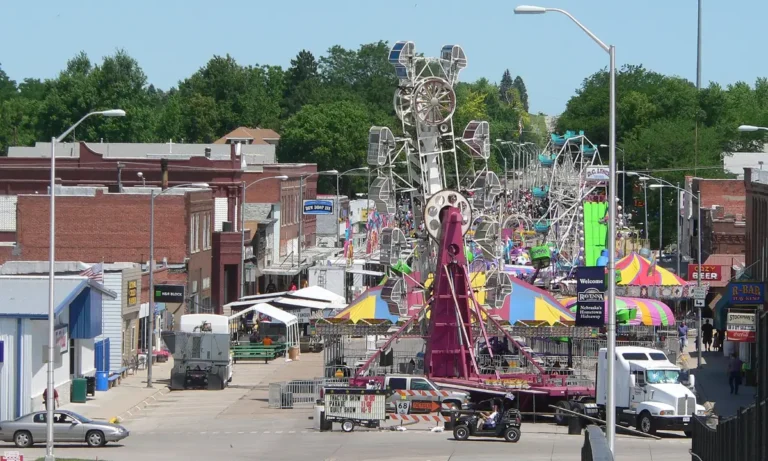
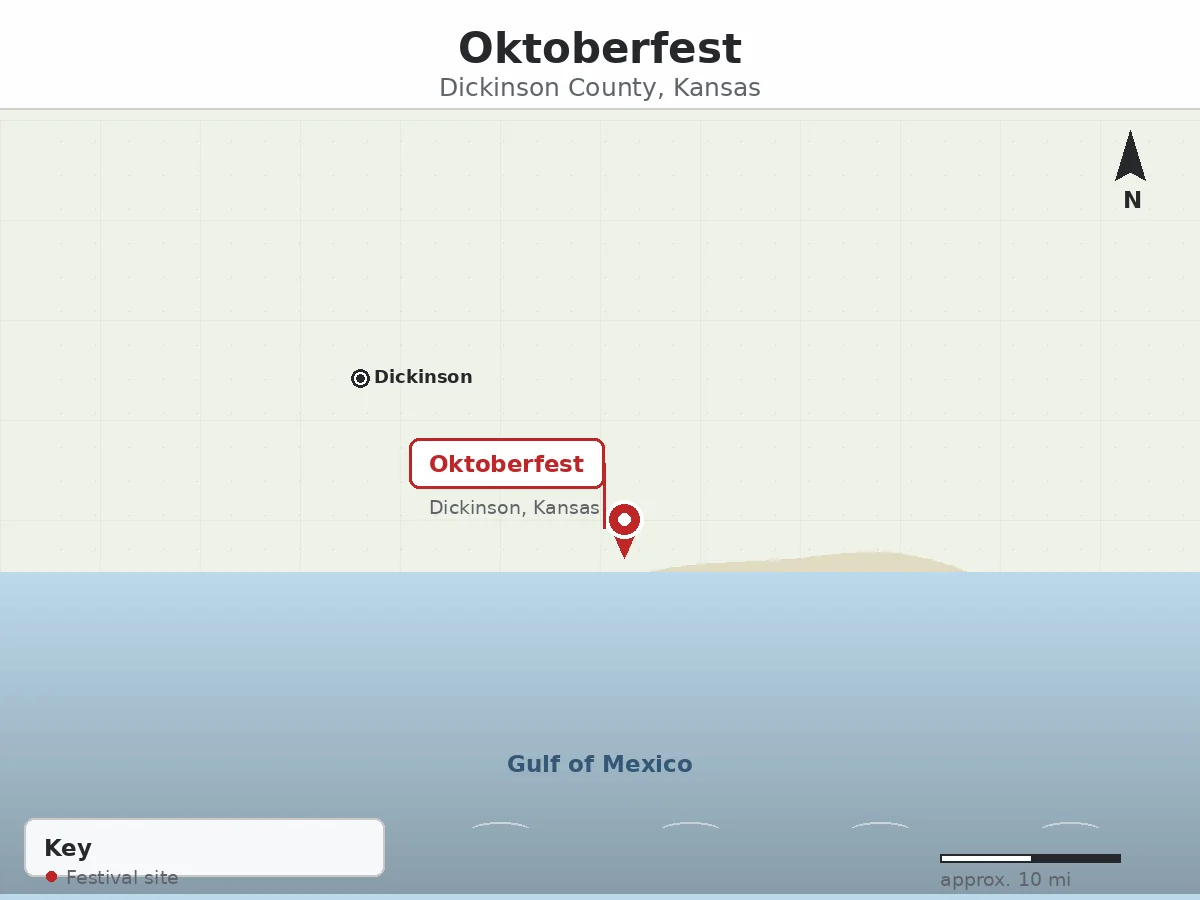
Where the celebration happens depends on which layer a reader opens. City tourism layers set the event in Downtown Abilene, and that downtown framing is the one repeated most often. A state tourism layer, describing the edition of September two thousand twenty-four, puts it instead at Little Ike Park. Both placements are printed, neither layer yields to the other, and this article leaves the two standing side by side instead of merging them into one smoothed-out venue line.
Responsibility for the weekend also comes through a single channel. A state tourism layer names Hanna Nagely as the organiser, explaining that she took over the role from her mother, Heidi Anderson. The event’s own billing in the city tourism layers never rises above the Abilene Oktoberfest name itself, so the clearest named account of who runs the celebration is that state tourism description of a daughter succeeding her mother.
The dated run is steady. City tourism layers bill a fifth annual edition in two thousand twenty-two, a sixth annual edition across two days in two thousand twenty-three, an eighth annual edition in two thousand twenty-five and a ninth annual edition in two thousand twenty-six, with a state tourism layer describing a further edition in September two thousand twenty-four. Read together, those listings sketch a celebration that has settled into the middle of September and, after its first documented year, into a two-day shape.
For a useful comparison, see the Decatur County Kansas Summerfest Festival for another county festival.
Quick Facts
| Item | Detail |
| Published name | Abilene Oktoberfest, also entered as Oktoberfest in city tourism calendars |
| Host town | Abilene, Kansas |
| County role | Abilene is the county seat of Dickinson County |
| Setting | Downtown Abilene in city tourism layers; Little Ike Park in a state tourism layer for the September two thousand twenty-four edition |
| Organiser | Hanna Nagely, named by a state tourism layer as successor to her mother, Heidi Anderson |
| Documented editions | Fifth annual in two thousand twenty-two through ninth annual in two thousand twenty-six, as billed |
| Season | Mid-September weekends |
| Admission | Free, per the city tourism layer for the two thousand twenty-six edition |
| First held | Launched in two thousand seventeen, per a state tourism layer’s account |
History
A state tourism layer gives the celebration a beginning with a person attached to it. In that account, Heidi Anderson launched the festival in two thousand seventeen, having grown up in Germany, and started it to keep her own mother’s traditions alive. The reasoning is worth pausing over: the Oktoberfest in Abilene was not framed as a copy of a distant festival template so much as one family’s household customs carried into a Kansas county seat and opened to neighbours.
The same state tourism layer completes the family arc by naming Hanna Nagely as the organiser who has taken over from her mother. That single detail explains the celebration’s continuity better than any slogan could, since the person presenting the event in recent listings inherited it rather than founding a rival version of it. Nothing in the layers suggests a change of name, town or season accompanied the handover.
Around that account sits a ring of annual billings in the city tourism layers: fifth annual in two thousand twenty-two, sixth annual in two thousand twenty-three, eighth annual in two thousand twenty-five and ninth annual in two thousand twenty-six. Those numbers sit comfortably beside a two thousand seventeen launch, and a reader may well notice the fit. They are still billings, though — the word a listing chooses for itself — and this article treats them as labels printed by the city layers rather than as independent proof of the state layer’s story.
What to Expect
Booths and tents give the weekend its flavour before any contest begins. A state magazine layer describes vendor booths, beer and wine tents and Bavarian food vendors, which together sketch a street-fair spread built around eating and drinking in the German style. The same layer adds live music, so the food stalls sit inside a soundtrack rather than in quiet rows.
Strength and aim supply the competitive side. That magazine layer names a Stein Hoisting Competition, and alongside it sit cornhole, keg rolling and Hammer-Schlagen competitions drawn from the magazine and city layers. City layers also print the form Masskrugstemmen for the stein-holding contest tradition, and this article keeps that printed German form as it stands instead of translating or tidying it.
Movement of a different kind comes from the dancers. A city tourism layer credits traditional German dancing by Blautaler Schuhplattler, a named troupe whose presence gives the programme a performed heritage element beyond the food and games. Families are not left to improvise either: the same city tourism source describes a kids’ korner with bouncy houses, outdoor games, crafts and face painting, which anchors a corner of the grounds firmly to younger visitors.
Taken together, the documented elements lean toward participation rather than pure display. Visitors are not merely watching a stage: they can test their grip in a stein hoist, roll a keg, toss cornhole bags or join the Hammer-Schlagen line, while the dancers supply the spectacle and the tents supply the refreshments. That balance helps explain why the listings keep returning year after year with the same ingredients, and why the programme reads as a working fair rather than a ceremony.
The shape of the weekend has grown across the documented years. The fifth annual edition in two thousand twenty-two occupied a single day, seventeen September. From two thousand twenty-three onward the listings widen to two days: fifteen to sixteen September that year, twenty to twenty-one September in the edition a state tourism layer described in two thousand twenty-four, nineteen to twenty September in two thousand twenty-five, and eighteen to nineteen September in two thousand twenty-six.
Planning Your Visit
Timing comes first, because the celebration belongs to a narrow mid-September window and the precise dates shift from year to year. The working habit is to watch the city tourism calendar as autumn approaches, since that is the layer that has carried each edition’s billing, and to treat the most recent year’s span as a guide rather than a promise.
Ground arrangements deserve the same caution as dates. Because one family of layers frames the event as a downtown occasion while a state tourism layer placed the two thousand twenty-four edition at Little Ike Park, a visitor should confirm the current year’s setting in the current year’s listing instead of relying on an earlier edition’s footprint.
Money, at least, is simple in the newest listing. The city tourism layer for the two thousand twenty-six edition states admission is free, and a state magazine layer likewise describes the Abilene event among free-to-attend Oktoberfests. Those statements belong to the layers and years that printed them, so they are best read as the documented position for the editions they describe, not as a permanent tariff. A state magazine layer prints a telephone number for the event for anyone needing details directly; that number is noted here as existing and is not reproduced.
A Sample Itinerary
No layer prints an hour-by-hour schedule, so the sketch below simply arranges the documented elements into a comfortable order across the two days. Begin with a slow pass along the vendor booths and Bavarian food stalls while the grounds are still fresh, grazing rather than committing to a full meal. Move next to the contest ground, where the Stein Hoisting Competition, keg rolling, cornhole and Hammer-Schlagen reward spectators as much as entrants. Leave room later for the Blautaler Schuhplattler dancing and the live music, which carry the heritage side of the programme, and let children spend their energy at the kids’ korner between stops. A second day, where the edition runs to one, suits a return visit aimed at whichever food stall or contest the first day only promised.
How It Compares
Kansas holds several Oktoberfests, and the state tourism layer names gatherings in Hays, Junction City and Seneca alongside the Abilene account. Those are separate towns’ events, not branches of this one, and nothing in the record folds them together. What distinguishes the Abilene celebration within its own documentation is the family thread: a founder described as German-born, a daughter who inherited the organiser’s role, and a launch explained through household tradition rather than through a chamber campaign.
Abilene also hosts a companion occasion that should not be confused with the festival itself. The local excursion railroad runs an Oktoberfest dinner train, which the record treats as a separate companion event riding on the same season. Booking a seat on that train is a different plan from attending the celebration, and the two belong in separate columns of any itinerary.
A Visitor Checklist
- Look up the year’s dates on the city tourism calendar before fixing travel.
- Confirm whether the current edition sits downtown or at Little Ike Park.
- Bring an appetite sized for Bavarian food stalls and tent drinks.
- Leave time to watch the Blautaler Schuhplattler dancers perform.
- Enter or spectate at the stein hoisting, keg rolling and cornhole contests.
- Set aside an hour for children at the kids’ korner activities.
- Treat the dinner train as a separate booking from the festival.
Beyond the Festival
The celebration’s downtown framing, in the city layers, puts visitors in the middle of the county seat rather than on a fairground at its edge, so the trip doubles as a walk through Abilene’s centre. The park form printed for two thousand twenty-four tells a greener version of the same visit, and either way the host town is small enough that the festival effectively becomes the town’s weekend. Travellers building a wider September circuit should remember that the Hays, Junction City and Seneca Oktoberfests named by the state tourism layer belong to their own communities on their own dates; each is a separate stop, not an extension of the Abilene weekend.
Why It Matters
The celebration’s significance in the record is personal before it is civic. A state tourism layer roots it in one woman’s determination to keep her mother’s traditions alive after growing up in Germany, and then shows the event passing to the next generation of the same family. That pattern — heritage carried by households rather than by institutions — is exactly what the programme performs in public, from the Schuhplattler dancing to the stein-hoisting contests. For Dickinson County, the result is a September fixture whose documented life is short but continuous, locally run, and, in its most recent listing, free to walk into.
Frequently Asked Questions
Under which name do listings actually carry this celebration?
City tourism layers bill it as Abilene Oktoberfest, and the city’s tourism calendars shorten the entry to Oktoberfest. No gathered layer prints the county title used at the top of this page, so searching under the published name is the reliable way to find the event.
Who took over running the event from its founder?
A state tourism layer names Hanna Nagely as the organiser and says she took over from her mother, Heidi Anderson. The same layer credits Anderson with launching the festival in two thousand seventeen to keep her own mother’s traditions alive.
What contests might a visitor watch or enter?
The documented contests include a Stein Hoisting Competition, cornhole, keg rolling and Hammer-Schlagen. City layers also print the form Masskrugstemmen, preserving the German name attached to the stein-holding tradition.
Is there anything aimed at children during the weekend?
Yes, a city tourism layer describes a kids’ korner stocked with bouncy houses, outdoor games, crafts and face painting. That corner gives families a base inside the grounds between the food stalls and the contests.
What to Expect From the Next Dickinson County Kansas Oktoberfest Festival
How often is Dickinson County Kansas Oktoberfest Festival held?
City tourism layers bill the celebration as an annual event, numbering the editions fifth, sixth, eighth and ninth across two thousand twenty-two to two thousand twenty-six. A state tourism layer describes the two thousand twenty-four gathering that sits between those billings, completing an unbroken run of documented years.
When is the next Dickinson County Kansas Oktoberfest Festival?
The newest edition in the record is the ninth annual, held on eighteen to nineteen September two thousand twenty-six, and no later date is printed in the layers gathered here. Anyone planning beyond that point should watch the city tourism calendar, which has carried the listing for each documented year.
Will the dates change?
The documented dates have already wandered within the middle of September, moving from a single day on seventeen September two thousand twenty-two to two-day spans later in the month in the years that followed. The exact weekend is therefore best treated as movable until the year’s own listing appears.
Closing Thoughts
Abilene’s Oktoberfest survives in print as a family inheritance performed in public: German food, held steins, danced tradition and a free gate in its latest listing. Readers who keep the published name, the unmerged venue forms and the fenced admission statements in view will read the record exactly as the layers present it.