Posey County Indiana New Harmony Firefly Festival
On two June evenings, the town of New Harmony in Posey County, Indiana, turns its attention after dark to a small insect with a long local history. The New Harmony Firefly Festival honours Say’s Firefly, the state insect of Indiana, in the very place where the naturalist Thomas Say first described that species in eighteen twenty-six while living in the town. The gathering is centred on the Atheneum Visitors Center and the surrounding historic district, and its signature experience begins once the light fades, when trams and golf carts carry visitors out toward viewing areas near the Wabash River, along wooded trails and along the riverfront. The county tourism layer and the University of Southern Indiana’s Historic New Harmony newsletter both document the event across three consecutive years, with dated editions in twenty twenty-four, twenty twenty-five and twenty twenty-six, and the pages that follow set out what those sources record about its programmes, its presenters and its practical shape.
About the Festival
The event’s published name is the New Harmony Firefly Festival, and the full form matches the title at the head of this article exactly. The university and tourism layers shorten it to Firefly Festival in running text, and one visitor quoted in the university newsletter used the still shorter Firefly Fest. Behind the event stand two bodies whose names are kept as the sources print them: Historic New Harmony, the University of Southern Indiana’s programme, and One New Harmony. The university newsletter states that the twenty twenty-four festival was offered by Historic New Harmony in partnership with One New Harmony, and organiser-side publicity describes the annual festival as presented by both bodies together. New Harmony itself is a small town in Posey County; it is not the county seat, a distinction that belongs to Mount Vernon, and the festival makes its home in and around the Atheneum Visitors Center within the town’s historic district. The shorter forms also tell a small story of their own: once the full name has been established, most accounts settle into the Firefly Festival shortening, while the lone Firefly Fest sighting survives inside a visitor’s quoted remark in the university newsletter, a sign of how casually the event sits in local conversation.
Quick Facts
| Detail | Information |
| Published name | New Harmony Firefly Festival |
| Host town | New Harmony, Posey County, Indiana |
| County seat | Mount Vernon; New Harmony does not hold that role |
| Presenters | Historic New Harmony and One New Harmony |
| Centre of the event | Atheneum Visitors Center and the historic district |
| Documented editions | June weekends in twenty twenty-four, twenty twenty-five and twenty twenty-six |
| Creature honoured | Say’s Firefly, the state insect of Indiana |
| Admission | Free for the festival itself, with a few activities marked paid in the twenty twenty-five programme map |
| Signature experience | Evening viewing trips by tram and golf cart to areas near the Wabash River |
History
The festival’s subject reaches back two centuries. Thomas Say, a naturalist living in New Harmony, first described Say’s Firefly in eighteen twenty-six, and the tourism and university layers agree in presenting the festival as an honouring of that insect and that connection. The beetle he named eventually became Indiana’s state insect, which gives this small town a claim on the species that no other community can copy: the description happened here, in the streets and along the riverbanks where the festival now sends its visitors out to watch. How far back the festival itself reaches is a question the gathered material leaves unanswered, because none of the sources assigns the event a first year or a founding moment. What can be said on the evidence is narrower. The university’s report on the twenty twenty-four edition shows the festival already running by that summer and looking ahead to twenty twenty-five, and dated editions then follow in twenty twenty-five and twenty twenty-six, each with its own documented programme. Anything earlier than that documented run would be guesswork, so this article begins the festival’s story where its sources do. Those three editions also show a young event finding its shape in public, adding a run and walk in its second documented year and giving its theatrical history piece two performances in its third.
What to Expect
Darkness is the headline act here, and the programme is built to fill the hours around it. The university layers for twenty twenty-four and twenty twenty-five describe evening firefly viewing as the core of the event, with free tram and golf-cart tours carrying visitors from the Atheneum out to the viewing areas near the Wabash River, along the wooded trails and along the riverfront. Around that centrepiece, the documented programmes layer in family entertainment: a glow dance party, kids’ activities and a Firefly Hour for Kids. History gets its own stage through a theatrical presentation printed as Thomas Say: Frontier Scientist, in which an actor portrays the naturalist himself; the twenty twenty-five programme map carries the piece, and the twenty twenty-six edition gave it two performances on the Saturday. Sport arrived more recently. The Firefly Festival Run/Walk was held for the first time in twenty twenty-five, presented jointly by Tri-State Fitness and Historic New Harmony according to a tourism listing layer, with a choice of two-mile and four-mile courses; the university newsletter records it returning for a second year in twenty twenty-six with a new five-kilometre course added. Regional media covering the twenty twenty-six edition add live music and food vendors, while the twenty twenty-five programme also included a film screening and a gallery paint-and-jam session. None of this amounts to a fixed bill repeated unchanged from year to year. Each documented edition rearranges the mixture a little, so earlier programmes are best read as evidence of the festival’s character rather than as a promise of any particular line-up.
Planning Your Visit
Two evenings in June are the whole of this festival, a Friday and a Saturday, so the planning is refreshingly simple. The documented editions fell on the seventh and eighth of June in twenty twenty-four, the twenty-seventh and twenty-eighth of June in twenty twenty-five, and the twenty-sixth and twenty-seventh of June in twenty twenty-six, which tells you the weekend moves within the month from year to year. Base yourself at the Atheneum Visitors Center in the historic district, since the viewing tours depart into the surrounding area from that centre and the district holds the rest of the programme. Money is the easiest part: the university’s twenty twenty-four report describes a free, family-friendly event, and regional media state that admission was free again for twenty twenty-six. One refinement matters, though. The twenty twenty-five programme map marks the headline events as free while placing a paid symbol against a small number of activities, among them the run/walk and one evening walk, so a visitor entering the run or joining that particular walk should expect a charge there even though the festival around them costs nothing. The university newsletter estimated that about one thousand people came to the Atheneum across the twenty twenty-four festival weekend, a figure that belongs to that year alone but hints at a busy, sociable scale rather than a crush. Because the whole event occupies just two evenings, there is no need to ration yourself between competing attractions spread over a long weekend; the documented programmes pack viewing, performance, family activity and the run into the same compact window.
For a useful comparison, see the Hendricks County Indiana Doctoberfest Festival for another county festival.
A Sample Itinerary
A Friday arrival sets the tone: settle into the historic district around the Atheneum, take in the evening’s family programme, perhaps the glow dance party, and then board a tram or golf cart as darkness settles for the viewing areas near the river, where the fireflies do the rest. Saturday can begin actively with the Firefly Festival Run/Walk, choosing between the two-mile and four-mile courses documented for its twenty twenty-five debut or the new five-kilometre course the university newsletter records for twenty twenty-six. The middle of the day suits the children’s programme, including the Firefly Hour for Kids, and a performance of Thomas Say: Frontier Scientist, which the twenty twenty-six edition staged twice on the Saturday. Save the second evening for another round of viewing from the trails and riverfront, because the insect itself, not the schedule, is the reason everyone has come. The twenty twenty-five programme’s film screening and gallery paint-and-jam session show how the daylight hours can be filled without ever leaving the festival’s orbit.
How It Compares
June in New Harmony is not given over to this festival alone. The Golden Raintree Antique Festival and a cruise-in shared the same June weekend in the town in twenty twenty-four, and both are separate events with their own audiences; a visitor that year could have browsed antiques by day and still owed the evening to the fireflies. The comparison that matters more is with the synchronous-firefly gatherings held at national parks in other states, which surfaced in the research behind this article. Those events belong to different places and different organisations entirely, and nothing in the New Harmony record connects them. What distinguishes the Firefly Festival is its grounding: it watches the insect in the town where that insect was first scientifically described, under the care of the university programme that stewards the town’s history.

Visitor Checklist
- Keep both the Friday and the Saturday evening free, since the viewing happens after dark on each.
- Make the Atheneum Visitors Center your first stop and your base for the tours.
- Choose a run/walk course in advance if you plan to enter, and allow for the paid mark the twenty twenty-five map set against it.
- Bring the children to the Firefly Hour for Kids and the wider family programme.
- Catch at least one performance of Thomas Say: Frontier Scientist.
- Stay out late enough for full darkness on the trails and the riverfront.
Beyond the Festival
The setting does much of the work. New Harmony’s historic district surrounds the Atheneum, and the viewing areas reach toward the Wabash River, its wooded trails and its riverfront, so even the journey out to watch the fireflies passes through the landscape that shaped the town. A visitor with spare daylight hours has the district itself to wander, and the knowledge that the naturalist whose work the festival honours walked and worked in this same small place two hundred years ago. The Atheneum Visitors Center anchors it all, the point from which the tours depart and to which they return, so the built heritage and the natural spectacle are never more than a short ride apart.
Why It Matters
Plenty of towns celebrate something they adopted; New Harmony celebrates something that began there. Say’s Firefly carries the name of the man who described it in eighteen twenty-six while living in the town, and its standing as Indiana’s state insect ties the whole state back to this one community in Posey County. The festival gives that inheritance a living form: a university programme and a community partner presenting two evenings of viewing, performance and family activity, documented across three consecutive years and drawing an estimated one thousand people to the Atheneum on its twenty twenty-four weekend alone. It also shows a festival confident enough to grow in public, adding a run, a new course distance and a second stage performance across the documented years without losing sight of the small glowing insect at its centre. For a small town, that is a story told exactly where it happened.
Frequently Asked Questions
Which insect does the festival honour?
The festival honours Say’s Firefly, the state insect of Indiana. Naturalist Thomas Say first described the species in eighteen twenty-six while living in New Harmony, and the tourism and university layers consistently present that connection as the reason the town celebrates this particular firefly.
Who presents the festival?
The university newsletter states that the twenty twenty-four edition was offered by Historic New Harmony, the University of Southern Indiana’s programme, in partnership with One New Harmony, and organiser-side publicity describes the annual festival as presented by both bodies. The twenty twenty-five run/walk had its own presenters, Tri-State Fitness and Historic New Harmony, according to a tourism listing layer.
Is everything at the festival free?
The festival itself is free: the university’s twenty twenty-four report calls it a free, family-friendly event, and regional media state admission was free for twenty twenty-six. The exception sits inside the programme, because the twenty twenty-five programme map marks a small number of activities, including the run/walk and one evening walk, with a paid symbol while marking the headline events free.
How do visitors reach the firefly viewing areas?
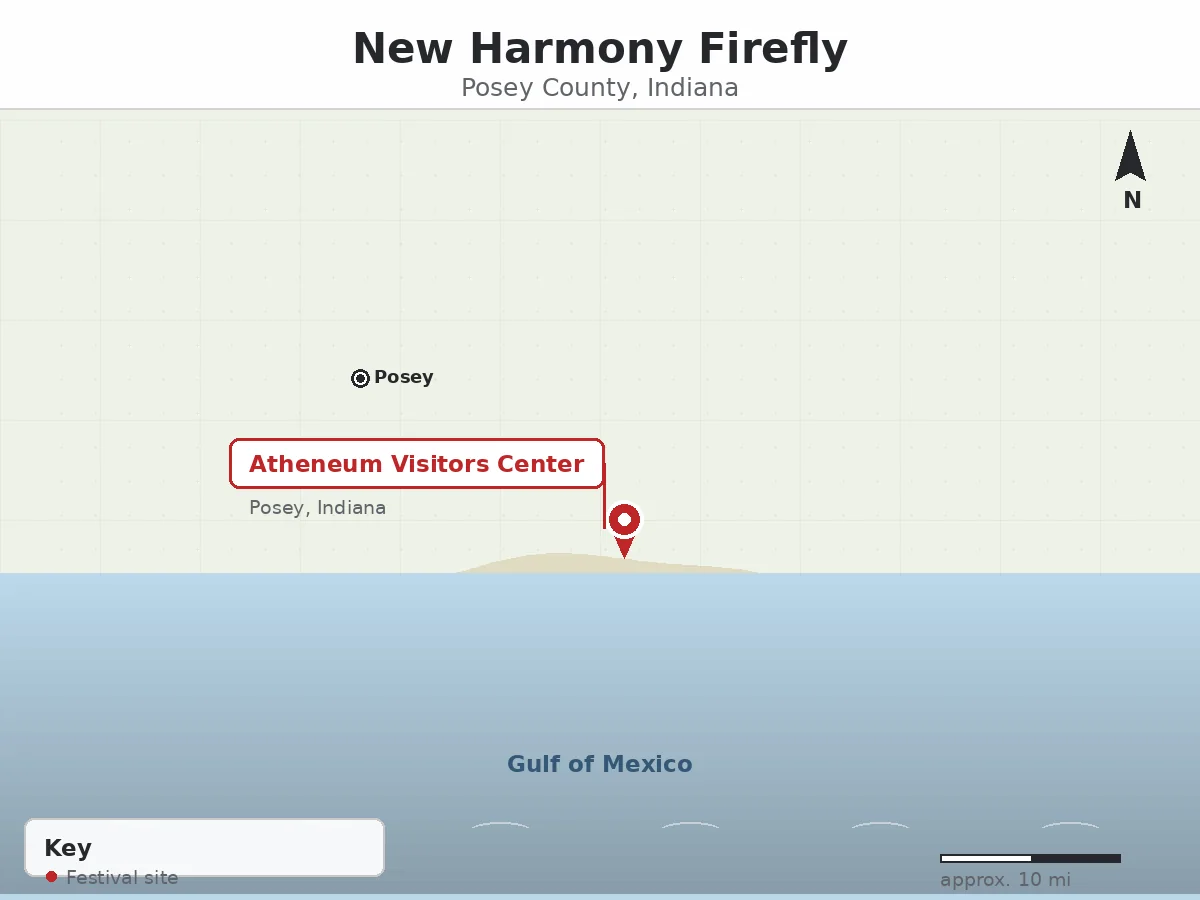
The university layers describe free tram and golf-cart tours running from the Atheneum Visitors Center out to the viewing areas. Those areas lie near the Wabash River and take in wooded trails and the riverfront, so the ride itself is part of the evening’s experience.
What to Expect From the Next Posey County Indiana New Harmony Firefly Festival
How often is Posey County Indiana New Harmony Firefly Festival held?
Organiser-side publicity describes the festival as an annual event, and the documented record supports that rhythm, with editions on June weekends in twenty twenty-four, twenty twenty-five and twenty twenty-six, each running across a Friday and a Saturday.
When is the next Posey County Indiana New Harmony Firefly Festival?
The most recent edition in the documented record is the twenty twenty-six festival, held on the twenty-sixth and twenty-seventh of June. No source gathered for this article confirms a later date, so the honest answer is that the next edition would be expected to follow the established pattern of a Friday and Saturday in June, with its exact weekend to be announced by the presenters.
Will the dates change?
The evidence suggests the weekend moves rather than staying fixed. The three documented editions landed on the seventh and eighth of June, then the twenty-seventh and twenty-eighth, then the twenty-sixth and twenty-seventh, so the month has held steady while the specific days shifted considerably, and a future edition is likelier to sit somewhere in June than on any particular weekend.
Closing
New Harmony’s firefly weekend asks very little of its visitors: two evenings, a walk out toward the river, and a willingness to stand in the dark and watch. In return it offers something few festivals can, a celebration of a creature in the one place on earth where that creature was first given to science, asking no ticket money at the gate and offering no spectacle louder than small lights switching on in the dark. On the documented record of twenty twenty-four, twenty twenty-five and twenty twenty-six, it is a tradition in good health.




One Comment