Jefferson County Indiana Madison Chautauqua Festival of Art
On the last full weekend of September, downtown Madison gives its historic streets over to painters, potters, weavers and jewelers for the Madison Chautauqua Festival of Art. The juried outdoor show spreads through the town’s National Landmark Historic District, along the Ohio River between Broadway and Vine Streets, in the blocks around the Lanier Mansion State Historic Site. Madison is the seat of Jefferson County, and for two days its riverfront fills with booths of fine art and fine craft, a riverfront food fest, live entertainment and visitors drifting from one artist’s display to the next. The organiser’s own site, a state tourism listing and industry coverage all describe a show free to the public, and the industry layer bills the gathering of 26 and 27 September 2026 as the fifty-fifth annual. However a visitor spends it, the weekend stands as the town’s signature gathering of the autumn calendar.

About the Festival
The published name is Madison Chautauqua Festival of Art, the form used by the organiser’s site, the state tourism listing and industry layers alike, and it matches the title at the head of this page word for word. Two close variants sit inside the organiser’s own paperwork, each belonging to the document where it appears. An organiser art-print rules document prints the plural form Madison Chautauqua Festival of Arts on a single occasion, while the heading of the organiser’s artist-application page for the 2026 edition reads Madison Chautauqua Festival of Arts & Crafts. Neither variant displaces the standard name; both are recorded here because the organiser’s own documents print them.
Behind the show stands a nonprofit organisation. The organiser’s site describes the festival as a non-profit organization operating under the umbrella of Visit Madison Tourism, while its artists page places the same festival under the umbrella of Visit Madison, Inc. Those two umbrella forms are kept separate here rather than blended into one. What both pages agree on is the shape of the event: a juried exhibition of fine arts and crafts, staged outdoors in the historic district, with exhibitors chosen by selection rather than admitted on a first-come basis.
Quick Facts
| Item | Detail |
| Published name | Madison Chautauqua Festival of Art |
| Host town | Madison, the seat of Jefferson County |
| Setting | National Landmark Historic District along the Ohio River, around the Lanier Mansion State Historic Site |
| Usual timing | Last full weekend of September, ten in the morning to five in the afternoon on both days |
| Edition documented for 2026 | 26 and 27 September, billed as the fifty-fifth annual |
| Admission | Free to the public |
| Exhibitors | Juried fine arts and crafts; published counts differ by layer and year |
| Parking and shuttle | Parking with continuous shuttle service from Madison Consolidated High School |
| Weather policy | The show runs rain or shine, with no rain date |
History
The documented record of this festival is carried largely by its annual billings. A newsletter layer billed the 2019 edition as the forty-ninth annual, while an art-fair industry layer and a state travel magazine bill the edition of 26 and 27 September 2026 as the fifty-fifth annual. Between those markers, the organiser describes the event, in listing-layer paraphrase, as a tradition of over fifty years. That is as far as the layers go: none of the material gathered here states an explicit founding year, and none is calculated from the sequence of billings, because arithmetic on anniversary labels is not evidence of a first edition.
What the record does show plainly is continuity of place and pattern: the show returns to the same downtown ground along the river on the last full weekend of September, with recent editions documented on consecutive years, 27 and 28 September in 2025 and 26 and 27 September in 2026. One element of the programme has its own long thread through the years: the organiser’s art-print rules document records that an annual limited-edition art print has been a part of the festival for the last thirty years. A single collectible print, issued edition after edition, gives returning visitors a thread of continuity alongside the changing roster of exhibitors, and its three decades inside the event say something about how deliberately this show has been built and kept.
For a useful comparison, see the Jay County Indiana Trees Festival for another county festival.
What to Expect
Booths line the downtown streets with juried work across a wide spread of categories: painting, drawing, photography, sculpture, weaving, folk art, jewelry, fiber, wood, baskets, clay, glass, paper, leather and wearable art. Because the exhibition is juried, the pieces on display have passed a selection process, and the mix leans toward original work presented by the people who made it. Most visitors simply walk the district, stop where something catches the eye, and talk with the artist beside the work.
Around the booths, the weekend carries a few fixtures of its own. A chalk walk puts artists to work on the pavement itself. A riverfront food fest feeds the crowds between browsing sessions. Entertainment and live music run through the weekend, and the annual limited-edition art print gives collectors a specific piece to hunt for. For younger visitors, a state travel magazine’s account of the 2026 edition describes a children’s art tent, printed as Little Picassos, set in the Art Park on the Lanier Mansion lawn, where children can make art rather than only look at it.
Planning Your Visit
Entry to the grounds costs nothing. The organiser’s site, the state tourism listing and industry layers agree that the festival is free to the public, so the money a visitor brings is for artwork, food and whatever the booths tempt them into carrying home. Hours are settled and simple: ten in the morning to five in the afternoon on both the Saturday and the Sunday of the last full weekend of September. The 2026 edition, billed as the fifty-fifth annual, fell on 26 and 27 September; the year before, the show ran on 27 and 28 September.
Getting downtown is arranged around one main piece of logistics. The organiser’s artists page documents parking with continuous shuttle service from Madison Consolidated High School, so visitors park at the school and ride in rather than circling the historic district looking for a space. The same page settles the weather question in advance: the show runs rain or shine, and there is no rain date. A grey forecast is therefore no reason to stay home, but it is a reason to dress for river weather, since the exhibition stands outdoors among the booths either way.
A Sample Day at the Festival
Ride the shuttle in from the high school parking area shortly after the booths open at ten, while the streets are still easy to walk. Give the first hour to the painting and photography rows, when the light is fresh and the artists have time to talk about their pieces. Late morning suits the chalk walk, where the pavement pictures are far enough along to read but still visibly in progress. Around midday, drift toward the riverfront food fest for lunch, then take a slower pass through the sculpture, wood and glass categories with the afternoon crowds. Families can give the middle of the day to the Art Park on the Lanier Mansion lawn and its children’s art tent. Keep the last hour before the five o’clock close for the print: the year’s limited-edition art print is the souvenir with the longest pedigree at this show, and deciding on it deserves unhurried time. Then ride the shuttle back as the booths close.
One Weekend, Three Festivals
Madison packs its last full weekend of September tightly, and a visitor should know which gathering is which. The Chautauqua is the juried art exhibition in the historic district along the river. Sharing the same weekend, Fall Old Court Days is a separate event held around the courthouse square in Madison; it belongs to a different tradition and a different patch of downtown ground. Also on that weekend, Lanthier Winery holds its Harvest Celebration Festival at the winery, a separate event again. Locally the cluster is billed as a Three Festivals Weekend, though each gathering keeps its own organisers, ground and character. A fourth Madison event, the Soup, Stew, Chili & Brew festival, does not belong to that weekend at all; it is a separate October occasion, and confusing it with the September cluster would put a visitor in town on entirely the wrong dates.
Checklist
- Confirm the year’s dates against the last full weekend of September before travelling
- Plan to park at Madison Consolidated High School and ride the continuous shuttle downtown
- Set aside time for the chalk walk and the riverfront food fest between booths
- Look for the year’s limited-edition art print early if collecting one matters to you
- Bring children to the Art Park on the Lanier Mansion lawn for the art tent
Beyond the Booths
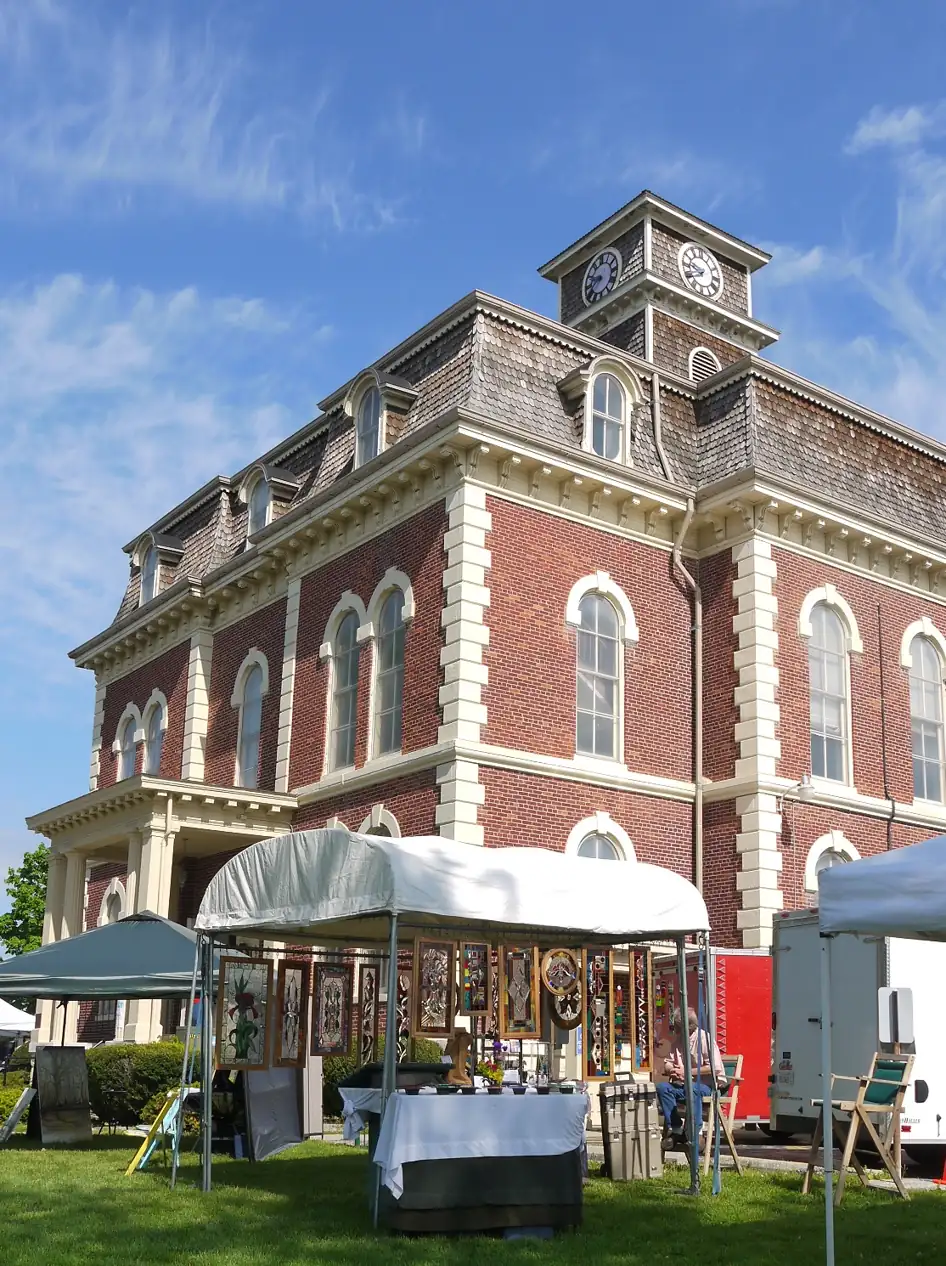
The festival’s ground is itself worth the trip. The booths stand inside a National Landmark Historic District, so the streets between Broadway and Vine are lined with the kind of nineteenth-century storefronts and houses that earned the designation, and the Ohio River runs along the edge of the show. The Lanier Mansion State Historic Site anchors the setting; its lawn holds the Art Park where the children’s tent sits, and the grounds give visitors a green pause between rows of exhibits. A slow walk through the district, away from the busiest booth clusters, rewards anyone who likes old brick, ironwork and river views, and it costs nothing beyond the time it takes.
Why the Chautauqua Matters
A juried art show that can point to a fifty-fifth annual billing carries weight in a county seat of Madison’s size. The industry layers credit the 2026 edition with approximately two hundred twenty exhibitors and two hundred twenty-five artists, and they put the weekend’s visitors at around forty thousand; those are the industry layers’ figures, offered as their claims rather than counted fact, and the organiser’s own pages are more modest, with an about page counting one hundred seventy-five arts and craftspeople and an artists page putting exhibitors at approximately two hundred. Even the lowest of those published counts describes a large exhibition. For Jefferson County, the weekend concentrates artists, buyers, food vendors and neighbours into the historic district at once, with free admission keeping the crowd a cross-section of the whole community rather than only committed art buyers.
Frequently Asked Questions
What happens to the show if rain moves in over the riverfront?
It goes ahead anyway. The organiser’s artists page states that the show runs rain or shine and that there is no rain date, so a wet forecast changes what visitors wear rather than whether the booths open. The exhibition stands outdoors, so a rainy year is simply a damper version of the same weekend, and regulars plan clothing and footwear around the forecast instead of waiting for a postponement the organiser says will not come.
Why do published exhibitor counts for the festival differ so much?
Because they come from different pages written for different purposes and different years. The organiser’s about page says one hundred seventy-five arts and craftspeople showcase work, while its artists page gives approximately two hundred exhibitors. Industry layers, writing about the 2026 edition, say approximately two hundred twenty exhibitors and two hundred twenty-five artists. Each figure is reported here with the layer that printed it; none is treated as the single settled count, since the sources do not agree on one.
What is the limited-edition art print connected with the weekend?
It is an annual print issued in a limited edition as part of the festival. The organiser’s art-print rules document records that the print has been a part of the festival for the last thirty years, which makes it one of the show’s longest-running customs. Collectors who return year after year can build a run of prints across decades, and the rules document that governs the print is also the one place where the plural name form, Madison Chautauqua Festival of Arts, appears in the organiser’s paperwork.
How does the shuttle arrangement work for visitors driving in?
The organiser’s artists page documents parking and continuous shuttle service from Madison Consolidated High School. In practice, drivers leave their cars at the school and ride the shuttle into the district rather than hunting for parking among the historic streets. Continuous service matters at a show open from ten to five, because visitors can arrive and leave throughout the day instead of gathering for a single scheduled run.
What to Expect From the Next Jefferson County Indiana Madison Chautauqua Festival of Art
How often is Jefferson County Indiana Madison Chautauqua Festival of Art held?
The Chautauqua returns every year to the last full weekend of September, running ten in the morning to five in the afternoon on both days. That placement held for the documented editions of 2025 and 2026, and the organiser presents the September weekend as the show’s standing place in the calendar. Visitors can plan on the same weekend shape each autumn, in the same downtown ground along the river.
When is the next Jefferson County Indiana Madison Chautauqua Festival of Art?
Following the 2026 edition of 26 and 27 September, the standing pattern of the last full weekend of September points to late September 2027 for the next running of the show. The layers gathered here document the festival through its fifty-fifth annual billing in 2026; the following year’s date is best confirmed against the organiser’s own announcements as the season approaches, since each year’s particulars are published by the organiser in its own time.
Will the dates change?
The documented editions argue against it. The forty-ninth annual billing in 2019, the 2025 edition and the fifty-fifth annual edition in 2026 all sit on the last full weekend of September, and the hours of ten to five have stayed constant across the recent record. Weather does not move the show either: the organiser’s artists page is explicit that the festival runs rain or shine with no rain date. If a change ever came, it would arrive through the organiser’s own pages rather than through rumour, so checking those pages in the weeks before the weekend is the reliable habit.
Closing
Few county festivals anywhere can fill a national landmark district with juried art, feed the crowd at a riverfront food fest, and still leave room on the same weekend for two neighbouring celebrations. Madison’s Chautauqua does it on the strength of a fifty-year tradition, a nonprofit organiser working under the town’s tourism umbrella, and a setting that most art shows could only envy. For anyone within reach of Jefferson County in late September, it is the weekend the town is at its best, and it asks nothing at the gate for the pleasure of walking through it.