Hamilton County Indiana GreekFest Festival
On a late-August weekend in Carmel, the grounds of a Greek Orthodox cathedral fill with the smell of grilled meats and honeyed pastry, the sound of live Greek music, and a big tent pitched for days of eating, dancing and touring. The celebration is published as GreekFest. Listing and parish layers also call it Indy GreekFest and the Indianapolis Greek Festival, and one student-news layer shortens the styling to Greek Fest. No layer consulted for this article uses the doubled form GreekFest Festival, so the published names are the ones carried here. The setting holds a small puzzle worth stating plainly: although one of its names says Indianapolis, the cathedral stands in Carmel, in Hamilton County, and the celebration has kept its historic Indianapolis name. Carmel is not the county seat; that distinction belongs to Noblesville. What follows gathers what those layers document, keeping each detail beside its year.
About the Celebration
The festival is presented by the parish of Holy Trinity Greek Orthodox Cathedral, which is the name form used by the organiser’s own site and by a parish newsletter. An older events layer prints the parish name differently, as Holy Trinity Greek Orthodox Church. Both forms are recorded here exactly as printed, and neither has been merged into the other. The gathering unfolds on the cathedral grounds in Carmel, under a big tent, as multiple layers describe it. It is, at heart, a parish celebration opened wide to the general public: the cooking, the music, the dancing and the tours all come out of the cathedral community, and the weekend runs on volunteers drawn from that community. A student-news layer covering the 2024 edition put the volunteer corps at over four hundred people, a sense of the labour behind a free-admission weekend. The same layer expected ten thousand visitors that year. That number was a hope published ahead of the event rather than a count taken at the gate, and it is reported here as an expectation only. No counted attendance figure for any edition appears in the layers read, and none is invented here.
Quick Facts
| Item | Documented detail |
| Published names | GreekFest; also Indy GreekFest and Indianapolis Greek Festival |
| Host community | Carmel, Hamilton County, Indiana |
| County seat | Noblesville; Carmel is not the seat |
| Venue | Grounds of Holy Trinity Greek Orthodox Cathedral, under a big tent |
| Organiser | Holy Trinity Greek Orthodox Cathedral; an older events layer prints Holy Trinity Greek Orthodox Church |
| Timing | Late August; recent documented editions run Friday and Saturday |
| Documented editions | 2015, 2024, 2025 and 2026 |
| Admission | Free, according to the events layers for 2015 and 2025 |
| Food | Greek cuisine and homemade pastries; gyros, spanakopita, loukoumades and baklava named for 2025 |
| Entertainment | Live Greek music and the Holy Trinity Hellenic Dance Troupe |
History
Two pieces of billing frame the celebration’s past, and they are kept separate here because the layers state them separately. A listing layer says the festival has welcomed guests for over fifty years. An events layer, describing the edition held from Friday the twenty-eighth to Sunday the thirtieth of August 2015, billed that year as the forty-second year of the festival. Neither statement is converted into a founding year here, and they are not reconciled into a single claim, because the layers themselves never do that work. In 2015 the celebration ran across three days, Friday through Sunday. More recent documented editions run across two days. For 2024, a student-news layer records Friday the twenty-third and Saturday the twenty-fourth of August, an opening ceremony at four in the afternoon on the Friday, and Saturday hours from eleven in the morning until ten at night. For 2025, an events layer gives Friday the twenty-second of August from four to ten in the evening and Saturday the twenty-third from eleven in the morning to ten at night, under the theme Culture, Tradition, and Community. A listing layer and a parish newsletter document an edition on Friday the twenty-first and Saturday the twenty-second of August 2026, and the newsletter afterwards thanked the volunteers for that edition, anchoring it as one that was held.
What to Expect
Food leads the documented programme. Layers describe authentic Greek cuisine and homemade pastries as the heart of the weekend. The dishes named most precisely come from the events layer for 2025, which lists gyros, spanakopita, loukoumades and baklava, so that particular menu belongs to that year’s account. Older layers add Greek wines and local craft beers to the picture of what is poured alongside the food. Music and dance run through the weekend: live Greek music is a standing feature in the layers, and traditional folk dancing is performed by the Holy Trinity Hellenic Dance Troupe. The cathedral itself is part of the programme, with tours offered to visitors curious about the building behind the festival. Cultural exhibits broaden the picture, and a marketplace called the Agora adds a shopping element. Children are catered for as well; visitor accounts describe children’s activities that include bounce houses. That detail rests on visitor accounts and is fenced to them. Review-site colour, such as which pastry sells out first, is anecdote and has been left out.
Planning Your Visit
Dates decide everything else about the trip. Every documented edition falls in late August, and the recent pattern is a Friday and Saturday rather than the three-day span recorded for 2015. The hours published for 2024 and 2025 are a useful guide to the weekend’s rhythm: Friday runs from four in the afternoon into the evening, with an opening ceremony at four on the Friday in the 2024 account, while Saturday is the long day, running from eleven in the morning until ten at night in both the 2024 and 2025 layers. Admission money is simple. The events layer for 2015 states that entry was free, and the events layer for 2025 says, in its own words, that admission is free for all. No layer read states a charge for entry in any year checked. Because the celebration spreads across cathedral grounds under a big tent, much of the weekend happens outdoors or under canvas, worth remembering when dressing for a late-August evening in Indiana. Anyone hoping to catch the dance troupe should plan around the performance rather than treating it as background, since the troupe is among the elements the layers name most consistently.
For a useful comparison, see the Hamilton County Indiana Potter’s Bridge Fall Festival for another county festival.
A Sample Festival Weekend
Friday offers the gentler way in. Arriving for the opening of the day at four in the afternoon, as the 2024 programme began with its opening ceremony, puts a visitor ahead of the evening’s full swing. A first circuit of the food offerings makes a sensible start, sampling the savoury dishes before the pastry tables claim attention. The evening then belongs to the music, running to ten at night on the 2025 pattern. Saturday is the fuller day, running from eleven in the morning until ten at night in the documented 2024 and 2025 hours. A late-morning arrival allows time for a cathedral tour before lunch, followed by a slower pass through the Agora marketplace. The afternoon suits the cultural exhibits and a first round of pastries, keeping loukoumades or baklava, both named in the 2025 account, for a pause in the day. Evening brings the dancing of the Holy Trinity Hellenic Dance Troupe and a final visit to the food lines before the grounds close. Visitors who remember the three-day shape recorded for 2015 should note that recent editions end on Saturday night, so there is no Sunday session in the modern pattern.
How GreekFest Compares
Two distinctions keep this celebration from being confused with its neighbours. The first is geographic and ethnic at once: a German festival held at the historic Athenaeum in Indianapolis, in Marion County, is a different ethnic festival in a different county, despite the short distance between the cities. GreekFest is the Greek celebration, rooted in an Orthodox parish in Carmel, and a shared format of food stalls and folk performance should not blur the two into one event. The second distinction is closer to home. The cathedral’s monthly Gyro Night is a separate recurring parish event, a regular evening built around a single beloved food, and it is not the festival. GreekFest is the large annual gathering with the full spread of cuisine, pastries, music, dancing, tours and marketplace; Gyro Night is the small monthly echo of one part of it.
A Visitor Checklist
- Confirm the current year’s dates before travelling, since each edition’s days are published year by year.
- Plan around the Friday opening at four in the afternoon if the opening ceremony appeals.
- Give Saturday the full day, from eleven in the morning to ten at night on the documented pattern.
- Arrive hungry, and pace the savoury dishes before the pastries.
- Look for gyros, spanakopita, loukoumades and baklava, the dishes named in the 2025 account.
- Make time for a cathedral tour between meals.
- Catch a performance by the Holy Trinity Hellenic Dance Troupe.
- Browse the Agora marketplace for something to carry home.
- Dress for an outdoor evening under and around a big tent.
- Remember that Carmel, not Indianapolis, is where the cathedral stands.
Beyond the Festival Grounds
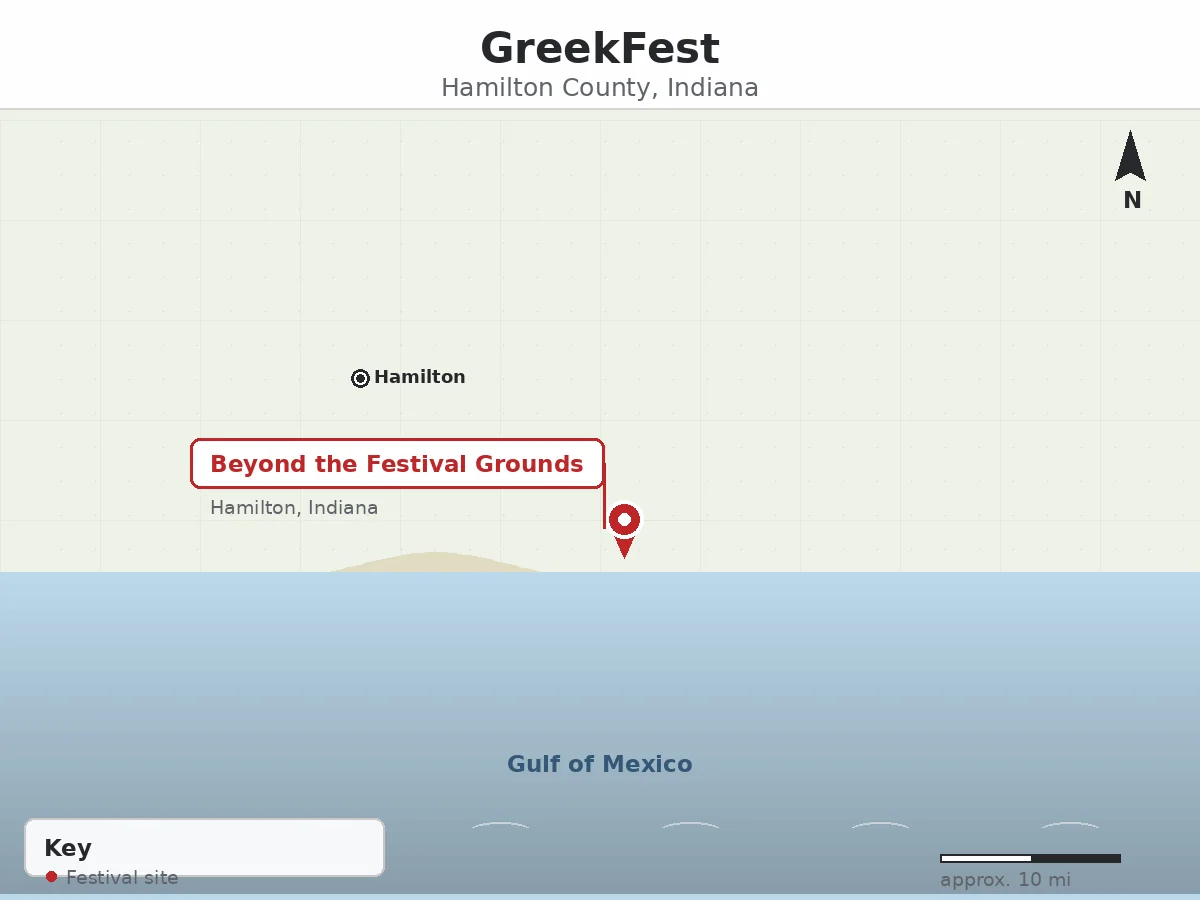
The most natural extension of the weekend runs through the parish itself. The cathedral’s monthly Gyro Night continues the food side of the celebration in miniature across the year, and its tours hint at a building worth appreciating in its own right, not only as a backdrop. Carmel sits within Hamilton County, whose seat is Noblesville, and the festival’s own naming carries its history with it: a celebration born under an Indianapolis name now makes its home in Carmel. The layers gathered here speak about the festival and the parish and say little about the town beyond that, so this section stays modest rather than inventing a guide the record cannot support.
Why GreekFest Matters
A parish festival that its layers bill as running for over fifty years, and that one layer billed in 2015 as being in its forty-second year, holds a particular place in a community’s life. It is at once an act of hospitality, a display of a congregation’s cooking and dancing traditions, and an open invitation to neighbours who share neither the faith nor the heritage. The scale of the volunteer effort, over four hundred people in the student-news account of 2024, shows how much of the parish treats the weekend as its own. Keeping the historic Indianapolis name while standing in Carmel ties the celebration to its roots rather than trimming its identity to fit a new address. For Hamilton County, the result is a late-August fixture in which an immigrant tradition is neither museum piece nor novelty but a living table, set under a tent, to which the whole county is invited.
Frequently Asked Questions
Why does a festival with Indianapolis in its name take place in Carmel?
One of the celebration’s published names is the Indianapolis Greek Festival, and listing layers use it alongside Indy GreekFest. The cathedral that hosts the event stands in Carmel, in Hamilton County, and the festival has kept its historic Indianapolis name there. The name is a piece of the event’s history rather than a statement about its present address, so visitors should navigate to Carmel, with Noblesville, not Carmel, being the county seat.
Which dishes are actually documented for the festival?
The most precise menu comes from the events layer for 2025, which names gyros, spanakopita, loukoumades and baklava among the Greek cuisine and homemade pastries. Other layers speak more generally of authentic Greek food and homemade pastries, and older layers mention Greek wines and local craft beers. Menus belong to their years, so the 2025 list guides expectations rather than promising any single edition.
How long has the celebration been running?
Two billings answer that in their own ways. A listing layer says the festival has welcomed guests for over fifty years, while an events layer billed the 2015 edition as the forty-second year of the festival. Both are recorded here exactly as stated. This article does not turn either figure into a founding year, because the layers do not state one, and the two claims are left side by side rather than merged.
What happens besides the food?
Quite a lot, on the documented record. Live Greek music plays across the weekend, the Holy Trinity Hellenic Dance Troupe performs traditional folk dancing, and cathedral tours take visitors inside the building. Cultural exhibits and the Agora marketplace add browsing to the eating, and visitor accounts describe children’s activities including bounce houses. The 2025 edition also carried a theme, Culture, Tradition, and Community.
What to Expect From the Next Hamilton County Indiana GreekFest Festival
How often is Hamilton County Indiana GreekFest Festival held?
The documented record shows the celebration returning in late August year after year, with editions published for 2015 and then for 2024, 2025 and 2026 in the recent run. A listing layer’s description of a welcome extended for over fifty years points in the same direction, toward a standing late-summer fixture rather than an occasional gathering.
When is the next Hamilton County Indiana GreekFest Festival?
The most recent documented edition ran on Friday the twenty-first and Saturday the twenty-second of August 2026. The layers read for this article do not publish dates for a later edition, so the honest answer is that the next dates will come from the parish’s own announcements. The recent pattern, a Friday and Saturday in the second half of August, is the best guide the record offers.
Will the dates change?
They have shifted in shape before. The documented edition of 2015 ran for three days, Friday through Sunday, while the documented editions of 2024, 2025 and 2026 each ran for two days, Friday and Saturday. The late-August placement has stayed constant across those years, but the length of the weekend has not, so each year’s published dates deserve to be read as that year’s own plan.
Closing Thoughts
GreekFest endures in the record as a parish’s open table: Greek cooking, homemade pastry, live music and folk dancing gathered under a tent on cathedral grounds in Carmel. Its published names, its unmerged organiser forms and its two separate pieces of billing have all been left exactly as the layers print them, because that untidiness is part of the evidence. For more than five decades by one layer’s count, and in a forty-second year by another’s, this celebration has welcomed its neighbours in late August, and the documented editions of recent years show it still doing so, two days at a time, with free admission and a volunteer corps in the hundreds.