Bonneville County Idaho War Bonnet Round Up Festival
Introduction
The War Bonnet Round Up is a professional rodeo staged in Idaho Falls, and it is the event standing behind the longer title at the top of this article. No published layer adds the word Festival to its name: the organiser layer, maintained by the City of Idaho Falls, and the news layers around the event call it a rodeo, often carrying the tagline Idaho’s Oldest Rodeo, a billing recorded here as the layers’ own claim rather than as a proven ranking. Idaho Falls is the county seat of Bonneville County, and the rodeo’s modern home is a city-owned arena grounds on the south side of town.
About
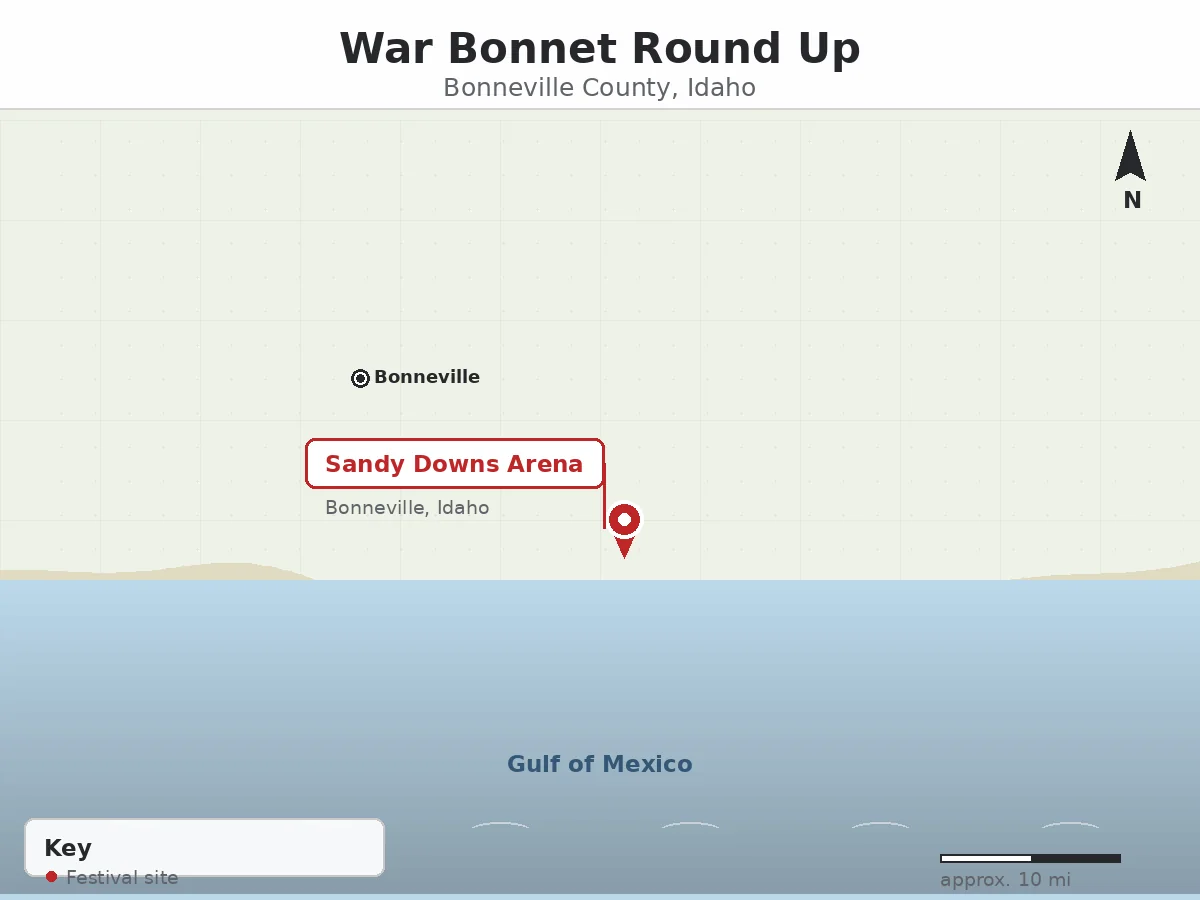
The current organiser layer names the City of Idaho Falls Parks and Recreation Department as the body running the rodeo today, publishing its dates, schedule and prices through city pages and city news releases. The arena itself appears under more than one name form depending on the layer consulted: ticketing layers call it Sandy Downs Arena, on South Fifteenth East, while city news layers use the fuller form Bank of Idaho Arena at Sandy Downs, and the organiser layer describes Sandy Downs itself as a city-owned facility. Those forms are recorded side by side here, never collapsed into a single official venue name. The rodeo is sanctioned by the PRCA, and city and encyclopedic layers put its competitor field at more than four hundred fifty contestants, a programme count that describes the entry list rather than the crowd. How large that crowd is stays unsettled in the record: encyclopedic and city layers claim more than twelve thousand spectators, while listing layers claim more than fifteen thousand, and this article adopts neither figure.
Quick Facts
| Item | Detail |
| Published name | War Bonnet Round Up (no published layer adds Festival) |
| Event type | PRCA-sanctioned rodeo, billed by its layers as Idaho’s Oldest Rodeo |
| Host town | Idaho Falls, the county seat of Bonneville County |
| Current organiser | City of Idaho Falls Parks and Recreation Department |
| Current grounds | Sandy Downs Arena in ticketing layers; Bank of Idaho Arena at Sandy Downs in city news layers |
| Earliest site | Tautphaus Park, in the 1911 and 1912 editions |
| Founding record | A first holding on September 5–8, 1911, and an official inauguration on September 23–27, 1912, recorded unmerged |
| 2026 edition | July 29 to August 1, billed as the one hundred fifteenth year |
| 2026 prices | Starting at twenty-two dollars Thursday and twenty-seven dollars Friday and Saturday, parking included |
| Crowd claims | More than twelve thousand in encyclopedic and city layers; more than fifteen thousand in listing layers |
History
The founding record for this rodeo arrives in two forms that no layer reconciles, and both are preserved here exactly as printed. The city organiser layer states that the rodeo originally started in 1911, and a university news layer likewise states that it started in 1911. The encyclopedic layer, however, records two distinct moments: a first holding on September 5–8, 1911, staged alongside the county fair at Tautphaus Park, and an official inauguration a year later, on September 23–27, 1912. Neither form is treated here as correcting the other. A resale-ticket layer phrases the span as since 1912, but that phrasing belongs to a resale layer only and is never used in this article as evidence for either date. The fair running beside that first holding was a neighbour on the calendar and the grounds, never a parent event.
Who ran the rodeo has changed by era, and the history layers keep those eras separate. Local businessmen stand behind the earliest editions. The Chamber of Commerce carried the event in a later era, and American Legion Post 56 held it in another, before the City of Idaho Falls Parks and Recreation Department emerged as the organiser named in the current layer. Those four forms describe a sequence across more than a century, not a committee that ever sat together.
The long run has known its breaks. History layers record interruptions during the Depression era and the Second World War era, along with cancellations in 2009 and 2010. A university news layer published in 2026 adds its own broader claim, that the rodeo takes place every year aside from unforeseen circumstances such as world wars and, most recently, the Covid-19 pandemic. That sentence is that layer’s claim, recorded here with its exceptions intact; it is not merged with the history layers’ cancellation list, and no combined chronology is drawn from the two.
For a useful comparison, see the Bonner County Idaho Sandpoint Idaho Film Festival for another county festival.
Edition billings accumulate without settling anything. City and news layers bill the 2026 edition as the one hundred fifteenth year, and the city’s vendor page invites readers to plan on a one hundred fifteenth anniversary across July 29 to August 1, 2026. For 2024, one listing layer billed the one hundred thirteenth year while another billed the one hundred twelfth, a direct conflict left open here. A magazine layer billed the 2019 edition the one hundred eighth annual. No founding year is computed from any of these numbers, and none of them is used to break the tie between the 1911 first holding and the 1912 inauguration.
What to Expect
The competitive core is a full professional rodeo card. A city layer lists the sanctioned events as bull riding, barrel racing, saddle bronc riding, bareback riding, steer wrestling, tie-down roping, team roping and women’s breakaway roping. A youth rodeo runs before the main performance, giving younger riders the arena ahead of the professionals, and the competitor field across the week exceeds four hundred fifty contestants in the city and encyclopedic layers’ shared count.
The nightly shape in the documented 2026 edition is steady: gates open at 4:30 p.m., pre-rodeo events begin at 6 p.m., and the main PRCA rodeo starts at 7 p.m. The week opens more gently, with a free kickoff family festival at Sandy Downs on the Wednesday before the first ticketed performance, a component of rodeo week rather than a separate event. Saturday’s listing stretches the closing day from 4:30 p.m. to 10:30 p.m.
Planning Your Visit
Prices belong to their years, and the city-published record is clearest for the two most recent documented editions. A city news layer gives 2026 starting prices of twenty-two dollars for Thursday and twenty-seven dollars for Friday and Saturday, with children ages three through ten admitted at ten dollars per night; those ticket prices include parking. The same layer published the same starting prices and the same child price for 2025, again with parking included. A limited number of reserved grandstand seats cost extra in the organiser’s framing, an upgrade on top of admission rather than the admission price itself.
Older pricing conflicts with the recent terms and is not presented as current. A magazine layer sourced to the City gave 2019 prices of twenty-five dollars for adults on Thursday and Friday and thirty dollars on Saturday, children at ten dollars and under-twos free, but with a five-dollar parking fee not included that year. That parking charge stands unmerged against the parking-included terms of 2025 and 2026. Prices seen on resale sites, including listings from eighteen dollars, are resale prices set by sellers, never the organiser’s admission. The practical habit the record rewards is checking the organiser layer for each edition’s own terms rather than carrying one year’s prices into another.
A Sample Itinerary: The 2026 Shape
The itinerary below follows the documented 2026 edition, Wednesday, July 29 to Saturday, August 1, 2026, and is labelled as that edition’s shape rather than a promise about any other year.
Wednesday belongs to the free kickoff family festival at Sandy Downs, the unticketed opening of rodeo week. On Thursday, arrive for the 4:30 p.m. gate opening, catch the pre-rodeo events from 6 p.m., and stay for the main rodeo at 7 p.m. Friday repeats that rhythm with the same gate, pre-rodeo and main-performance times. Saturday, the closing day, runs from 4:30 p.m. to 10:30 p.m. in the city’s listing, with the same evening build toward the final 7 p.m. performance. The 2025 edition kept the same broad shape a year earlier, opening with a free kickoff party on July 30 from 4 p.m. to 8 p.m. ahead of its July 30 to August 2 run.
How It Compares
The nearest comparison is also the easiest confusion to avoid. The Bonneville County Fair is a separate event with its own record: the 1911 rodeo was staged alongside the fair at Tautphaus Park, but sharing ground and a September week in 1911 never made the two the same undertaking, and no fair dates, prices or programme details are imported here. The free kickoff family festival invites a second confusion, since it carries the word festival inside rodeo week; in the layers it is a component of the Round Up’s own programme, not a standalone festival, and the sheet title’s trailing Festival wording attaches to no published name for either event.
Checklist
- Confirm which arena name form your tickets use, Sandy Downs Arena or Bank of Idaho Arena at Sandy Downs
- Check the current year’s city-published starting prices before assuming the 2026 figures still hold
- Remember that recent city terms include parking, while the 2019 terms charged five dollars extra
- Treat resale listings, including any from eighteen dollars, as seller pricing rather than gate admission
- Arrive near the 4:30 p.m. gate opening if you want the pre-rodeo events from 6 p.m.
- Keep the free Wednesday kickoff in mind as part of rodeo week, not a separate festival
- Leave room on Saturday, when the documented 2026 closing day ran to 10:30 p.m.
Beyond the Festival
Bonneville County itself dates to 1911, created with Idaho Falls as its seat, so the rodeo’s first holding and the county’s own beginning share a year in the record. The earliest editions unfolded at Tautphaus Park, in town, while the modern event occupies the city-owned Sandy Downs grounds. A downtown preview event also appears in the record for July 31, 2019, in the magazine layer’s account of that edition, a reminder that rodeo week’s footprint has at times reached beyond the arena fence.
Why It Matters
Few county events in the record carry a paper trail this long or this argumentative. The Round Up matters partly because its documentation refuses to tidy itself: two founding forms, billing counts that disagree by a year, crowd claims fifteen thousand strong in one layer and twelve thousand in another, and parking terms that flip between editions. Read carefully, that untidiness is itself the history of a community institution handed from businessmen to a chamber, from a Legion post to a city department, and still filling four nights at the turn of August. The PRCA sanction ties the event to the professional circuit rather than to exhibition riding alone, and the city layer publishes it squarely on those terms.
Frequently Asked Questions
Which beginning should a reader believe, 1911 or 1912?
Both forms stand in the record, and this article merges neither into the other. The city organiser layer and a university news layer each state that the rodeo started in 1911, and the encyclopedic layer dates a first holding to September 5–8, 1911. The same encyclopedic layer separately records an official inauguration on September 23–27, 1912. The safest reading is that something was held in 1911 and something was formalised in 1912; the layers never say more than that, and the edition billings cannot settle the question, since the billings themselves conflict.
Whose hands has the rodeo passed through?
The history layers describe an era sequence rather than a single organiser. Local businessmen ran the earliest editions, the Chamber of Commerce carried a later era, and American Legion Post 56 held the event in another period. Today the organiser layer names the City of Idaho Falls Parks and Recreation Department, which publishes the rodeo’s dates, schedule and prices. The four forms belong to different stretches of the rodeo’s life and are never presented as partners in one organisation.
What did a ticket actually cover in the recent city-published editions?
For 2026, a city news layer published starting prices of twenty-two dollars for Thursday and twenty-seven dollars for Friday and Saturday, children ages three through ten at ten dollars per night, with parking included in the ticket price; a limited run of reserved grandstand seats cost extra as an upgrade. The 2025 city terms matched those starting prices with parking likewise included. The 2019 magazine terms differed, including a five-dollar parking fee charged on top, and resale listings such as those from eighteen dollars reflect seller pricing, not admission.
How big is the crowd, by the record’s own conflicting lights?
The layers disagree, and the disagreement is the honest answer. Encyclopedic and city layers claim more than twelve thousand spectators, while listing layers claim more than fifteen thousand; neither figure is a counted gate total, and this article adopts neither. The one firm scale figure in the record concerns the programme rather than the audience: more than four hundred fifty competitors, a count shared by city and encyclopedic layers.
What to Expect From the Next Bonneville County Idaho War Bonnet Round Up Festival
How often is Bonneville County Idaho War Bonnet Round Up Festival held?
Documented editions cluster in the same late-summer window across very different years: August 1–3 in 2019, July 30 to August 2 in 2025 and July 29 to August 1 in 2026. A university news layer describes the rodeo as taking place every year aside from unforeseen circumstances such as world wars and the Covid-19 pandemic, but that is that layer’s characterisation, and the history layers separately record Depression-era and Second World War-era interruptions plus cancellations in 2009 and 2010.
When is the next Bonneville County Idaho War Bonnet Round Up Festival?
An encyclopedic infobox layer lists August 4–7, 2027 as the next edition’s dates. That listing is presented here exactly for what it is, one reference layer’s forward entry sitting beside the documented late-July to early-August pattern; it is not a date announced by the city organiser layer in the material read for this article, and it should be confirmed against the city’s own pages before travel is planned around it.
Will the dates change?
The documented editions suggest a stable window rather than fixed days. The 2019, 2025 and 2026 editions each opened on a Wednesday or Thursday at the turn of August and ran three to four days, sliding by a day or two from year to year. A future edition holding the same window while shifting its exact dates would match the pattern the record shows.
Closing
The War Bonnet Round Up endures in the record as Idaho Falls’ city-run professional rodeo: PRCA-sanctioned, rooted in a disputed 1911–1912 beginning, priced and scheduled in unusual detail by its own organiser, and described by layers that agree on its importance more readily than on its numbers.
One Comment