Bonner County Idaho Lost in the 50s Festival
Introduction
Each May, Sandpoint’s downtown streets fill with tailfins, chrome and nineteen-fifties styling for the weekend its organiser and news layers publish as Lost in the ’50s. Listing layers print the name without the apostrophe, as Lost in the 50s, and both forms are kept here as their layers give them, unmerged. Sandpoint is the county seat of Bonner County, and the festival is anchored in its centre: a Friday parade of vintage and classic cars, a judged downtown show on Saturday, and evening concerts at the Bonner County Fairgrounds. A news-network layer names Carolyn Gleason as the event’s founder and organiser. Its documented story holds a break few long-running festivals admit to: an ending announced in 2020, no edition in 2021, and a comeback in 2022 that has carried the weekend to a thirty-ninth Annual billing for May 2026.
About
Lost in the ’50s is a car-centred May festival in Sandpoint, Idaho, built around vintage and classic automobiles, period music and fifties dress. April 2022 coverage in a news-network layer describes Carolyn Gleason as the show’s organiser and founder, and a hot-rod magazine layer traces its beginnings to a ’50s-themed dance held to raise money for the Festival at Sandpoint, the car show growing up alongside that dance as an adjunct to it. That origin links the two events without merging them: the Festival at Sandpoint is a separate summer music festival, dealt with in the comparison below.
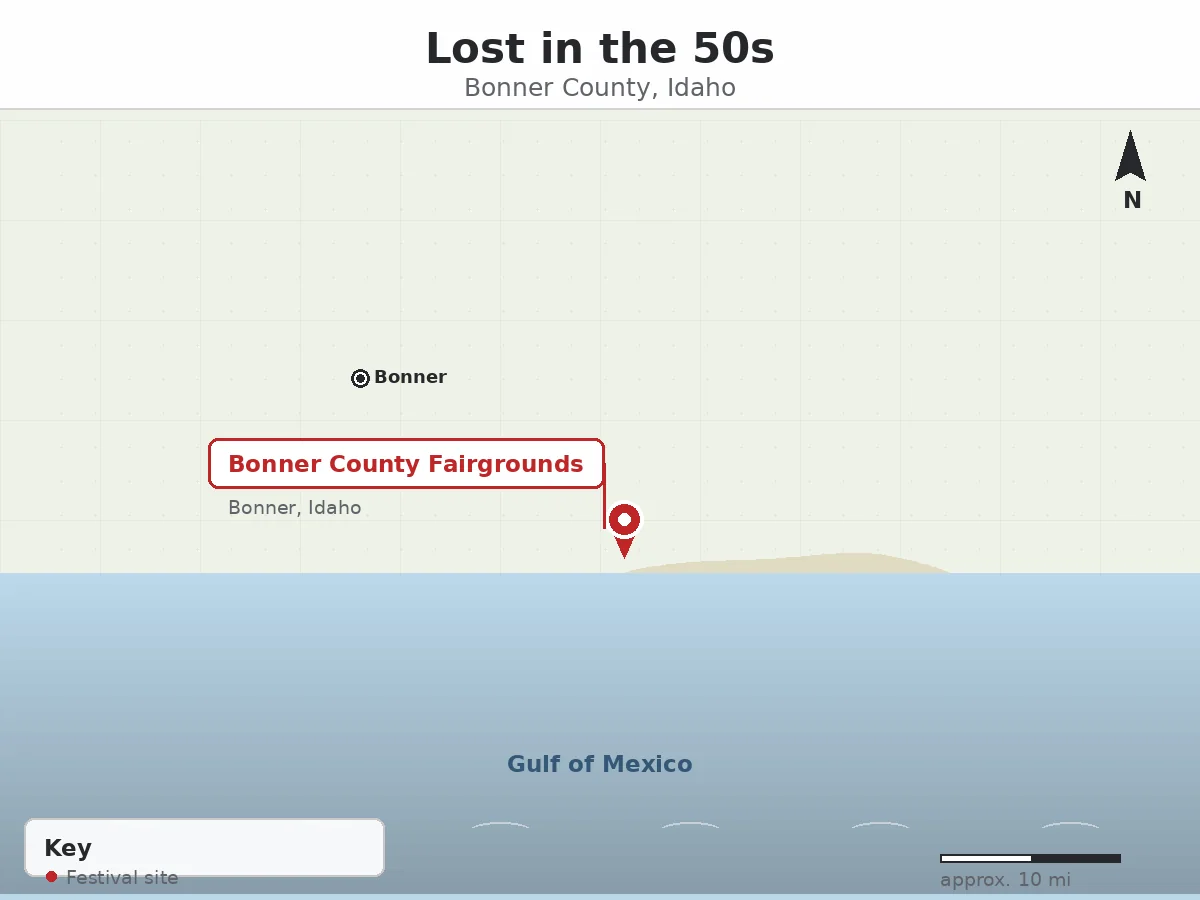
The layers place the weekend’s pieces in different settings, and those settings are recorded with their layers rather than settled into a single venue. A 2023 news layer puts the car show on First, Second and Third avenues and on Main and Cedar streets in downtown Sandpoint. News layers have the Friday parade assembling at the Sandpoint High School parking lot before it rolls. The same 2023 news layer places the evening concerts at the Bonner County Fairgrounds. No layer in the record names one ground as the festival’s home, so none is invented here.
Quick Facts
| Item | Detail |
| Published name | Lost in the ’50s (organiser and news layers); Lost in the 50s (listing layers) |
| Host town | Sandpoint, the county seat of Bonner County |
| Founder and organiser | Carolyn Gleason, per a news-network layer |
| Origin | An adjunct to a ’50s-themed dance raising money for the Festival at Sandpoint |
| Timing | The third weekend of May, per several layers |
| Settings | Downtown Sandpoint streets; the Sandpoint High School parking lot; the Bonner County Fairgrounds |
| Watching the show | Free to spectators, per a news layer |
| Separate charges | Fairgrounds concerts ticketed; car registration a participant fee; no values published |
| Founding year | None stated in any layer; anniversary billings only |
| Documented span | An announced end in 2020, a return in 2022, and a thirty-ninth Annual billing for 2026 |
History
No source in the record states an explicit founding year for Lost in the ’50s, and this article does not manufacture one. What the layers offer instead is a trail of anniversary billings. A local-site layer has described the event at different points as marking thirty years and as being in its thirty-second year. A news-network layer billed the returning 2022 edition as a thirty-fifth anniversary. A news layer in 2023 spoke of thirty-six years. A magazine listing layer bills the edition of May 14 to 16, 2026 as the thirty-ninth Annual. The series climbs plausibly, but converting any of those numbers into a first year would be arithmetic dressed up as evidence, so the founding stays where the record leaves it: unstated.
The status history is documented more plainly than the founding. A local-history blog layer records that in 2020 the organiser announced the event had reached its end and that there would be no 2021 edition. That announcement is part of the record and is not softened here. The news-network layer then documents the other half: after a two-year COVID-era hiatus, the festival returned on May 19 to 21, 2022, and editions are documented again from that return through the thirty-ninth Annual billing of 2026. Neither half cancels the other: the ending was announced and did not hold, and the return is not written as though no ending had been declared. Between the dance-adjunct origin and the present decade’s documented editions, the middle years rest on the billing trail alone; this history claims no more continuity than those layers support.
For a useful comparison, see the Bonner County Idaho Arts and Crafts Festival for another county festival.
What to Expect
The weekend’s shape, as the layers describe it, runs across three days each May. Friday brings a parade of vintage and classic cars, assembling at the high school parking lot and rolling into the evening, with a street dance in the programme. Saturday belongs to the judged downtown car show, when the avenues fill with entered cars and awards are given. Evenings carry headline retro concerts at the fairgrounds. In 2022, and in 2022 only, the news-network layer names those headliners: Darlene Love on the Friday and The Righteous Brothers on the Saturday. No layer presents that pairing as a standing lineup for any other year. Fifties music and fifties dress run throughout the weekend, per the layers’ descriptions.
Scale is where a reader must keep the figures apart, because the record offers three different kinds. A news layer describes a couple thousand people milling about downtown — a reporter’s description of a crowd, not a count. The organiser, quoted in the 2022 news-network layer, spoke of five hundred twenty-five cars prequalified and more than seven hundred cars expected: a claim about cars, never a figure for people. An older hot-rod magazine layer puts the field at nearly five hundred cars, again a car count. None of the three is blended with another, and the record contains no counted attendance figure of any kind.
Planning Your Visit
Build the trip around the third weekend of May — the timing a hot-rod magazine layer, the news-network layer and a relocation-guide layer all give — and confirm the current year’s dates before travelling, since the record’s most recent dates come from a listing layer, not a standing organiser calendar. The documented 2023 shape is a useful template: the parade on Friday evening, the downtown show across the middle of Saturday, and concerts in the evening at the fairgrounds.
Money needs separating into its parts. A news layer states that the car show is free to wander and check out all the cars, and that freedom covers spectating only. The fairgrounds concerts are separately ticketed components, and registering a car is a participant fee paid by entrants; neither charge is an admission price for the festival itself, and no layer in the record publishes a value for either, so no figure is quoted here. Visitors who come only to look can treat the downtown show as the weekend’s free core and the concerts as an optional extra.
Because the weekend is split between downtown streets, a school parking lot and the fairgrounds, plan movements between the three rather than expecting one gate. Each day divides naturally into a downtown part and a fairgrounds part.
A Sample Itinerary: The 2023 Shape
The clearest published programme is the 2023 edition, Friday, May 19 to Sunday, May 21, 2023, per a news layer; the itinerary follows that documented shape, not a standing schedule.
On the Friday, reach the high school parking lot as the parade assembles, watch it roll at 6:00 p.m., and stay on for the street dance the programme layers pair with parade night. On the Saturday, give the late morning and early afternoon to the judged downtown car show, published for 9:30 a.m. to 3:45 p.m. across First, Second and Third avenues and Main and Cedar streets, with awards among the show’s purposes; in the evening, move out to the Bonner County Fairgrounds for the concerts the 2023 layer places there. On the Sunday, the documented programme span closes. The layers publish no separate Sunday timetable, so treat the day as the weekend’s wind-down rather than a second full show day.
How It Compares
The comparison that matters most is with the Festival at Sandpoint, the summer music festival for which the original ’50s-themed dance raised money. The car show began beside that dance, which makes the music festival part of this event’s origin story — and nothing more. It is a separate event, separately run, in a different season, and none of its facts are imported here. Sharing a hometown and a historical thread does not merge the two weekends.
Namesakes travel badly, too. Events elsewhere borrowing the name or idea, outside Idaho, are unrelated productions; this record is Sandpoint’s alone. Within the weekend itself, the parade, the judged show and the fairgrounds concerts are components of one organiser’s programme, not separate festivals sharing a date.
Checklist
- Confirm the current year’s dates before booking; the pattern is the third weekend of May, and the latest documented dates come from a listing layer.
- Arrive in time for the Friday parade, which assembles at the high school parking lot and rolled at 6:00 p.m. in the documented 2023 shape.
- Keep Saturday between 9:30 a.m. and 3:45 p.m. for the judged downtown show.
- Treat fairgrounds concert tickets as a separate purchase from the free downtown spectating.
- Remember that car-entry figures describe the field of cars, never the size of the crowd.
- Dress in fifties style if you enjoy it; the layers describe period dress throughout the weekend.
- Allow for moving between downtown and the fairgrounds rather than planning around a single venue.
Beyond the Festival
Sandpoint rewards a longer stay than a single show day. The festival uses the town’s ordinary streets rather than a closed ground, so the weekend doubles as an introduction to the downtown itself: its avenues host the show, its school lot stages the parade, its fairgrounds take over after dark. Stay through the Sunday and the town returns to normal speed with the show cars gone — evidence of how completely the festival borrows the place rather than replacing it. The same town hosts a separate summer music festival later in the year, connected to this weekend only by the old fundraiser dance in its past.
Why It Matters
The festival’s significance in the record rests on three documented things. First, endurance of a kind the billings attest even without a founding year: a thirty-fifth anniversary billing for the 2022 return and a thirty-ninth Annual billing for 2026 describe an event with decades behind it. Second, the return itself. An organiser announced a finish in 2020, the 2021 edition did not happen, and the festival came back anyway — a sequence the layers document plainly, and stronger evidence of local attachment than any promotional claim. Third, the origin: a money-raising dance for another festival grew a car show beside it, and the adjunct outlasted its beginnings to become the established event. That a free-to-watch show on public streets sits at the centre of it all makes the weekend part of Sandpoint’s public life rather than a gated attraction.
Frequently Asked Questions
Did the festival really end in 2020?
An ending was genuinely announced. A local-history blog layer records that in 2020 the organiser declared the event had reached its end and that there would be no 2021 edition, and 2021 indeed passed without one. A news-network layer documents the reversal: after a two-year COVID-era hiatus the festival returned on May 19 to 21, 2022, and editions are documented again through a thirty-ninth Annual billing for 2026. So the announcement was real, and so was the comeback; the article keeps both halves in view rather than quietly dropping either.
Who started the festival, and what did it grow out of?
A news-network layer, in April 2022, describes Carolyn Gleason as the event’s organiser and founder. Its roots, per a hot-rod magazine layer, lie in a ’50s-themed dance staged to raise money for the Festival at Sandpoint; the car show began as an adjunct to that dance. The festival it grew beside remains a separate event — an origin fact, not a merger.
What will a spectator pay to watch the cars?
Watching costs nothing, per a news layer, which calls the car show free to wander and check out all the cars. Money attaches to components instead: the evening concerts at the fairgrounds are separately ticketed, and entering a car carries a registration fee paid by participants. Neither is an admission charge, and no layer publishes an amount for either.
How large is the weekend, in people and in cars?
Keep the two measures apart, because the layers do. For people, the record holds only a news layer’s description of a couple thousand people milling about downtown — an impression, not a tally. For cars, the organiser quoted in 2022 spoke of five hundred twenty-five prequalified and more than seven hundred expected, while an older hot-rod magazine layer put the field at nearly five hundred. Car figures describe the show field; none of them counts the crowd, and no counted attendance figure exists in the record.
What to Expect From the Next Bonner County Idaho Lost in the 50s Festival
How often is Bonner County Idaho Lost in the 50s Festival held?
The layers agree on a placement rather than a promise: a hot-rod magazine layer, the news-network layer and a relocation-guide layer all put the festival on the third weekend of May. The documented run is not unbroken — an announced ending in 2020, no edition in 2021 and a return in 2022 interrupt it — so the accurate description is a May weekend that recurs across the documented years with one recorded two-year break, not an unbroken chain.
When is the next Bonner County Idaho Lost in the 50s Festival?
The most recent dates in the record are May 14 to 16, 2026, billed by a magazine listing layer as the thirty-ninth Annual. No later edition is announced in the layers gathered, so none can be confirmed from this record. The third weekend of May is the only guide the record offers for whatever follows — a pattern drawn from past editions, not a published commitment.
Will the dates change?
The precedent cuts both ways. The May placement rests on several layers agreeing and the latest listing continuing it, yet this is an event whose organiser once announced its finish outright before it returned. Against that history, the dates are a well-supported expectation to check against the current year’s listings, never a guarantee.
Closing
Lost in the ’50s endures in the record as Sandpoint’s May weekend of chrome and period song: founder-led, free to watch downtown, candid about its own interruption, and documented — billings, car claims and all — without a founding year ever being stated. That is the shape the layers support, and it is enough.

One Comment