Ada County Idaho Jaialdi Basque Festival
Most festivals measure their lives in single years. Jaialdi measures its life in five-year leaps, and Boise organises its patience accordingly. When the festival arrives, it takes over a downtown week: street dances on the Basque Block, rural sports in an arena, handball at the fronton, food and music everywhere a crowd can stand. When it ends, the city simply waits, because waiting is built into what Jaialdi is. The sheet title, Jaialdi Basque Festival, fairly characterises the published event, which travels under the single Basque word Jaialdi — a word that means “festival” in Euskara, the Basque language, according to the organiser and museum layers. The eighth edition ran from Tuesday, July 29 to Sunday, August 3, 2025, and it was the first since 2015, a gap that says more about this festival’s rhythm than any programme could.
About the Festival
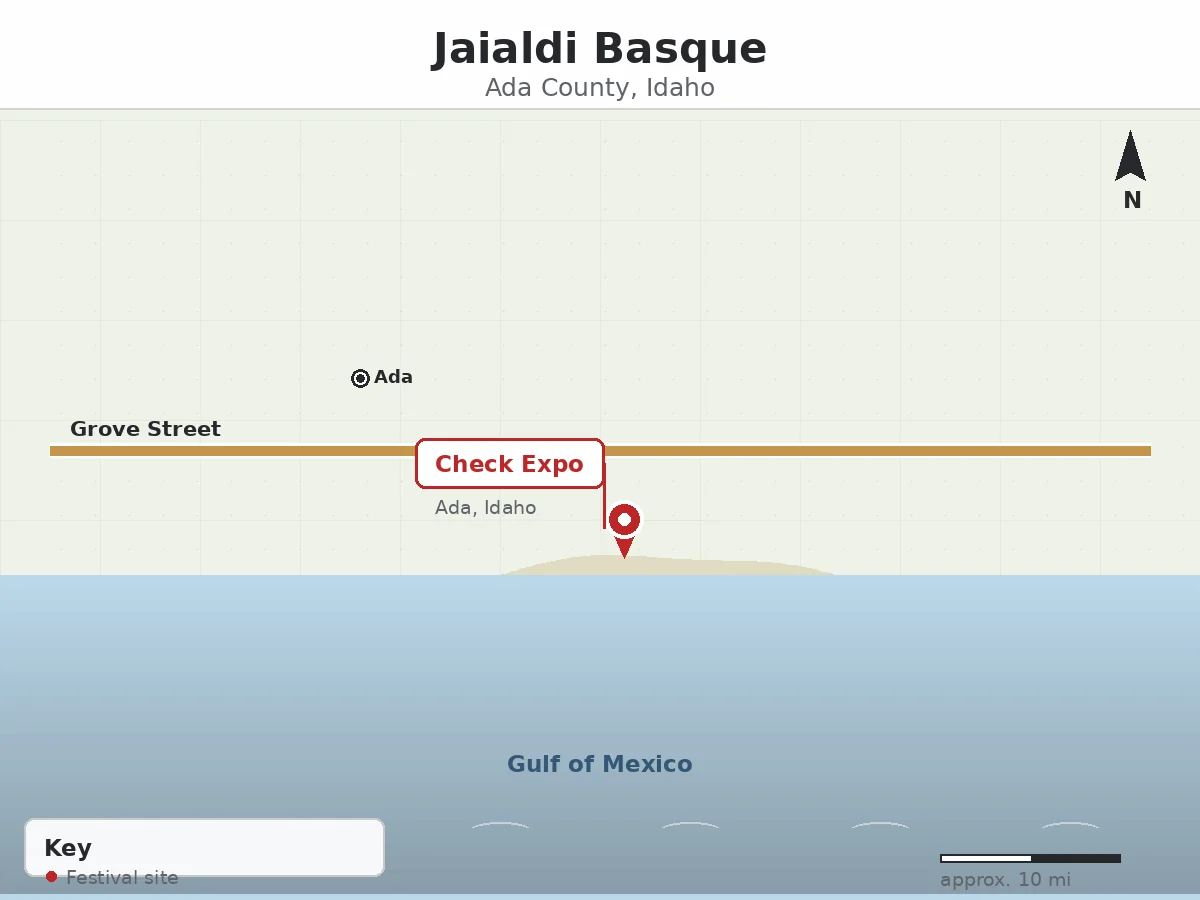
Jaialdi unfolds across downtown Boise, the seat of Ada County, rather than inside a single fenced ground. The organiser’s schedule layer for 2025 spreads the week across the Basque Block on the 600 block of Grove Street, the Idaho Central Arena, Expo Idaho, the Anduiza Fronton on West Grove Street, the Basque Center on Grove Street, and the Cathedral of Saint John the Evangelist on North Eighth Street. No one venue contains it, and no one description of who runs it holds across every layer. A museum layer states plainly that Jaialdi is an Euzkaldunak event — Euzkaldunak being the Boise Basque Center — and a Basque Government layer describes an event that members of the Euzkaldunak Basque Centre organise every five years. The organiser’s own pages frame the work differently, presenting a festival planned and staffed by volunteers across the years between editions without naming a parent body on its history page. Those two framings stand unmerged in this article: the museum and government attribution says whose event it is, and the organiser’s own framing says whose hands build it. The organiser’s history layer also characterises the gathering in fuller form as an international Basque festival, a description the sheet title’s plainer wording fairly reflects.
Quick Facts
| Item | Detail |
| Published name | Jaialdi |
| Host city | Boise, seat of Ada County |
| Cadence | Every five years |
| First edition | 1987, at the historic Old Idaho Penitentiary, per the organiser history layer |
| Latest documented edition | Tuesday, July 29 to Sunday, August 3, 2025 — the eighth Jaialdi |
| Organiser attribution | Euzkaldunak, the Boise Basque Center (museum and government layers); volunteer planning and staffing (organiser’s own pages) |
| Principal 2025 venues | Basque Block, Idaho Central Arena, Expo Idaho, Anduiza Fronton, Basque Center, Cathedral of Saint John the Evangelist |
| Admission | Most events free; Sports Night, Festara, Dantzaldi and the Expo Idaho programme ticketed; no prices appear in the record |
| Attendance | No counted figure; organiser-side claims of around thirty thousand |
| Next edition | Expected in 2030 per travel layers — an expectation, not an announced dated edition |
History
The organiser’s history layer tells the beginning as a single unrepeatable gesture: “The first Jaialdi was celebrated in 1987 at the historic Idaho State Penitentiary and was intended [as] a one-time-only event.” A destination layer prints the setting as the Old Idaho Penitentiary and agrees on the story’s shape without printing the 1987 year in the passage captured. The one-time event refused to stay one-time. In 1990, Governor Cecil Andrus asked for another Jaialdi to mark Idaho’s statehood centennial, and after that second edition the organisers settled on a recurring festival every five years. A museum layer lists the editions that followed: 1987, 1990, 1995, 2000, 2005, 2010 and 2015. News layers add a founder-era name, identifying Al Erquiaga as one of the creators of the first Jaialdi and of its first board of directors — a creator credit from those layers, not an organiser name form. One conflict stands open in the record and is recorded here unsettled: a Basque newspaper’s schedule layer describes the festival as taking place every five years since 1990, which sits against the organiser’s statement of a first edition in 1987, and nothing in the layers harmonises the two. The five-year rhythm then met a harder interruption. The 2020 edition was postponed through the pandemic and never took place, so when Jaialdi returned in 2025 it came back in its five-year format as the eighth edition — the organiser’s history layer calls it “our eighth International Basque Festival” — closing a ten-year absence since 2015.
What to Expect
Expect strength contests that treat farm labour as spectacle. The herri kirolak rural sports include weightlifting, wood chopping, hay bale throwing and wagon lifting, plus a human tractor-pull style drag described by a magazine layer. Expect speed at the Anduiza Fronton, where pilota and handball players work the court on West Grove Street. Expect dance in two registers: Boise’s own Oinkari Basque Dancers and visiting dancers from Oñati. The 2025 music bill, fenced to that edition in the organiser and news layers, named Gatibu, Xabi Aburruzaga, Amuma Says No and Neomak. Around the performances runs the food — Basque dishes and pintxos served across the venues — and quieter exhibits such as a sheep-wagon display and museum programming. The week also holds the Jaialdi Mass at the Cathedral of Saint John the Evangelist, and it is timed, per the organiser’s history layer, to the last week of July, around the Boise Basque community’s San Ignatius de Loyola celebration. The arena hosts Sports Night, Festara and Dantzaldi, while Expo Idaho carries the daytime programme.
Planning Your Visit
Begin from the five-year fact rather than from any single date: if Jaialdi is not happening this year, it is not happening next year either, and travel plans should bow to that arithmetic. For an edition year, anchor the week at the Basque Block, where the street dances billed as “Basque-ing on the Block” occupy the 600 block of Grove Street, and treat the arena and Expo Idaho as the week’s two poles — the arena for the ticketed evening components, Expo Idaho for the daytime programme, which the organiser’s schedule layer set at Saturday 10:00 a.m. to 5:00 p.m. and Sunday 11:00 a.m. to 4:00 p.m. in 2025. Budget with the organiser layer’s split in mind: most of the festival costs nothing, while Sports Night, Festara, Dantzaldi and the Expo Idaho “Basque-ing” programme are ticketed components. No ticket prices were captured in the layers searched, and no single general-admission price exists in the record, so any figure quoted elsewhere should be checked against the organiser’s own current materials before it is relied on. Contact details exist in organiser sources for those who need them.
For a useful comparison, see the Ada County Idaho Art in the Park Festival for another county festival.
A Sample Itinerary on the 2025 Shape
The following sketch follows the documented shape of the eighth edition, Tuesday, July 29 to Sunday, August 3, 2025, and is labelled as that edition’s shape rather than a promise about any future week. Open the festival on the Basque Block, where the street dances set the tone and the Basque Center anchors the neighbourhood’s own ground. Give one evening to the Idaho Central Arena — Sports Night puts the rural sports under a roof, with the lifting, chopping and throwing presented as headline contests. Spend a daytime session at the Anduiza Fronton watching pilota, the fastest game of the week played in the smallest room. Reserve Saturday for Expo Idaho’s daytime programme, running 10:00 a.m. to 5:00 p.m., and return Sunday for its shorter 11:00 a.m. to 4:00 p.m. session. Fit the Jaialdi Mass at the Cathedral of Saint John the Evangelist on North Eighth Street into the week’s quieter hours, and leave one arena night for Festara or Dantzaldi, where the dance programme takes the big floor.
How Jaialdi Compares
Jaialdi invites two confusions, and both deserve a clear answer. The first is Boise’s own San Inazio Festival, an annual Basque Block event: it shares the neighbourhood, the food and much of the community, but it is a separate, smaller gathering, and its facts are not Jaialdi’s. The second confusion travels further. Because jaialdi is simply the Basque word for a festival, celebrations carrying the name exist in the Basque Country and in other diaspora cities; those are separate events that share a generic word, not editions of the Boise festival, and none of their details are imported here. What separates Boise’s Jaialdi from nearly every other event in this series is the interval itself: an annual festival can have an off year, but a five-year festival turns each edition into a reunion that a whole community generation plans around.
Checklist
- Confirm the year first — Jaialdi runs on a five-year cycle, and most years hold no edition at all
- Plan around the Basque Block’s street dances on the 600 block of Grove Street
- Set aside money only for the ticketed components: Sports Night, Festara, Dantzaldi and the Expo Idaho programme
- Check Expo Idaho’s daytime hours before choosing a weekend day
- Visit the Anduiza Fronton for pilota at least once during the week
- Treat any attendance figure you meet as an organiser-side claim, not a count
- Keep 2030 in mind as an expectation to watch, not a date to book against
Beyond the Festival Week
The Basque Block rewards a visit in any year, edition or not: the Basque Center, the museum programming and the fronton belong to Boise’s permanent Basque geography, and the community they serve is present whether or not the festival is in town. A destination layer puts Boise’s Basque population at roughly sixteen thousand — community context for everything described here, and never an attendance figure for the festival itself. Travellers who miss an edition can still walk Grove Street, and travellers who catch one will find that the week leans on institutions that were standing long before the crowds arrived and remain after they leave. The festival itself never fully sleeps between editions, either: on the organiser’s own account, volunteers plan and staff the event across the intervening years, so the four quiet years are working years in which the next week’s venues, performers and contests are slowly assembled. That long preparation is part of why a single week can carry arena sports, fronton pilota, street dances, a Mass, museum programming and neighbourhood food without any one site bearing the whole load.
Why Jaialdi Matters
Jaialdi’s significance rests on scarcity honestly kept. The three crowd claims in the record — the organiser history layer’s “upwards of thirty thousand attendees at the last festival,” spoken of the 2015 edition in 2025 materials; a museum layer’s “draws in over thirty thousand attendees”; and a destination layer’s “typically draws thirty thousand-plus” — are organiser-side and destination-side claims, recorded unmerged, with no independently counted figure behind any of them. The article asserts none of them as a count. What can be asserted is structural: a diaspora community built a festival too large for an annual rhythm, gave it a five-year heartbeat, lost one edition to a pandemic, and still brought it back. That endurance, documented across the organiser, museum, government and news layers, is the festival’s real measure.
Frequently Asked Questions
Why does Boise wait five years between one Jaialdi and the next?
Because the organisers chose that rhythm after the second edition. The organiser’s history layer states that the 1987 festival was meant to be one-time-only, that Governor Cecil Andrus requested a return in 1990 for the statehood centennial, and that a recurring festival every five years was decided on afterwards. The museum layer’s edition list — 1987, 1990, then 1995 through 2015 at five-year steps — follows that decision, and 2025 resumed it.
Which parts of the week carry a ticket, and which parts cost nothing?
The organiser layer splits the week cleanly: most events are free, and four components are ticketed — Sports Night, Festara, Dantzaldi and the Expo Idaho “Basque-ing” programme. Those tickets buy entry to single components; they are not a general admission, and no layer searched published their prices. The street dances, the fronton and the Mass sit on the free side of the line as the record presents them.
Did the first Jaialdi really happen inside a penitentiary?
That is what the organiser’s history layer states: the first Jaialdi was celebrated in 1987 at the historic Idaho State Penitentiary, a destination layer printing the site as the Old Idaho Penitentiary. It was intended as a one-time-only event. One caution belongs with the story: a Basque newspaper’s schedule layer describes the festival as running every five years since 1990, which conflicts with the 1987 statement, and this article records the conflict rather than settling it.
How many people actually come — is there a counted figure?
The gathered layers contain claims, not a count. What exists are three assertions from the festival’s own side: upwards of thirty thousand at the last festival before 2025, per the organiser’s history layer; over thirty thousand drawn in, per a museum layer; and a typical thirty thousand-plus, per a destination layer. They agree in scale and differ in wording, and none was independently counted. The roughly sixteen thousand Basques a destination layer credits to Boise describe the host community, not a crowd.
What to Expect From the Next Ada County Idaho Jaialdi Basque Festival
How often is Ada County Idaho Jaialdi Basque Festival held?
Every five years. That cadence is the festival’s defining term, stated by the organiser’s history layer, reflected in the museum layer’s edition list, and confirmed even by the schedule layer that disagrees about the starting year. Any description of Jaialdi as an annual event misreads the record.
When is the next Ada County Idaho Jaialdi Basque Festival?
Travel layers expect an edition in 2030, following the five-year cycle forward from 2025. That is an expectation built on the cycle, not an announced dated edition: no organiser layer in the record publishes 2030 dates, venues or a programme. Watch for the organiser’s own announcement rather than treating the cycle’s arithmetic as a booking.
Will the dates change?
They have slipped before, at the largest possible scale. The 2020 edition was postponed through the pandemic and never held, stretching the gap between the 2015 and 2025 editions to ten years. Within an edition, the documented pattern places the week in the last days of July around the San Ignatius de Loyola celebration, as in 2025, but a future edition’s exact days remain the organisers’ to announce.
Closing
Jaialdi asks more of its audience than most festivals: five years of patience, repaid in a single dense week of sport, dance, food and memory on a few Boise streets. The record behind this article — organiser history and schedule layers, museum and government attributions, destination and news layers — agrees on the shape of that bargain even where it disagrees about a starting year. Boise, the seat of Ada County, keeps the other four years quietly. The fifth is worth the wait.
One Comment