Maui County Hawaii Emma Farden Sharpe Hula Festival
Each August, West Maui sets aside time for a gathering devoted wholly to hula, held in memory of one of the island’s most influential teachers. The Emma Farden Sharpe Hula Festival brings halau hula from across Maui together for performances in the ancient and modern styles, cultural workshops, craft vendors and live Hawaiian music, and it asks nothing at the gate: news layers bill it as free and family-friendly. Festivals of Aloha organises the event, and recent editions have unfolded in three quite different settings — beneath the Lahaina Banyan Tree, at a shopping centre in Kahului, and at a beachfront resort in Kāʻanapali. The documented run from 2022 through 2026 tells a story of a festival that kept its August appointment even after wildfire drove it out of its home town for a year.
About the Festival
The published name is consistent wherever the festival appears: organiser, tourism-authority and news layers all print “Emma Farden Sharpe Hula Festival”. The name honours Kumu Hula Emma Farden Sharpe, a revered Maui teacher who lived from 1904 to 1991 and who established Na Mele O Maui, a choral festival for Maui schools. Her dates belong to her biography; the festival that carries her name has its own, separate history, set out below.
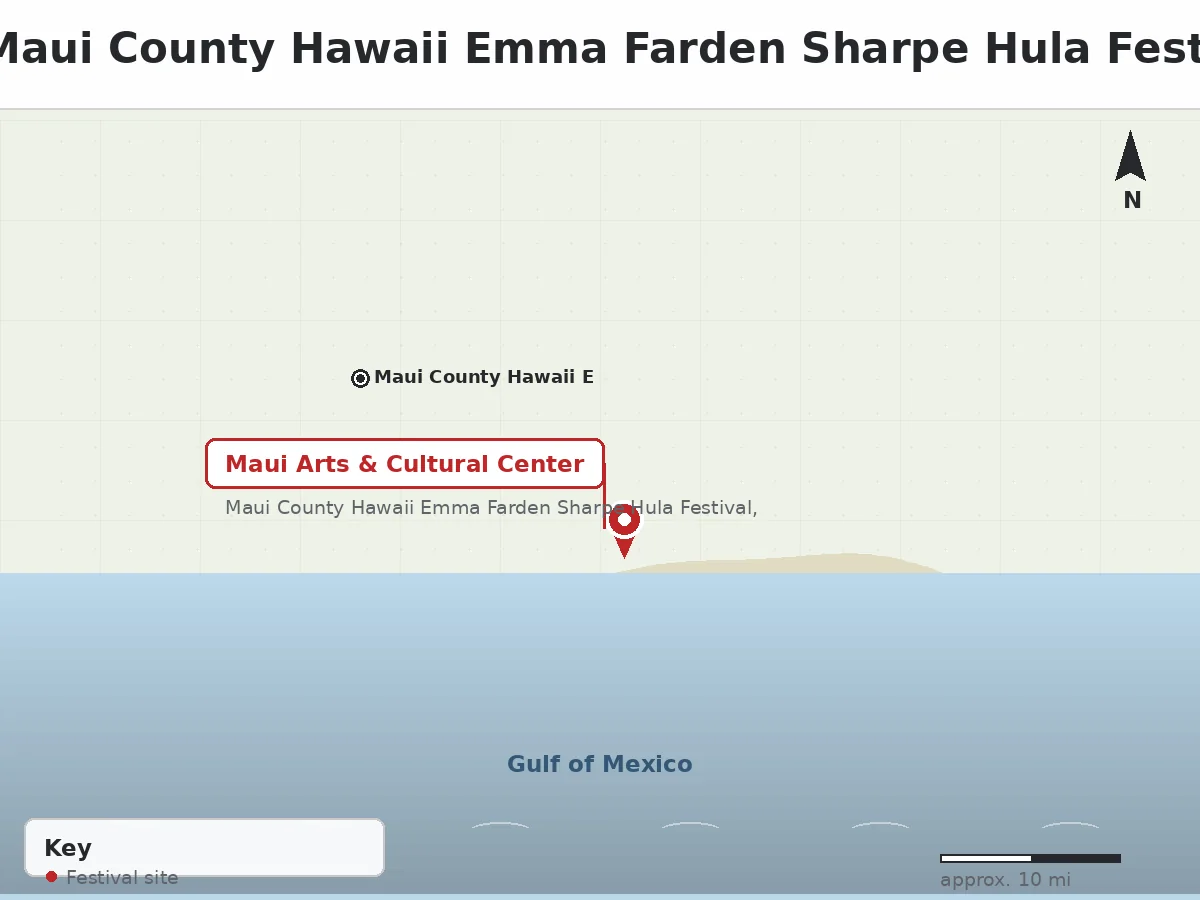
The host town is Lahaina, in West Maui. Lahaina is not the county seat — Wailuku is the seat of Maui County, and readers should not let the festival’s West Maui identity confuse the two. Most documented editions belong to Lahaina or its Kāʻanapali shore, though one edition, in 2024, was held in Kahului instead.
The organiser is Festivals of Aloha, the organisation named for the festival in the Hawaii Tourism Authority’s 2026 Community Enrichment Program list and the operator of the festival’s own web page. News layers name three supporters: the County of Maui Office of Economic Development, the Hawaii Tourism Authority and the Royal Lahaina Resort & Bungalows. Support is not organisation, and this article keeps the roles apart — a distinction that matters for the resort, which also served as the festival’s venue in 2025 and 2026 while remaining, in the record, a supporter rather than the organiser.
Quick Facts
| Item | Detail |
| Published name | Emma Farden Sharpe Hula Festival |
| Named for | Kumu Hula Emma Farden Sharpe (1904–1991) |
| Organiser | Festivals of Aloha |
| Supporters in news layers | County of Maui Office of Economic Development; Hawaii Tourism Authority; Royal Lahaina Resort & Bungalows |
| Host town | Lahaina, West Maui |
| County seat | Wailuku — Lahaina is not the seat of Maui County |
| Recent settings | Lahaina Banyan Tree; Queen Kaʻahumanu Center, Kahului; The Branches at Royal Lahaina Resort & Bungalows |
| Documented editions | August 2022, 2023, 2024, 2025 and 2026 |
| Admission | Free, per news and calendar layers |
| Published attendance | No figure appears in the layers gathered |
History
Emma Farden Sharpe’s own work came first. Alongside her teaching, she established Na Mele O Maui, a choral festival that brought Maui school singers together, and the hula festival grew out of that world. An encyclopedic layer records that the hula festival began as an extension of Na Mele O Maui, and the organiser’s own news layer says the same in nearly the same terms: the festival began as an extension of Na Mele O Maui and phased out in the early 1990s. For roughly two decades there was no hula festival of this line. Then, in 2014, it was restarted under a new name — the name it still carries — chosen to honour Sharpe herself.
For a useful comparison, see the Maui County Hawaii Hana Limu Festival for another county festival.
Honesty about the record matters here, in two respects. No layer gathered states a single founding year for the festival under its present name, and the undated extension era cannot be pinned to particular years from this record, so none are invented here. And 2014 is recorded as a restart, never as a founding: the present festival consciously revives an earlier one rather than beginning the line.
The modern documented run is August-shaped. On Saturday, August 27, 2022, the festival gathered beneath the Lahaina Banyan Tree from 9:00 a.m. to 5:00 p.m., billed in news layers as a return to an in-person event. It returned to the same ground on Saturday, August 12, 2023, with the same hours. Days earlier that month, wildfires had devastated Lahaina, and the 2024 edition was held away from the town: on Saturday, August 17, 2024, from 10:00 a.m. to 5:00 p.m., the festival met at Queen Kaʻahumanu Center in Kahului, an edition that included that year’s Legacy Award presentation. In 2025 the festival came back to West Maui, taking up residence at the Royal Lahaina Resort & Bungalows on August 22 and 23 — a move news layers billed as the festival’s return to West Maui for the first time since the 2023 wildfires. The 2026 edition stayed at the resort, running Friday, August 21, from 5:30 p.m. to 9:00 p.m., and Saturday, August 22, from 10:00 a.m. to 5:00 p.m.
What to Expect
Hula stands at the centre of the programme. Halau hula from across Maui perform in both kahiko, the ancient style, and ʻauana, the modern style, so a single day can move between chant-driven formality and the gentler, melodic dancing most visitors picture. Live Hawaiian music accompanies the performances, and historical exhibits — noted in the encyclopedic layer — place the dancing in a longer island story.
Around the stage, the festival is deliberately hands-on. Cultural workshops form part of the programme, and an organiser layer shows a workshop registration form; no price for the workshops is published in the layers gathered, so the form should be read as a sign-up mechanism and nothing more — it is not evidence of a fee. Keiki activities give children their own way into the day, and Hawaii-made artisan and craft vendors sell work produced in the islands. Each year the festival also presents its Legacy Award, honouring a figure in hula. The names belong to their years: the 2024 presentation honoured Carolee “Doll” Aricayos, and the 2025 spotlight fell on Phyllis Ross. Neither name should be carried into another year’s programme.
Planning Your Visit
Work backwards from the venue, because this festival has moved more than most. Three settings appear in the recent record — the Lahaina Banyan Tree in 2022 and 2023, Queen Kaʻahumanu Center in Kahului in 2024, and The Branches, the venue at the Royal Lahaina Resort & Bungalows on Kāʻanapali Beach, in 2025 and 2026 — and no layer presents any of them as a permanent home. Confirming which ground an edition uses matters more here than shaving minutes off the drive.
Hours shift by edition as well. The Banyan Tree years ran a single Saturday from 9:00 a.m. to 5:00 p.m.; the Kahului edition ran 10:00 a.m. to 5:00 p.m.; the 2026 resort edition split its time between a Friday evening, 5:30 p.m. to 9:00 p.m., and a Saturday from 10:00 a.m. to 5:00 p.m. News layers for 2025 and 2026 bill the festival as free and family-friendly, and a destination-style calendar layer simply marks it “Free”, so the documented price of entry is nothing — but no attendance figure is published in any layer gathered, which means nobody can honestly promise you a small crowd or a large one. Lahaina and Kāʻanapali sit along the same West Maui shore, while Kahului lies across the island’s waist near the airport; the edition’s setting decides which side of Maui your day belongs to.
A Sample Itinerary From the 2026 Edition
This itinerary follows the documented shape of the 2026 edition only — Friday, August 21 and Saturday, August 22, 2026, at The Branches at the Royal Lahaina Resort & Bungalows — and earlier editions were arranged differently.
- Friday evening: arrive for the 5:30 p.m. opening session and stay through the evening performances until 9:00 p.m., using the shorter night to learn the venue’s layout.
- Saturday morning: return for the 10:00 a.m. start, catch the early halau performances, and browse the Hawaii-made craft vendors between sets.
- Saturday midday: join a cultural workshop if places are offered, and give the keiki activities time if children are with you.
- Saturday afternoon: stay for the later performances and live music through the 5:00 p.m. close, the fullest stretch of the programme.
How This Festival Compares
The closest relative is also the easiest confusion. Na Mele O Maui, the school choral competition Sharpe founded, is this festival’s parent event, not the festival itself: the choral competition is still held separately, at the Maui Arts & Cultural Center, and its own history belongs to it. The hula festival began as that event’s extension and now stands on its own under Sharpe’s name; anything beyond that stated relationship — dates, results, participants — belongs to the parent event’s record, not this one. Within Lahaina, the Lahaina O-Bon Festival is likewise a separate event, a different observance in the same town with no connection to this gathering beyond geography. What sets the Sharpe festival apart from both is its single focus: a free, non-competitive August showcase in which Maui halau honour a teacher’s memory by dancing.
Visitor Checklist
- Confirm which venue the current edition uses before making travel plans; three different settings appear in the recent record.
- Note the edition’s hours, since the Friday-evening-plus-Saturday shape of 2026 differs from the single Saturdays before it.
- Treat admission as free, per the news and calendar layers, but do not assume workshops carry no arrangements — a registration form exists and no price is published.
- Arrive expecting halau performances in both kahiko and ʻauana styles across the day.
- Look out for the year’s Legacy Award presentation, honouring a figure in hula.
- Keep Na Mele O Maui and the Lahaina O-Bon Festival separate in your plans; they are distinct events.
- Do not rely on any crowd estimate — no attendance figure is published for this festival.
Beyond the Festival Grounds
The festival’s settings are destinations in themselves. The Lahaina Banyan Tree shades a full town block a few steps from the harbour, and an edition held beneath it is woven straight into the old town’s streets. The Kāʻanapali shore, where the Royal Lahaina Resort & Bungalows stands, is West Maui’s great resort beach, made for a swim before an evening session. And the 2024 setting, Queen Kaʻahumanu Center in Kahului, pairs naturally with the Maui Arts & Cultural Center nearby — the home of Na Mele O Maui, the parent event — letting a visitor trace both halves of Sharpe’s legacy in a single trip across the island.
Why This Festival Matters
Many festivals preserve a food, a crop or a craft; this one preserves a lineage of teaching. By carrying Emma Farden Sharpe’s name, the festival keeps her central idea in public view — that Maui’s own dancers and singers, taught well, are reason enough for a celebration. Its recent history deepens that meaning. A festival that lost its home ground to wildfire, met for a year in another town’s shopping centre, and then came back to West Maui has become part of Lahaina’s own story of persistence. That it remains free, open and family-friendly in the layers that bill it makes the tribute practical as well as ceremonial: the door is open to anyone who wants to watch Maui dance.
Frequently Asked Questions
Why did the 2024 edition take place in Kahului instead of Lahaina?
Because Lahaina was recovering from the August 2023 wildfires. News and organiser layers place the 2024 edition at Queen Kaʻahumanu Center in Kahului on Saturday, August 17, 2024, from 10:00 a.m. to 5:00 p.m. — the edition held away from Lahaina after the fires. The festival returned to West Maui in 2025, at the Royal Lahaina Resort & Bungalows, in what news layers billed as its first West Maui edition since the wildfires.
Is this festival the same event as Na Mele O Maui?
No. Na Mele O Maui is the school choral competition Emma Farden Sharpe founded, and it is still held separately at the Maui Arts & Cultural Center. The hula festival began as an extension of that competition, which makes Na Mele O Maui its parent event — related, but a different gathering with a different art form at its centre.
Has a hula festival carried Sharpe’s name from the very beginning?
No, and the record is clear about the sequence. The hula festival began as an extension of Na Mele O Maui, phased out in the early 1990s, and was restarted in 2014 with the new name honouring Sharpe. The 2014 date is a restart, not a founding, and no layer gathered states a single founding year for the festival under its present name.
What does the workshop registration form mean for visitors?
Workshops are part of the festival, and the organiser’s layer shows a registration form for them. No price for the workshops is published in the layers gathered, so the form cannot honestly be read as a fee — it is a sign-up step, and visitors should treat it as exactly that unless a future edition’s own material says more.
What to Expect From the Next Maui County Hawaii Emma Farden Sharpe Hula Festival
How often is Maui County Hawaii Emma Farden Sharpe Hula Festival held?
The documented editions fall in August of each year from 2022 through 2026, which gives the festival a clear yearly rhythm in the recent record. That pattern describes the editions the layers document; it is the strongest guide a reader has, though it rests on news and organiser layers rather than on any charter or rule printed in them.
When is the next Maui County Hawaii Emma Farden Sharpe Hula Festival?
The latest documented edition is August 21–22, 2026, at the Royal Lahaina Resort & Bungalows. No 2027 edition is announced in the record gathered, so no future date can be stated as confirmed. A further August edition would fit the documented pattern, and nothing more definite should be claimed until the organiser publishes it.
Will the dates change?
They have moved before in everything but month. Editions have shifted between a single Saturday and a Friday-plus-Saturday span, hours have varied from year to year, and the venue has changed three times in five editions — including one year spent in Kahului. August has held steady across the documented run, but the exact days, hours and setting of any future edition remain the organiser’s to announce.
Closing
The Emma Farden Sharpe Hula Festival is a small festival with a long memory: an extension of a school choral competition that fell silent in the early 1990s, revived in 2014 under its teacher’s name, and carried through wildfire and displacement back to West Maui’s shore. For a visitor, it offers something rarer than spectacle — Maui halau dancing, free of charge, in honour of the woman who taught Maui to value its own performers.
One Comment