Honolulu County Hawaii Greek Festival
Honolulu’s Greek Festival is a two-day celebration of Greek food, music and dancing staged at McCoy Pavilion in Ala Moana Beach Park, and it belongs to Saints Constantine and Helen Greek Orthodox Cathedral of the Pacific, whose parish treats the weekend as its annual fundraising event. The organiser publishes it simply as the Greek Festival, while parish and encyclopaedic layers call it the Annual Greek Festival, and the two name forms are left standing side by side rather than merged. Honolulu is the seat of the City and County of Honolulu, and the pavilion sits within the city’s great beachfront park, giving the weekend an open-air character unlike a church-hall fair. Much of its paper trail runs through newspapers, magazines and visitor guides rather than through the parish itself, so this account keeps those layers separate and says plainly where each fact comes from.
About the Festival
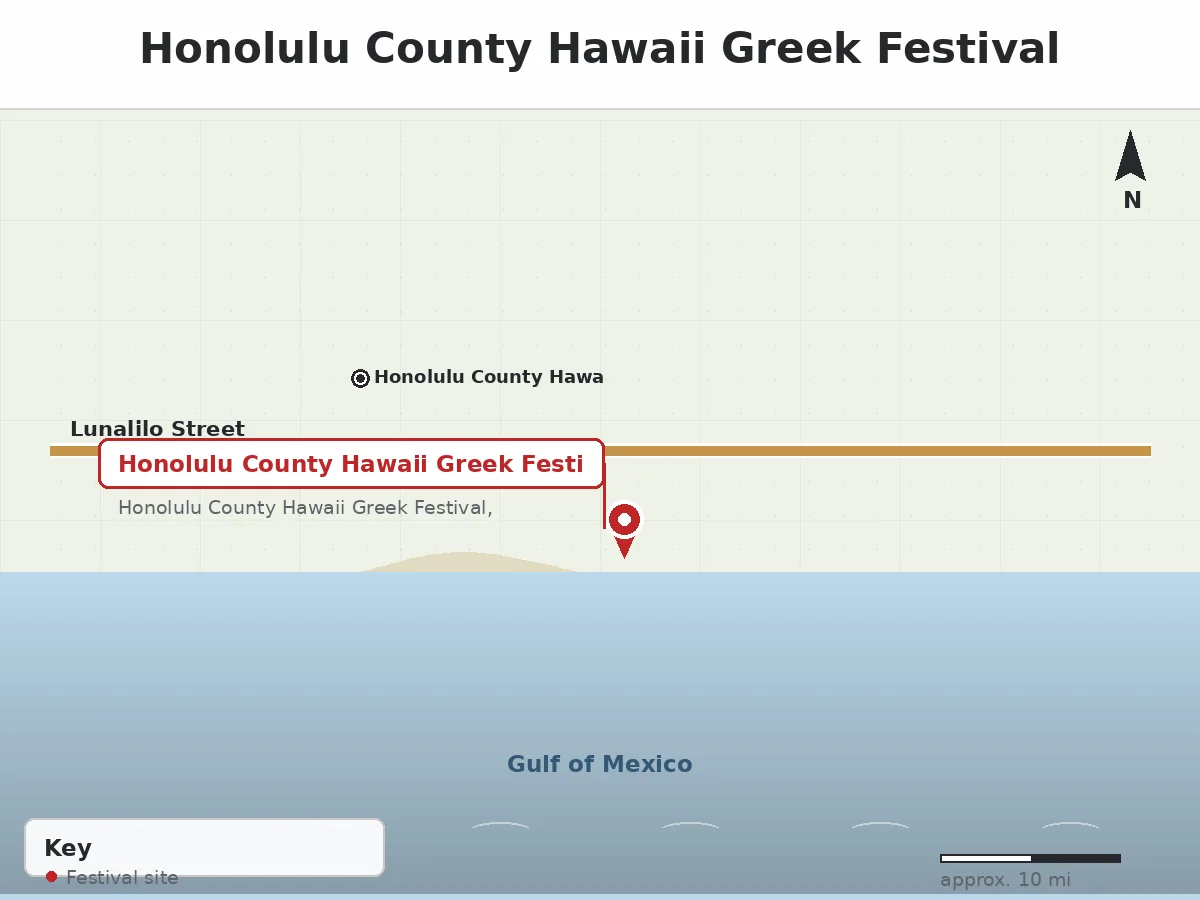
The festival is the cathedral parish’s annual fundraising event, a point on which the organiser layer and a magazine layer agree: the money raised supports the parish rather than a commercial promoter. The cathedral itself, Saints Constantine and Helen Greek Orthodox Cathedral of the Pacific, stands on Lunalilo Street according to a parish layer, but that church address is not where the festival happens: every layer gathered places the event at McCoy Pavilion in Ala Moana Beach Park. Keeping the two apart matters: a visitor who navigates to the church will find the parish building, not the festival grounds. The parish is a Greek Orthodox cathedral community, and the festival carries its culture outward — Greek cooking, Greek music, Greek dancing and church-related exhibits presented to the general public of Honolulu. In that sense the weekend works in two directions at once, sustaining the parish financially while introducing its heritage to neighbours who may never attend a service.
Quick Facts
| Item | Detail |
| Published names | Greek Festival (organiser layer); Annual Greek Festival (parish and encyclopaedic layers) |
| Organiser | Saints Constantine and Helen Greek Orthodox Cathedral of the Pacific, Honolulu |
| Role of the event | The cathedral parish’s annual fundraising event |
| Venue | McCoy Pavilion, Ala Moana Beach Park, Honolulu |
| Address form | 1201 Ala Moana Boulevard, as printed in a 2014 visitor-guide layer |
| Host city status | Honolulu is the seat of the City and County of Honolulu |
| Traditional shape | Two days in late August, noon to 9:00 p.m. in multiple layers |
| Founding year | Not stated explicitly in any source captured; billings only |
| Highest settled billing | Thirty-seventh Annual, held October 27–28, 2018 after a hurricane postponement |
| Published attendance | Some fifteen thousand people across two days in 2003, an organiser claim carried by a newspaper layer |
History
No source captured states the festival’s founding year outright, and this account does not invent one by counting backwards from the annual billings. What the record offers instead is a sequence of numbered editions reported by newspapers and other layers across fifteen years. A newspaper layer bills the 2003 edition the twenty-third Annual, and the same newspaper’s coverage calls the 2006 event the twenty-sixth Annual and the 2007 event the twenty-seventh Annual. A local blog and news layer bills the 2012 edition the thirty-second Annual, while event and news layers bill the gathering of August 26 and 27, 2017 the thirty-sixth Annual. A magazine layer then bills the 2018 edition the thirty-seventh Annual and explains that it ran on October 27 and 28 of that year because it had been postponed from its usual August slot on account of Hurricane Lane. Against that whole sequence stands one conflicting billing: a guide layer advertises a thirty-eighth Annual for August 2026, a number that does not reconcile with the thirty-sixth and thirty-seventh billings of 2017 and 2018, and no arithmetic is performed here to force it into line. The guide layer’s figure is therefore recorded as a conflicting listing-layer billing and nothing more: it proves neither when the festival began nor what its current numbering is. The honest summary is that the festival was already in its twenty-third numbered year by 2003 and was still being staged at McCoy Pavilion in 2018, with its deeper origins unstated in the material gathered.
What to Expect
The programme layers describe a festival built first around food. Greek food booths and a taverna anchor the grounds in the layers that describe them, with pastries alongside and a deli and imported goods for visitors who want to carry something home. Live Greek music supplies the soundtrack: a magazine layer names the Hellenic Sounds band, while folk dancing appears across the programme layers as a recurring element. Church-related exhibits round out the picture, connecting the food and entertainment back to the parish that stages the weekend. These elements vary by year and by layer; what stays consistent is the combination of eating, listening, watching dancers and browsing. The pavilion setting keeps the weekend under cover, with the beach park around it for families drifting in and out across the two days.
Planning Your Visit
Think first about which facts are firm and which are not. The firmest ground is the traditional shape: multiple layers describe two days in late August running from noon to 9:00 p.m., although a 2012 layer gives the Sunday closing as 8:00 p.m., and that earlier closing is left standing unmerged beside the more common nine o’clock form rather than being resolved. The recent dates are genuinely unsettled. A recent magazine layer describes the festival as still held at McCoy Pavilion and gives August 29 and 30 as this year’s dates, in that layer’s own framing, while a low-trust tour-aggregator layer instead lists September 2026 with dates still to be announced. Neither layer is organiser-published, the two conflict, and this article crowns neither: anyone planning around a specific weekend should confirm dates through the parish before travelling. Admission information likewise comes only from guide and news layers, because the organiser material captured publishes no price at all. Layers from 2006, 2007, 2014 and 2018 state three dollars; a 2014 guide layer and a 2018 magazine layer say, in varying wording, that children eleven and under and active military enter free; a 2018 guide layer mentions one dollar for attendees wearing a toga; and the 2018 magazine layer notes cash only. Those figures are reported here as the historical guide-layer record, not as a current price list published by the parish.
For a useful comparison, see the Honolulu County Hawaii Waikiki Spam Jam Festival for another county festival.
A Sample Itinerary in the Festival’s Traditional Shape
The day sketched below follows the festival’s traditional documented shape — two late-August days at McCoy Pavilion running from noon into the evening — and is offered as a picture of that shape, not as a confirmed schedule for any coming year. Arrive near the noon opening, when the food booths are freshest and the pavilion is at its calmest, and make a first circuit of the grounds to see which booths and deli offerings are running that year. Eat the savoury course early from the taverna plates, then let the afternoon carry the entertainment: settle where the live Greek music is playing, watch the folk dancing when it takes the floor, and leave space between courses for the church-related exhibits. Return to the pastry booths later in the day for sweets, browse the imported goods before the light fades, and stay toward the evening close, which most layers place at 9:00 p.m. On the second day, reverse the order — music and exhibits first, the dishes you missed second — so the weekend feels like two different visits rather than one repeated.
How It Compares
Two confusions shadow this festival’s name, and both are worth clearing away. The first is geographic: a mainland parish of the same cathedral name, in Illinois, publishes near-identical Greekfest bulletin material, and several such bulletins surfaced during research only to be excluded: that parish’s dates and details belong to a different mainland event and have never been used here. Anyone searching the festival’s name should check that what they are reading concerns Honolulu and McCoy Pavilion before trusting its dates. The second confusion is calendrical: Honolulu’s Korean Festival is a separate event that is sometimes co-listed in August guides, so a shared month and a shared guide page do not make the two festivals related. Within Honolulu’s own late-summer calendar, the Greek Festival’s distinguishing marks are its parish ownership, its fundraising purpose and its pavilion home in Ala Moana Beach Park, none of which the co-listed events share.
Visitor Checklist
- Confirm the current year’s dates through the parish before fixing travel, because the recent magazine and aggregator layers disagree.
- Bring cash; a 2018 magazine layer noted cash only, and the parish publishes no card policy in the captured material.
- Budget against the guide-layer record — three dollars in the 2006, 2007, 2014 and 2018 layers — while expecting that a current price may differ.
- Aim for the noon opening on at least one day to reach the food booths before the grounds fill.
- Check which layers’ programme elements are running this year, since booths, music and exhibits vary by edition.
- Navigate to McCoy Pavilion in Ala Moana Beach Park, at the 2014 guide layer’s address of 1201 Ala Moana Boulevard — not to the cathedral on Lunalilo Street.
- Consider the toga detail with a smile: a 2018 guide layer put admission at one dollar for attendees wearing one.
Beyond the Festival
The festival sits inside a wider parish and neighbourhood life that a visitor can sample in the same trip. The cathedral on Lunalilo Street is the community’s everyday home, and while it is not the festival venue, its presence explains the festival: the food booths, the dancing and the exhibits are an outward expression of a congregation that worships there year-round. Ala Moana Beach Park, the pavilion’s setting, is one of Honolulu’s great public waterfront spaces, so a festival afternoon pairs naturally with the beach. The festival also belongs to the city’s late-summer festival season, when guide pages group it with other August events — including the separate Korean Festival — giving visitors a cluster of cultural weekends in the same part of the calendar.
Why This Festival Matters
A parish festival that newspapers were already numbering in the twenties by 2003 has plainly been part of Honolulu’s civic rhythm for a long time, even if the gathered sources never state its first year. Its significance runs in several directions. For the cathedral parish, it is the annual fundraising engine, the weekend on which the community’s cooking and labour convert directly into support for its work. For Honolulu, it is one of the city’s durable ethnic festivals, a standing invitation for residents of every background to eat, listen and dance inside Greek culture for two days a year. And for the historical record, its single published crowd figure — some fifteen thousand people over the two days in 2003, an organiser claim carried by a newspaper layer — hints at the scale the weekend had already reached by then, though no later figure was captured and none is asserted here for any other year.
Frequently Asked Questions
Why do the numbered editions not line up with the newest billing?
Because the billings come from different layers of different ages. Newspaper and event layers bill 2017 the thirty-sixth Annual and 2018 the thirty-seventh Annual, which form a consistent pair, while a guide layer bills a thirty-eighth Annual for August 2026, which does not follow from them. This article records each billing with its layer, performs no arithmetic to repair the sequence, and treats the guide figure as a conflict in the listing record rather than as settled fact.
What do the guide layers say about getting in?
Only the guide and news layers discuss admission at all; the organiser material captured publishes no price. Those layers state three dollars for 2006, 2007, 2014 and 2018, describe children eleven and under and active military as entering free in varying wording, mention one dollar for attendees wearing a toga in a 2018 guide layer, and note cash only in the 2018 magazine layer. Read them as the historical published record, and expect the parish’s current terms to be confirmed directly.
Is the festival held at the cathedral itself?
No. The cathedral stands on Lunalilo Street according to a parish layer, and it is the parish’s home, but every layer gathered places the festival at McCoy Pavilion in Ala Moana Beach Park. The church is the organiser and beneficiary; the pavilion is the venue, and visitors should head for the beach park.
When is the festival on most recently?
That is the record’s open question. A recent magazine layer describes the festival as still held at McCoy Pavilion and gives August 29 and 30 as this year’s dates, while a low-trust tour-aggregator layer lists September 2026 with dates to be announced. The layers conflict, neither comes from the organiser, and this article presents no 2026 date as confirmed; the traditional shape in the older layers is two days in late August.
What to Expect From the Next Honolulu County Hawaii Greek Festival
How often is Honolulu County Hawaii Greek Festival held?
The layers describe an annual parish event with a traditional two-day shape in late August, and the billings across 2003 to 2018 follow an annual rhythm, including one edition displaced to October by a hurricane. Nothing in the gathered record suggests the parish has abandoned that annual pattern, though the record also shows the pattern can bend when weather intervenes.
When is the next Honolulu County Hawaii Greek Festival?
No organiser-confirmed date for a next edition appears in the material gathered. The traditional expectation would be two days in late August at McCoy Pavilion, but the recent magazine layer’s August 29 and 30 and the aggregator layer’s September 2026 point in different directions, so the honest answer is that the next date awaits confirmation from the parish itself.
Will the dates change?
They have changed before: the 2018 edition moved from August to October 27 and 28 because of Hurricane Lane, and the traditional hours are not perfectly uniform across layers either, with one 2012 layer closing Sunday an hour earlier. A festival at an open beach-park pavilion in hurricane season carries that flexibility in its history, so future dates should always be treated as provisional until the parish confirms them.
What endures, whatever weekend the parish next chooses, is the combination itself: a cathedral community cooking for its city at a beach-park pavilion, with music, dancing and pastries doing the fundraising. The paperwork around this festival is thinner and more quarrelsome than its organisers probably realise — conflicting billings, guide-layer prices, dates in dispute — but the event underneath the paperwork has been drawing Honolulu crowds since at least its twenty-third numbered year, and the layers agree on the thing that matters most: it is still the parish’s weekend, at McCoy Pavilion, in late summer.
One Comment