Honolulu County Hawaii Waikiki Spam Jam Festival
For one Saturday evening each spring, a stretch of Kalākaua Avenue in Waikīkī fills with cooking booths, music stages and crowds tasting dishes built around a single canned meat. The event reaches print in two name forms the record never merges: organiser and press-release layers style it the Waikiki SPAM JAM Festival, while the organiser’s website uses the title-case form Waikiki Spam Jam. Honolulu, the city around it, is the seat of the City and County of Honolulu, and this is a street festival on the city’s best-known visitor avenue rather than a gathering on a fairground. An organiser press release states that the first festival was held in 2002; the latest documented edition, billed as the twenty-second Annual, took place on April 25, 2026. Entry is free in every layer that addresses price, and recent editions have directed their benefit to the Hawaiʻi Foodbank. The record behind the festival also carries real disagreements — over which stretch of the avenue it occupies, over when the idea behind it first surfaced, and over how many people it truly draws — and those are reported here as disagreements, not smoothed away.
About
The Waikiki Spam Jam is a single-evening street festival: one avenue, dozens of booths, and one ingredient interpreted as many ways as the cooks can manage. The organiser’s 2026 news layer describes more than forty booths and three stages of live entertainment, alongside a SPAM-themed drone show, the whole programme running from 4:00 p.m. to 10:00 p.m.
Credit for the event is carried in several forms that are never collapsed into one. A 2016 organiser press release describes the festival as presented by Outrigger Resorts. Outrigger’s own story layer and a brand story layer credit co-founders Barbara Campbell and Bitsy Kelley, both of Outrigger, with the idea itself. Separately, the festival organisation publishes the official site and its own news pages. The beneficiaries stand apart from all of these credits: the Hawaiʻi Foodbank is named as beneficiary in all recent layers, and the 2026 layer adds the Waikīkī Community Center and the Visitor Aloha Society of Hawaiʻi as beneficiaries. Receiving the benefit is not the same as organising the festival, and no layer presents any beneficiary as its organiser.
Quick Facts
| Item | Detail |
| Published names | Waikiki SPAM JAM Festival in organiser and press-release layers; Waikiki Spam Jam in the organiser website’s title-case form |
| Host city | Honolulu, seat of the City and County of Honolulu |
| Setting | A street festival on Kalākaua Avenue in Waikīkī |
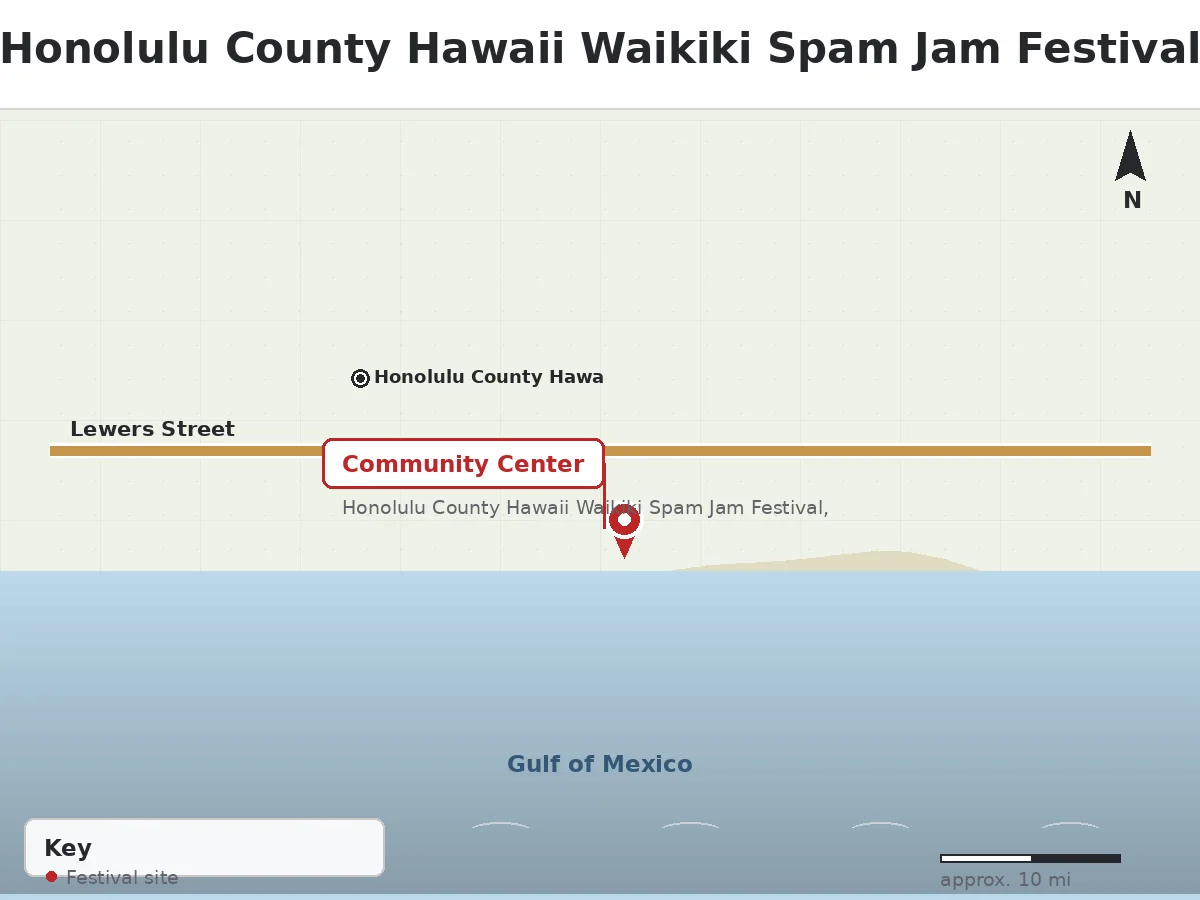
| Avenue span | Given two ways in the layers and never settled: between Seaside and Liliʻuokalani avenues, or from Lewers Street to Kaiulani Avenue |
| First held | 2002, as stated in an organiser press release; the earlier idea is dated 1999, 2000 and 2001 in three separate layers, and no idea year is treated as the founding |
| Latest documented edition | Twenty-second Annual, Saturday, April 25, 2026, 4:00 p.m. to 10:00 p.m. |
| Admission | Free in every layer that states it; no organiser layer publishes any admission price |
| Programme in 2026 | More than forty booths, three stages of live entertainment and a SPAM-themed drone show |
| Beneficiaries | Hawaiʻi Foodbank in all recent layers; the 2026 layer adds the Waikīkī Community Center and the Visitor Aloha Society of Hawaiʻi |
| Attendance | No counted figure exists anywhere in the record; every number published is a claim or an expectation |
History
The trail behind this festival divides into two separate questions, which the sources answer with very different confidence. For the first edition itself, an organiser press release carried by a wire service is unusually direct, stating in its own wording: “Since the very first Waikiki SPAM JAM in 2002.” The stated 2002 beginning is the founding this article reports.
When the idea arose is another matter, and the layers give three answers. A brand story layer dates the idea to 1999. A wire release ties the idea to National Housekeepers Week and dates it to 2000. Outrigger’s own story layer dates it to 2001 and says the first festival followed nine months later. Those three accounts stand side by side here, unmerged and uncrowned: an idea year is not a founding year, and none of the three is presented as one.
For a useful comparison, see the Honolulu County Hawaii Honolulu Pride Festival for another county festival.
The billings that survive mark the festival’s growth without being converted into a chronology of their own. A brand layer bills the May 2, 2015 edition as the thirteenth Annual, and an organiser press release bills April 30, 2016 as the fourteenth Annual. The run then breaks. A wire layer states that the festival returned on April 29, 2023 “after a three-year hiatus” — that is the whole of what the layer says, it offers no cause, none is invented here, and the missing seasons are not reconstructed. After the return, a travel-newsletter layer bills April 26, 2025 as the twenty-first Annual, while a news layer and the organiser site’s news page bill April 25, 2026 as the twenty-second Annual. The organiser’s Past Festivals page and news layers date the recent run exactly: April 27, 2024, April 26, 2025 and April 25, 2026, each running from 4:00 p.m. to 10:00 p.m.
What to Expect
The shape documented for 2026 is a dense, self-contained evening. More than forty booths line the closed avenue, each serving the canned meat in its own preparation, so the core activity is grazing: walk, taste, compare, and walk some more. Three stages of live entertainment run through the evening, and a SPAM-themed drone show gives the night a programmed spectacle above the street. Because everything happens inside six hours on one stretch of road, the festival rewards arriving near the start rather than expecting a sprawling all-day fair.
Around the festival day sits a component that should not be mistaken for the festival itself. The “Dine-In SPAM” restaurant promotion ran from April 18 to May 3, 2026, at participating Waikīkī restaurants. It belongs to the wider programme, but it is a promotion spread across more than two weeks of dining rooms; the festival is the single Saturday evening on Kalākaua Avenue, and the promotion’s dates are never the festival’s dates.
Planning Your Visit
Everything about attending turns on one fixed point: the festival occupies a single Saturday evening, documented most recently from 4:00 p.m. to 10:00 p.m., so there is no second day to fall back on if the evening is missed. Admission costs nothing in every layer that states it, and no organiser layer publishes a price of any kind, which makes this an unusually simple event to budget for — the spending happens at the booths, not at a gate.
The one genuine uncertainty to plan around is the footprint. A television-station guide published on the organiser’s own site in 2026 places the festival between Seaside and Liliʻuokalani avenues, while a festival-guide layer describes it as running from Lewers Street to Kaiulani Avenue. Neither form is settled, and this article does not choose between them. The practical response is to allow for the central Waikīkī stretch of Kalākaua Avenue generally, to confirm the current year’s layout through the organiser’s news pages before travelling, and to treat the avenue itself, rather than any single address, as the destination. Booths draw their longest lines early, and the drone show is an after-dark pleasure worth staying for.
A Sample Evening at the 2026 Festival
This sample follows the documented shape of Saturday, April 25, 2026, the twenty-second Annual edition.
Arrive on Kalākaua Avenue before 4:00 p.m. and walk the full festival stretch once without buying anything, noting which booths are drawing lines. Spend the first hour on the signature dishes, while queues are shortest. As the evening settles, divide time between the three stages, catching a full set rather than fragments of several. Keep the middle of the evening flexible so a second pass can revisit the booth your group is still talking about. Stay through the closing hours for the drone show overhead, and let the 10:00 p.m. finish return you to the ordinary Waikīkī night.
How It Compares
Most food festivals of this scale sit behind gates on fixed grounds, run for whole weekends and charge admission; this one closes a public avenue for six hours, charges nothing in any layer that states a price, and is over by 10:00 p.m. Its closest relatives in the record are also its easiest confusions. The brand owner’s other promotions share a product and a marketing family, but they are not this festival: the Waikiki Spam Jam is a specific Honolulu street event with its own founders, billings and history. Likewise, the Dine-In SPAM restaurant promotion is a component arranged around the festival, not a rival event and not a separate festival in its own right. The fair comparison is with other big street closings: a free, single-evening occupation of a famous avenue, carried by booths rather than by a gated programme.
Checklist
- Confirm the current year’s Saturday and date through the organiser’s own news pages before booking any travel
- Plan around the documented hours of 4:00 p.m. to 10:00 p.m., with no second day in reserve
- Allow for either published avenue span, since the layers disagree about the exact stretch
- Budget for booth dishes rather than admission, which is free in every layer that states it
- Arrive near the 4:00 p.m. start, when signature booths have their shortest lines
- Leave room in the evening for a full set at one of the three stages
- Stay after dark for the SPAM-themed drone show documented in the 2026 programme
- Treat the restaurant promotion’s longer run of dates as separate from the festival day itself
- Remember the benefit: recent editions direct it to the Hawaiʻi Foodbank
Beyond the Festival
Waikīkī does not empty when the festival ends. The neighbourhood is Honolulu’s visitor shoreline, a dense strip of hotels, shops and beach along the same avenue the festival borrows, so the evening extends into the surrounding streets rather than concluding at a gate. The restaurant promotion adds a slower way into the same theme: across its run from April 18 to May 3, 2026, participating Waikīkī restaurants served their own dishes built on the same ingredient, at ordinary tables, on ordinary nights. A visitor can thus meet the festival’s idea at two tempos — as a crowd in a closed street, and as a single plate in a quiet room.
Why It Matters
The festival’s significance rests on documented ground rather than on its crowd claims. A free street festival, first held in 2002 by the stated organiser account, that survives a three-year hiatus and returns to be billed the twenty-second Annual in 2026 has demonstrated staying power. Its benefit structure gives the evening a purpose beyond eating: recent layers direct that benefit to the Hawaiʻi Foodbank, and the 2026 layer widens it to the Waikīkī Community Center and the Visitor Aloha Society of Hawaiʻi. What the record will not support is a precise measure of its size. The claims are generous, but they are claims, and the honest summary is that this is a large, long-lived, free celebration whose exact scale nobody in the record has ever counted.
Frequently Asked Questions
Which stretch of Kalākaua Avenue does the festival really take over?
The record gives two answers and settles neither. A television-station guide published on the organiser’s own site for 2026 places the festival between Seaside and Liliʻuokalani avenues. A festival-guide layer instead describes it as running from Lewers Street to Kaiulani Avenue. Visitors should plan for the central Waikīkī stretch of the avenue and confirm the current layout near the date.
Did the festival begin in 1999, in 2000, or in 2001?
None of those years is presented as its founding. They are idea years, each from a different layer: a brand story gives 1999, a wire release tied to National Housekeepers Week gives 2000, and Outrigger’s own story gives 2001, adding that the first festival followed nine months later. The founding the record states outright is the first festival itself, held in 2002 per an organiser press release.
Is the Dine-In SPAM restaurant promotion a separate festival?
No. It is a component promotion arranged around the festival, running from April 18 to May 3, 2026 at participating Waikīkī restaurants. It is neither a rival event nor a second festival, and its longer run of dates should never be read as the festival’s dates — the festival is one Saturday evening on Kalākaua Avenue.
How many people actually attend the Waikiki Spam Jam?
Nobody in the record has counted. The figures that exist are claims, kept separate here: an organiser press release in 2016 said more than twenty-five thousand festivalgoers were expected, which is an expectation rather than a count; co-founder Barbara Campbell put the figure at roughly thirty thousand in a podcast layer; a Hawaiʻi Foodbank vice-president put it at forty thousand in the same kind of layer, and a weak blog layer said nearly forty thousand.
What to Expect From the Next Honolulu County Hawaii Waikiki Spam Jam Festival
How often is Honolulu County Hawaii Waikiki Spam Jam Festival held?
The documented pattern is a single Saturday evening in late April, billed in annual terms — the thirteenth Annual in 2015 through the twenty-second Annual in 2026. The pattern is not unbroken, though: a wire layer records a three-year hiatus before the return on April 29, 2023, so the annual billing describes the rhythm of its running years, not a guarantee for every year.
When is the next Honolulu County Hawaii Waikiki Spam Jam Festival?
No 2027 edition is announced anywhere in the record. The latest documented festival is the twenty-second Annual on April 25, 2026, and recent editions cluster on late-April Saturdays — April 27 in 2024, April 26 in 2025 and April 25 in 2026. A future edition would be expected to follow that pattern, but no specific future date is confirmed or stated here as announced.
Will the dates change?
The recent evidence points both ways. The day, the season and the hours have been steady across the documented run — a late-April Saturday, 4:00 p.m. to 10:00 p.m. — which suggests continuity. Against that, the three-year hiatus shows the festival can pause entirely, so steadiness is a pattern to plan around rather than a promise, and each new date needs confirming when the organiser publishes it.
Closing
The Waikiki Spam Jam is, on the documented evidence, a durable piece of Honolulu street life: an idea three layers date three different ways, a first festival firmly stated for 2002, a free evening of booths and stages on Kalākaua Avenue, and a benefit directed in recent years to feeding Hawaiʻi. Its record rewards readers who keep its certainties and its claims in separate piles — and rewards visitors, in its running seasons, with dinner served an entire avenue at a time.