Lowndes County Georgia Hahira Honeybee Festival
Hahira is a small town in Lowndes County, Georgia, and for one week in early autumn its downtown belongs to a honeybee. The Lowndes County Georgia Hahira Honeybee Festival spreads along Main Street and curls around the town’s Community Train Depot, and the published record behind it is unusually tidy: an organiser that states plainly who founded the event and when, dated editions for two recent years, and a day-by-day programme for the most recent week. Hahira is not the seat of Lowndes County, since that distinction belongs to Valdosta.
Even the event’s name arrives in more than one spelling. The organiser publishes it as the Hahira Honeybee Festival, with the insect’s name written as a single word, while listing and vendor layers print Hahira Honey Bee Festival in separate words, and the organiser’s own site styles its title as The Hahira Honeybee. This article keeps those forms side by side exactly as their layers print them, treating each source as a separate witness.
About the Festival
The festival is run by the Hahira Honeybee Festival Committee, which shortens its own name to HHBFC on the organiser’s pages. A news layer describes that committee as an independent nonprofit staffed entirely by volunteers, nicknamed the Busy Bees. The City of Hahira helps during festival week by providing city services, and the record is careful about the limits of that role: municipal assistance keeps the week functioning, but no layer credits the city with organising the festival.
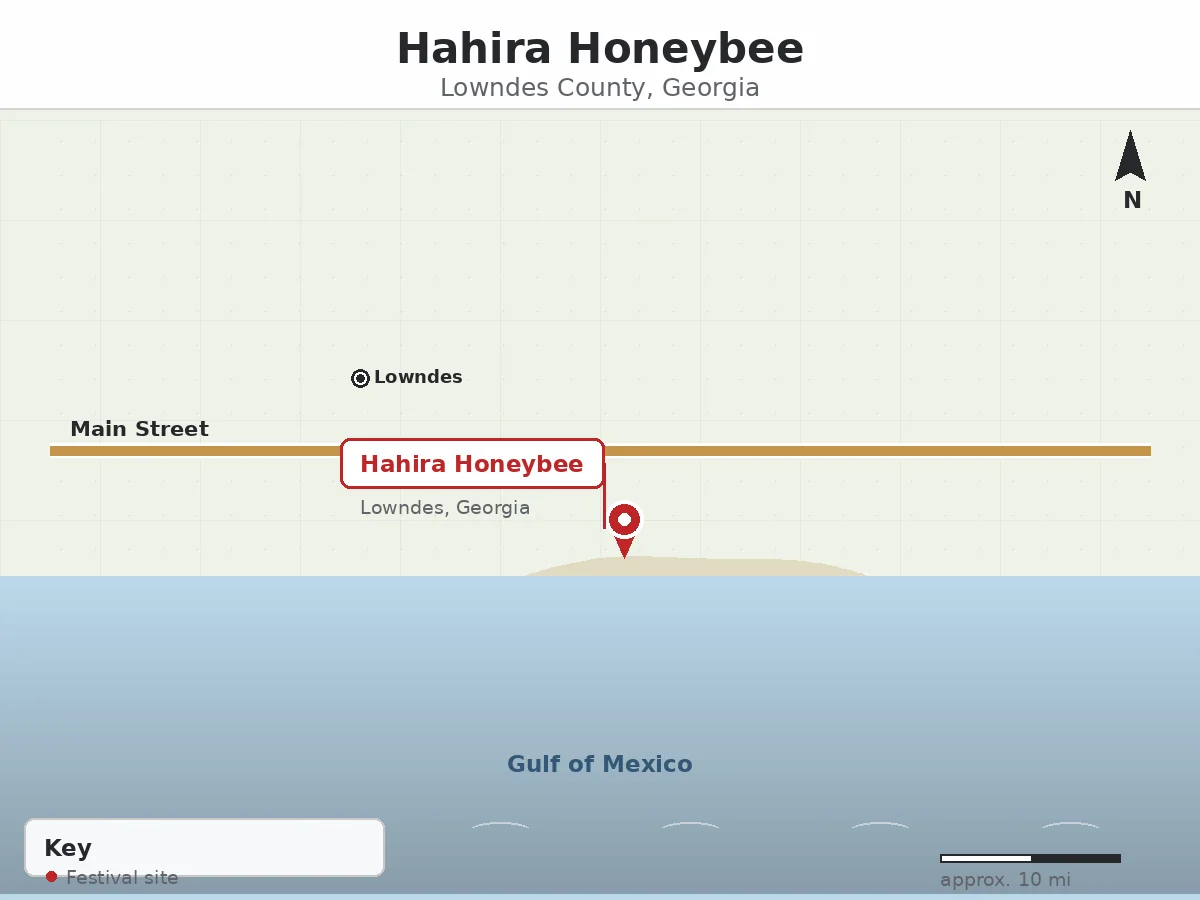
Downtown is the whole venue. The organiser places the festival on Main Street in Hahira, wrapping around the City of Hahira’s Community Train Depot, and publishes no single street address for the grounds. A conservation group’s vendor layer does print numbers for the street, giving 101 West Main Street in one reference and a booth reference at 100 West Main Street in another, yet those figures belong to that layer alone, and neither is settled here as the festival’s address.
Admission follows the logic of an open street. An events-blog listing states outright that admission is free, no organiser-published gate price exists anywhere in the gathered record, and every layer describes a street festival with no gate to pass through.
For a useful comparison, see the Lowndes County Georgia Valdosta-Lowndes Azalea Festival for another county festival.
Quick Facts
| Item | Detail |
| Published name | Hahira Honeybee Festival, as the organiser’s site prints it |
| Other printed forms | Hahira Honey Bee Festival in listing and vendor layers; The Hahira Honeybee in the organiser’s styling |
| Organiser | Hahira Honeybee Festival Committee, an independent nonprofit of volunteers |
| Stated start | 1981, by Mamie Sorrell and Adeline Landrum, per the organiser’s history page |
| Setting | Downtown Hahira, a Lowndes County town that is not the county seat |
| Grounds | Main Street around the Community Train Depot; no single grounds address is published |
| Admission | Free, as an events-blog listing states; no gate appears in any layer |
| Attendance | An organiser estimate of thirty thousand to fifty thousand visitors; no count is published |
| Documented recent editions | September 29 to October 4, 2025, and September 28 to October 3, 2026 |
| Booth days in 2026 | Friday, October 2, 9 a.m. to 6 p.m., and Saturday, October 3, 9 a.m. to 5 p.m. |
History
The organiser’s history page gives the festival a stated beginning rather than a legend: the Hahira Honeybee Festival was started in 1981 by Mamie Sorrell and Adeline Landrum. That sentence carries the founding in this article. Anniversary language circulates in the surrounding layers, with a pageant layer billing a forty-second Annual in 2023, a listing layer billing the forty-fourth Annual for 2025, and news and events-blog layers calling the 2026 week the forty-fifth. Those numbers sit comfortably beside a 1981 start, yet they are recorded here strictly as billings, because billings are marketing arithmetic, and the founding rests on the stated history alone.
The firmly dated editions belong to the present decade’s middle years. A listing layer fixes the 2025 festival from September 29 to October 4 and attaches the forty-fourth Annual billing to that week. The 2026 edition ran from September 28 to October 3 under the forty-fifth billing, and its shape is documented more fully than any earlier year, with three kinds of sources contributing pieces. Between the stated start and those recent weeks, the gathered layers offer the billings and little else, so the intervening decades stay as the record leaves them: continuous by implication, undocumented in detail.
What to Expect
The fullest programme on record is the 2026 week’s, and it belongs to that year rather than to every edition. A news layer lays the days out like a community diary: a Kick-Off Breakfast at the Hahira Depot opened the week on Monday, a Senior Walk followed on Tuesday, and a Downtown Brown Bag Luncheon filled Wednesday. Friday brought a Historical Society Fish Fry, while the programme also included a 5K and one-mile fun run. Saturday closed the days with the Honeybee Festival Parade, which a vendor layer times at 12 noon, and a quilt raffle drawing at 4 p.m. The organiser adds that the 2026 honoree was the Salvation Army, a choice recorded for that edition only and never treated as a standing feature.
The commercial heart of the week beats on its final two days. Arts, crafts and food booths operated on Friday, October 2, from 9 a.m. to 6 p.m., and again on Saturday, October 3, from 9 a.m. to 5 p.m., so market-minded visitors should read the week as a long community prelude to a two-day fair. Crowds, when the organiser describes them, are described generously but loosely: the history page estimates that anywhere from thirty thousand to fifty thousand visitors come to town. That range is the organiser’s own estimate, and no counted attendance figure for any edition appears anywhere in the record.
Planning Your Visit
Build the trip around Friday and Saturday if the booths matter most, because those are the two documented market days, with the longer hours falling on Friday. The weekday gatherings reward a different kind of visitor, and a full-week stay is the only way to take in both registers of the event. Since the festival occupies an open downtown rather than a fenced ground, the depot on Main Street is the natural landmark to aim for, while the street numbers in the vendor layer should be read as that layer’s references instead of an official address.
Money, at least, asks little planning. Admission is free according to the events-blog listing, and no layer describes a gate or a ticket window. One nearby cost does deserve a clear warning: the Miss Hahira Honeybee Pageant is organised separately, meets at Bethany Baptist Church, and runs on its own application and fees, none of which should ever be mistaken for the price of walking Main Street during festival week. Finally, confirm the dates before travelling in any future year, because the record assembled here announces editions only through 2026.
A Sample Itinerary
This outline follows the documented shape of the 2026 week, offered as a model rather than as a promise about any other year. Arrive on Monday in time for the Kick-Off Breakfast at the depot, then learn the layout of Main Street while the town is still quiet. Tuesday’s Senior Walk sets an unhurried tone, and Wednesday’s Downtown Brown Bag Luncheon suits a traveller content to let the town’s routines provide the entertainment.
Keep Friday for the Historical Society Fish Fry and the first of the booth days, browsing the stalls between 9 a.m. and 6 p.m. Saturday is the fullest day: booths reopen from 9 a.m. to 5 p.m., the parade steps off at noon according to the vendor layer, and the quilt raffle drawing at 4 p.m. gives the afternoon a focal point. Somewhere inside the week the programme also places a 5K and one-mile fun run, although the gathered record does not pin that run to a particular day, so runners should look for its placement in the current year’s own announcements.
How It Compares
Lowndes County keeps its two best-known festivals in different towns and different seasons. Valdosta, the county seat, holds its own Azalea Festival, an entirely separate production with its own organisation, and nothing about that event should be read across to Hahira’s week. The Hahira festival’s character is the smaller and more local of the two: a volunteer committee, a single main street, a depot for a centrepiece, and a programme built from breakfasts, walks and luncheons as much as from booths.
A closer comparison sits inside Hahira itself. The Miss Hahira Honeybee Pageant shares the festival’s name and its bee, yet it is a separately organised component event, staged at Bethany Baptist Church under its own arrangements, with an application and fees of its own. The street festival, by contrast, is documented as free and gateless. Treating the two as one event with one set of rules would misstate both.
Festival Checklist
- Decide which register of the week you want, the community gatherings, the booth days, or both
- Aim for the Community Train Depot on Main Street as your landmark rather than any single street number
- Reserve Friday or Saturday for the arts, crafts and food booths
- Note the Saturday landmarks in advance, the parade at noon and the quilt raffle drawing at 4 p.m.
- Carry no admission budget for the street festival itself, which the listing record describes as free
- Keep the pageant’s application and fees mentally separate from the festival
- Check the current year’s announcements for the fun run’s day, which the record leaves unpinned
- Recheck the dates before travelling, as no edition beyond 2026 is announced in the material here
Beyond the Festival
The depot is the place to begin even outside festival week, since the organiser’s own geography wraps the celebration around the City of Hahira’s Community Train Depot, and the building anchors Main Street whether or not booths line it. A visitor who comes for the festival and stays for the street gets the fuller picture: a small town whose largest annual gathering is assembled by its own volunteers, in its own downtown, around its own landmark. Bethany Baptist Church, where the pageant is held, belongs to that same local map, and Valdosta offers the contrasting scale of the county seat’s separate festival tradition at another point in the year.
Why the Festival Matters
Longevity on volunteer labour is the festival’s quiet claim on attention. The organiser’s history names two founders, Mamie Sorrell and Adeline Landrum, and a start in 1981, and the modern record shows the work still resting with a committee of volunteers rather than a municipal department or a commercial promoter. The honoree visible in 2026, when the Salvation Army was honoured, suggests a festival that folds recognition of local service into its celebration, although that reading belongs to the documented year and not automatically to the others. Even the organiser’s estimate of thirty thousand to fifty thousand visitors, loose as it is, records how the town measures the week: not by a turnstile, which the festival does not have, but by the felt weight of a crowd arriving in a small place.
Frequently Asked Questions
Why does the festival’s name appear in two different spellings?
Because the layers that publish it do not agree with each other. The organiser’s site prints Hahira Honeybee Festival with the insect written as one word, and styles its own title as The Hahira Honeybee. A festival-listing layer and the vendor layers instead print Hahira Honey Bee Festival, separating the words. This article records the forms unmerged, since settling the spelling by preference would erase a real feature of the record.
Who actually runs the festival week in Hahira?
A committee of volunteers does. The organiser names itself the Hahira Honeybee Festival Committee, shortened to HHBFC on its own pages, and a news layer describes the body as an independent nonprofit made entirely of volunteers known as the Busy Bees. The City of Hahira assists by providing city services during the week, which is help, not organisation.
Does the pageant charge form part of the festival’s admission?
No, and the distinction matters. The Miss Hahira Honeybee Pageant is a separately organised event held at Bethany Baptist Church, with its own application and its own fees, so its costs belong to the pageant alone. The street festival itself is stated to be free in an events-blog listing, no organiser-published admission price exists, and no layer describes any gate at which a visitor would pay.
How firm is the claim of thirty thousand to fifty thousand visitors?
It is an estimate and presents itself as one. The figure appears on the organiser’s history page, which says it has been estimated that anywhere from thirty thousand to fifty thousand visitors come to town. A range that wide is best read as a sense of scale rather than as a measurement, and no counted attendance figure for any single edition is published anywhere in the record.
What to Expect From the Next Lowndes County Georgia Hahira Honeybee Festival
How often is Lowndes County Georgia Hahira Honeybee Festival held?
The documented record shows a single festival week in each of the recent years it covers, falling in the autumn. Dated editions exist for the weeks of 2025 and 2026, and annual billings in the surrounding layers, a forty-second in 2023 and a forty-fourth in 2025 ahead of the forty-fifth in 2026, present the event as a yearly fixture of Hahira’s calendar. This article confirms the rhythm only where layers document it, leaning on the billings for continuity without converting them into proof.
When is the next Lowndes County Georgia Hahira Honeybee Festival?
No organiser-announced date for a future edition appears in the material assembled here, so the honest answer is that the next week is not yet on record. The two most recent documented editions each opened on the last Monday of September and closed on the first Saturday of October, which sketches where a future week would likely sit, but a pattern drawn from two years is an expectation rather than an announcement. Travellers should wait for the committee’s own publication of dates.
Will the dates change?
They could, and the record itself counsels a little caution. Both documented weeks occupied the same corridor, running from late September into the first days of October, yet each year’s dates were published by that year’s layers rather than guaranteed by any standing rule. Weather and the committee’s own planning sit outside the published record, so the dates of any coming edition remain the organiser’s to set and the visitor’s to verify.
Taken as a whole, the Hahira record is a model of how a small festival can document itself: founders named on the organiser’s own page, anniversary counts left as the billings they are, an attendance figure that admits to being an estimate, and a volunteer committee still carrying a week that began, by its own account, in 1981.
One Comment