Marengo County Alabama Pepper Jelly Festival
Most small towns celebrate something they grow, build or catch. Thomaston celebrates something it cooks, jars and spreads on a biscuit. Each April, this quiet Black Belt town in Marengo County turns its attention to the sweet-heat preserve that made it known well beyond its own borders: pepper jelly, made on site at the Alabama Rural Heritage Center from jalapeño peppers, bell peppers, pectin, sugar and vinegar. The Marengo County Alabama Pepper Jelly Festival, whose full name is the Pepper Jelly Festival and Rural Heritage Day, gathers music, homemade food, art, crafts and entertainment around that single jar. It carries an outsized claim, recorded in the festival’s own reference article, of being historically the second-largest event held every year in Marengo County, behind only Christmas on the River in Demopolis.
About the Festival
The Pepper Jelly Festival is Thomaston’s annual April celebration of its most famous product. The Encyclopedia of Alabama’s entry on Thomaston puts it plainly: “Each April, the town celebrates its most famous product with its annual Pepper Jelly Festival.” A local-news invitation for one edition named the hosts directly: “The Alabama Rural Heritage Center and the Town of Thomaston invite you to its annual Pepper Jelly Festival.” Those two hosts shape everything about the day. The center supplies the kitchen, the jelly and the grounds; the town supplies the people, the volunteers and the reason to gather.
Thomaston is a small town in Marengo County, in Alabama’s Black Belt. It is worth being precise about its place in the county: Thomaston is not the county seat. The seat of Marengo County is Linden, and the county’s largest city is Demopolis. Thomaston’s festival matters not because of any courthouse or county office, but because a food made in one repurposed school building gave the whole town a name people remember.
The festival’s character is deliberately old-fashioned. It is billed as a celebration of rural life and traditions, and its programme has stayed stable across the years covered by the record: live music, homemade food, art, crafts and entertainment, all centred on a preserve that balances sweetness against a gentle pepper warmth. Visitors expecting a large commercial fair will find something closer to a homecoming.
Quick Facts
| Item | Detail |
| Festival name | Pepper Jelly Festival and Rural Heritage Day |
| Host town | Thomaston, Marengo County, Alabama |
| Hosts | Alabama Rural Heritage Center and the Town of Thomaston |
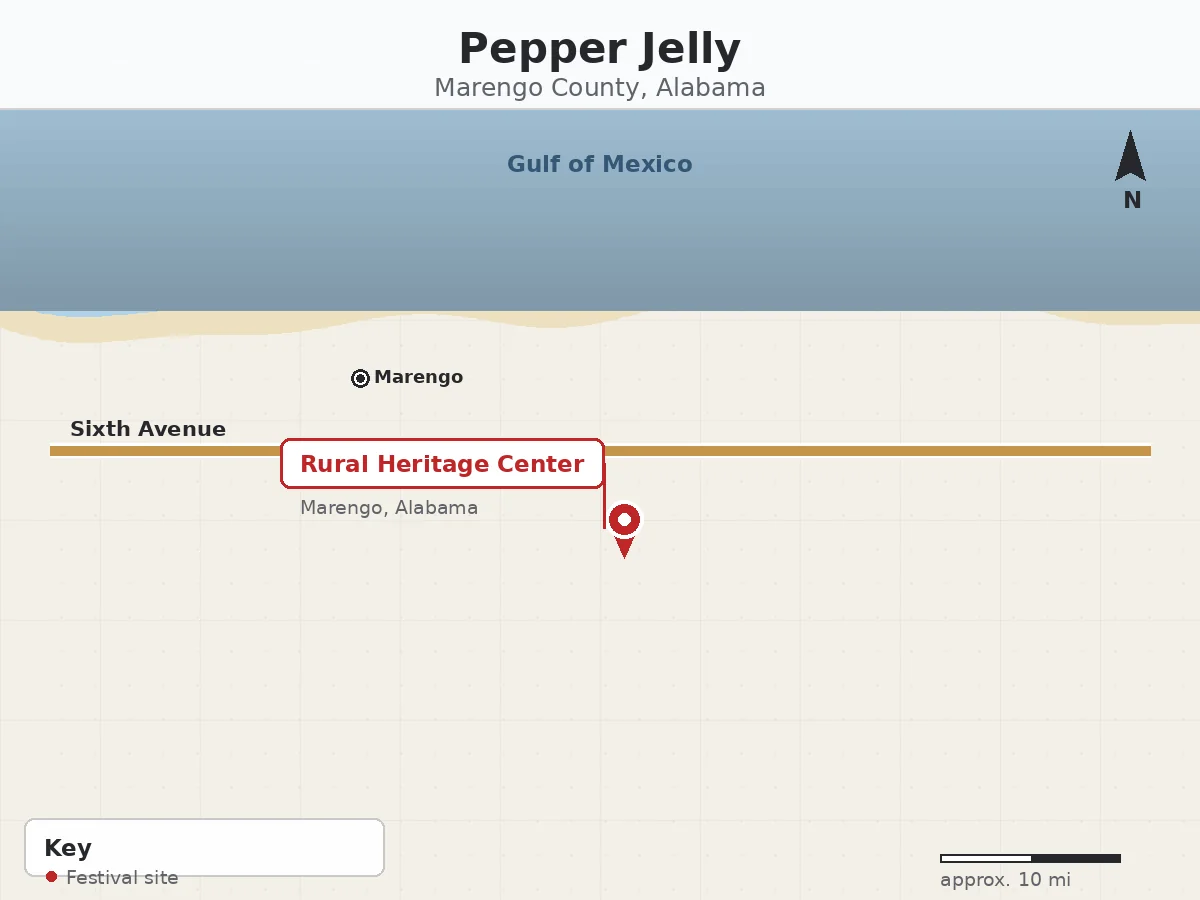
| Venue | Alabama Rural Heritage Center, 133 Sixth Avenue, Thomaston |
| Usual timing | Last Saturday in April |
| Signature product | Mama Nem’s Pepper Jelly, made at the center |
| Former name | Rural Fun Day |
| Programme staples | Music, homemade food, art, crafts and entertainment |
| Admission | Not stated in the verified record |
| County seat | Linden (Thomaston is not the county seat) |
History
The festival did not begin under its current name. The record shows that the event was formerly called Rural Fun Day, and that it was renamed in recognition of the unique pepper jelly made at the Alabama Rural Heritage Center. That change of name tells the story of the festival better than any slogan could: what started as a general rural celebration became, over time, a festival organised around the one product that set Thomaston apart.
For a useful comparison, see the Marengo County Alabama Alabama Crawfish Festival for another county festival.
Two different claims about the year 1986 sit side by side in the sources, and they must be kept apart. The festival’s reference article gives “Founded 1986” in its summary box. Separately, the Encyclopedia of Alabama states that the Alabama Rural Heritage Center was “Established in 1986.” One claim is about the festival; the other is about the center. Because the two institutions are so closely intertwined, it is tempting to merge them into a single settled founding story, but the honest position is that each claim belongs to its own source and neither, on its own, proves the other’s date. No founding year for the festival is asserted here.
The building itself carries much of the history. The center occupies the old home economics building on the former Marengo County High School campus, redesigned and repurposed by Auburn University’s Rural Studio. A performer’s past-performance page places the festival at that Rural Heritage Center on Saturday, April 26, 2014, with her set starting around 11 a.m., confirming the center was already the festival’s home by then. A local-news invitation for Saturday, April 29, 2017 described food, entertainment by local talent, and arts and crafts, and noted that the edition centred on the restoration of the Marengo County High School grounds.
The record also preserves a disruption. No event was held in 2020 because of the COVID-19 pandemic, and the festival’s reference article records that “the 35th is deferred to 2021.” That ordinal billing is reported here exactly as the source gives it, in its own layer; it is not used to calculate a founding year, and it sits separately from both 1986 claims above.
What to Expect
The anchor of the festival is the jelly itself. Inside the center, a feature described by a regional profile as a Pepper Jelly Wall leads into the gift shop, and the Mama Nem’s Bistro restaurant operates at the center. An Auburn University feature names the women behind the signature preserve: the “Pepper Jelly Women” who make Mama Nem’s Pepper Jelly at the center are Marilyn Daniels, Carolyn Finley, Shirley Crocker, Margaret Parker, Peggy Pritchett and Lille Parsons. The recipe’s recorded ingredients explain the flavour visitors describe: sweet first, then a mild warmth rather than a fierce heat.
Around that centre, the day follows the pattern the sources repeat. Expect live music and entertainment by local talent, homemade food, and stalls of art and crafts. A secondary listing layer for a recent edition also describes crafts, a 5K run, music and cooking among the day’s offerings; that detail comes from a travel-blog roundup rather than the hosts, so it is recorded as a listing layer, not as a confirmed programme. What every layer agrees on is the tone: a one-day, small-town gathering where the shopping supports the center that keeps the tradition alive.
One honest caution belongs in this section. The regional profile that supplies the center’s address and describes the Pepper Jelly Wall and the bistro also marks the Alabama Rural Heritage Center, in an update from 2025, as “(now closed).” A separate spring-2026 festival listing layer nevertheless places the festival in Thomaston in April 2026. Those two layers are not reconciled here: the profile may reflect the center’s day-to-day operations rather than its festival role, or the listing may be out of date, but the sources checked do not settle the question, and this article does not pretend otherwise.
Planning Your Visit
Timing is the first thing to fix in your diary. The festival’s standing pattern, given by its reference article, is the last Saturday in April, and the Encyclopedia of Alabama confirms the April placing. Working from that pattern, the dated layers in the record line up neatly: April 26 in 2014, April 29 in 2017, and a travel-blog listing that gives April 25, 2026, from 10 a.m. to 3 p.m., which is indeed the last Saturday of April 2026. Treat that 2026 date and those hours as a listing layer only. They come from a secondary roundup, not from the hosts, so a careful visitor confirms the current year’s date before travelling.
The venue is the Alabama Rural Heritage Center at 133 Sixth Avenue in Thomaston, on the former Marengo County High School campus. The festival is a single-day event, so most visitors build the trip as a day visit: arrive in the morning, spend the middle of the day at the festival, and leave room to look around the old campus grounds.

Admission needs an honest sentence: no source in the verified record states whether the festival charges entry or what any charge would be. Nothing here claims the festival is free, and no price is quoted, because none is published in the material checked. The same caution applies to the center’s current operating status, given the unresolved closure layer described above.
A Sample Festival Day
Because the only published hours in the record belong to a secondary listing layer, this itinerary follows the shape of the day rather than a confirmed timetable. Begin with an unhurried arrival in Thomaston and a first walk around the festival grounds on the old high school campus, taking in the crafts and art stalls before the middle of the day grows busy. Let the Pepper Jelly Wall and the gift shop come early, while the shelves are full.
Give the late morning to the music and local entertainment; the one precisely timed performance in the record, a performer’s set at around 11 a.m. in 2014, suggests the entertainment is well under way by then. Eat homemade food for lunch and save room to taste the jelly in more than one form. Spend the afternoon between the crafts and the entertainment, and finish by choosing the jars you are taking home.
How It Compares
Within Marengo County, the obvious comparison is Christmas on the River in Demopolis, the county’s biggest annual event, and the comparison is built into the festival’s own record, which describes Pepper Jelly as historically the second-largest festival held every year in the county, behind that Demopolis celebration. The two events could hardly differ more in flavour: one is a riverfront Christmas spectacle in the county’s largest city, the other a spring Saturday in a small town, organised around a jar of jelly. Pepper Jelly is the more intimate of the two, and the more edible.
Against Alabama’s wider calendar of food festivals, Thomaston’s event stands out for being anchored to a single product made in a single kitchen. Festivals built around a crop usually celebrate something harvested from fields; this one celebrates something cooked, jarred and labelled by named local women in a repurposed school building. That gives the day a heritage-centre character a purely commercial food fair rarely achieves.
Planning Checklist
- Work from the last Saturday in April as the festival’s standing pattern.
- Confirm the current year’s date and details before travelling, since the most recent dated listing comes from a secondary source.
- Aim for the Alabama Rural Heritage Center, 133 Sixth Avenue, Thomaston.
- Check the center’s current operating position locally, because the record carries an unresolved closure note.
- Do not budget around any admission figure; none is published in the verified record.
- Leave space in the car for jars of Mama Nem’s Pepper Jelly and other preserves.
- Plan the visit as a single day, with the old Marengo County High School campus as part of the experience.
- Remember that Demopolis and Linden are separate towns; Thomaston is neither the county seat nor the largest city.
Beyond the Festival
A trip to Thomaston rewards a slower look at the Black Belt around it. The festival grounds, on the former Marengo County High School campus, carry the Rural Studio’s design work, and the center building shows how an old home economics classroom can be given a second working life.
Within the county, Demopolis offers the riverfront setting of the county’s largest festival, Christmas on the River, and Linden serves as the county seat. A visitor who times a spring trip around Pepper Jelly and returns in December for the Demopolis event will see Marengo County at its two most celebratory moments.
Why This Festival Matters
The Pepper Jelly Festival matters because it turned a kitchen product into a town identity. Many communities have a heritage centre; few have a flavour. The women who make Mama Nem’s Pepper Jelly gave Thomaston something portable, giftable and unmistakably its own, and the festival built around it keeps that work visible, tasted and bought. Its survival through a name change from Rural Fun Day, a pandemic cancellation and a deferred edition shows a community determined to keep its signature tradition on the calendar.
It also matters as an example of how rural heritage is actually preserved: not in a display case, but in a working kitchen and a restored school building, on one Saturday each spring when the town invites everyone else to come and taste why it is proud.
Frequently Asked Questions
Why is the festival named after pepper jelly?
Because the preserve is the town’s signature product. The event was formerly named Rural Fun Day and was renamed in recognition of the unique pepper jelly made at the Alabama Rural Heritage Center, where the kitchen produces the Mama Nem’s range of jams and jellies.
Who are the Pepper Jelly Women?
They are the makers named in an Auburn University feature about the center: Marilyn Daniels, Carolyn Finley, Shirley Crocker, Margaret Parker, Peggy Pritchett and Lille Parsons. They make Mama Nem’s Pepper Jelly at the center from jalapeño peppers, bell peppers, pectin, sugar and vinegar.
Was the festival really cancelled one year?
Yes, according to the festival’s reference article. No event was held in 2020 because of the COVID-19 pandemic, and the same source records that “the 35th is deferred to 2021.” That billing is reported as the source states it; it is not used here to work out a founding year.
Is the Alabama Rural Heritage Center open?
The record does not settle that. A regional profile updated in 2025 marks the center as closed, while a spring-2026 listing layer places the festival in Thomaston in April 2026. Both layers are reported as they stand, and visitors should check the current position locally rather than rely on either one alone.
What to Expect From the Next Marengo County Alabama Pepper Jelly Festival
How often is Marengo County Alabama Pepper Jelly Festival held?
The festival comes round once each year. Its reference article gives its standing pattern as the last Saturday in April, and the Encyclopedia of Alabama describes it as the town’s annual April celebration, so the reasonable expectation is one edition each spring, in April.
When is the next Marengo County Alabama Pepper Jelly Festival?
Working from the standing pattern, the next edition would fall on the last Saturday of April. The most recent dated layer in the record, a secondary travel-blog listing, gives April 25, 2026, from 10 a.m. to 3 p.m. That date is not organiser-confirmed, so treat it as a guide and verify the current year’s arrangements before travelling.
Will the dates change?
The April pattern itself is well supported across the record, from the 2014 and 2017 editions through the 2026 listing, and there is no sign of a move to another season. The exact Saturday is fixed by the calendar rather than by announcement, but the one cancellation in the record, in 2020, shows that circumstances can interrupt even a long-running spring tradition.
Thomaston’s festival asks very little of its visitors: one April Saturday, a drive to a small Black Belt town, and a willingness to taste something sweet that finishes warm. In return it offers music, homemade food, local craft and a jar with a name on it, made by neighbours in an old school kitchen. For a town that is neither a county seat nor a city of any size, that is a remarkable thing to be known for.
One Comment