Schenectady County New York Festival of Trees Festival
For most of December, the galleries of a history museum in Schenectady fill with lighted fir trees, and a quiet building on Washington Avenue becomes the brightest room in the county. The Schenectady County New York Festival of Trees Festival takes its event from the Festival of Trees, the annual December fundraiser of the Schenectady County Historical Society, staged inside the Society’s museum at 32 Washington Avenue in the city of Schenectady. That identity needs stating plainly: this is an indoor holiday benefit festival held among museum exhibits, not a county fair. No recognised Schenectady county fair is the subject of this article, and the festival appears in neither of the state’s fair directories. There are no fairgrounds behind it, no midway, no livestock barns and no camping. What there is, instead, is a community ritual in which local businesses, artists and non-profit organisations decorate dozens of trees, visitors vote for their favourites, and the money raised supports a historical society’s work.
About a Museum Transformed for December
The Festival of Trees is the Schenectady County Historical Society’s own annual fundraiser, and in the Society’s current layers it is the Society’s event alone. Its Executive Director, Mary Zawacki Graves, described the 2025 edition as the nineteenth year of hosting this beloved event, and the Society’s release explains that the proceeds benefit the programs and services of the non-profit organisation. The city of Schenectady is the county seat, and unusually for this series of titles, the seat itself hosts the event, in the Stockade historic district.
The scale is domestic rather than agricultural. In 2025, more than seventy sponsors came together to decorate trees, and the galleries held upwards of seventy trees. Each tree is decorated by its own sponsor, artist or community group, so the display reads as a portrait of the county’s civic life as much as a Christmas exhibition. The Society’s 2025 release singles out its signature upside down chandelier trees and its eco-art trees, set among firs adorned with vintage, handmade and carefully crafted ornaments, toys, animals and more.
Quick Facts
| Item | Detail |
| Event | Festival of Trees, an indoor December fundraiser |
| Organiser | Schenectady County Historical Society, in its current published layers |
| Venue | The Society’s museum, 32 Washington Avenue, Schenectady |
| Setting | Museum galleries in the Stockade historic district; no fairgrounds |
| County seat | The city of Schenectady, which hosts the festival |
| Season | December, through the Christmas season |
| Documented span | The 2025 edition ran daily in December, from the sixth to the twenty-seventh |
| Trees | More than seventy decorated trees in the 2025 layers |
| Admission | Eight dollars in 2025, child terms conflicting between that year’s layers |
| Camping | None; this is an indoor city museum event |
From Two Buildings to One Museum
The Society’s own billing carries the festival’s beginning: since 2007, its 2025 release says, the Festival of Trees has offered the community an opportunity to be creative with tree decorations. That billing is carried here as billing rather than as a computed founding. The neighbourhood record for 2013 billed that edition the seventh annual festival, sitting consistently between the 2007 beginning and the nineteenth year claimed for 2025, but no edition number belongs to any other year, and no uninterrupted run should be built from the sequence.
The earliest documented edition looked different. In 2007 the festival ran from mid-November into early December as a joint presentation by the Society and the YWCA of Schenectady, staged at both locations. The two buildings stand a few doors apart on the same street, the Society at 32 Washington Avenue and the YWCA at 44 Washington Avenue, and in the two-venue years one admission covered both. A chamber release for 2016 still describes the two hosting together, under the line one admission, two locations, and a tourism layer as late as 2023 still called it a fundraiser for both.
For a useful comparison, see the Saratoga County New York Fair Festival for another county festival.
The recent record is narrower. The Society’s newsletter for 2017 already lists the festival at 32 Washington Avenue only, and its 2024 and 2025 layers present it as the Society’s alone. The YWCA’s part is therefore history, documented but finished, never the current arrangement.
What to Expect Inside the Galleries
Trees in Every Room
The core experience is simple and cumulative. Gallery after gallery holds lighted fir trees, each decorated by a different hand, so no two rooms repeat themselves. One tree carries vintage ornaments, another handmade pieces, another toys or animals worked into its branches. The signature upside down chandelier trees stop first-time visitors mid-step, and the eco-art trees make their effect from reclaimed materials.
Voting for Your Favourites
Visitors do not merely look. The festival invites them to vote for their top choices, and the published layers name the categories Cutest, Most Creative and Most Glamorous among the honours. The Society’s page for 2023 speaks of voting across eight categories, but the full list of eight is named in no layer found, so only the three documented names can be promised.
Sponsors, Makers and the Fundraising Core
Behind every tree stands a sponsor. Local businesses, non-profit organisations, artists and community groups register to decorate and sponsor a tree, and in 2025 more than seventy did so. That sponsorship, with the admission charge, is the documented fundraising machinery. No silent auction is documented in any organiser-side source, however common auctions are at other tree festivals, and none should be expected here. The earliest documented year also had a raffle for trees, at five dollars per ticket, and holiday music on Saturdays and Sundays; both belong to that 2007 layer alone.
The Opening Night
The public run has traditionally been preceded by a first look. In 2017 the Society’s newsletter lists a Night of Lights sneak preview on the Friday evening before the opening, priced at fifteen dollars; a tourism layer for 2023 gives advance tickets for a Night of Lights at twenty-five dollars; and the Society’s events list for 2024 records a sneak-preview reception for sponsors, benefactors and donors, an invitation layer rather than a public ticket. Three layers from three years, not one standing offer.
Planning Your Visit
When the Festival Runs
The festival is a December event running roughly three weeks through the Christmas season. The best documented recent edition is 2025, running daily from December 6 to December 27, from ten in the morning to half past four. The 2024 edition ran from December 7 to December 28 at the same hours in the county tourism layer. The 2023 edition ran from December 2 to December 23. Earlier editions sat differently: 2017 from December 2 to 17, 2016 from December 3 to 18 with hours split by day, 2013 from late November to mid-December, and 2007 from mid-November to early December.
Admission, Fenced by Year
Admission belongs to its year, and the price has moved gently, so no figure can be quoted as timeless. For 2025, the Society’s own release sets admission at eight dollars, free for children under twelve. The county tourism layer for the same edition instead describes eight dollars for adults, thirteen and up, leaving a twelve-year-old’s position different between the layers; neither wording is sharpened here, and a family with a twelve-year-old should ask at the desk. The documented price for 2024 is six dollars, as it is for 2023, where the Society’s page gives six dollars for adults aged twelve and over and its sponsor form adds that children under twelve were free; 2017 was also six dollars, with children under twelve free. In 2016 admission was five dollars for adults and two dollars for children aged six to twelve, with five and younger free. In 2013 it was five dollars, children at three dollars and those under two free. In 2007 adults paid six dollars, children aged five to fifteen three dollars, and children under five nothing. Whether tickets can also be bought in advance is unsettled in the layers, and is left so here. No figure for a 2026 edition is published, and none above should be carried forward as next year’s price.
Two smaller uncertainties deserve the same honesty. The 2025 closure days conflict: the Society’s release lists closure on December 24, 25 and 26, while the tourism layer lists only December 24 and 25, and neither version is preferred here. Parking is unpublished: no organiser-published parking price or arrangement was found, so no fee can be quoted and none assumed. Plan as for any small city museum visit, allowing time to find ordinary city parking near the Stockade.
A Sample December Afternoon
Arrive a little before the doors open at ten and buy admission at the front desk. Spend the first hour moving slowly through the galleries while the rooms are quietest, reading each tree’s sponsor card, because the makers are half the story. Pause longest at the upside down chandelier trees and the eco-art trees, and cast your votes before lunch. Take lunch in the city, return for a second, faster circuit to check whether your favourites still hold, and finish with a walk through the Stockade streets outside.
A Fundraiser, Not a Fair
The comparison this title most needs is with the county fair it is not. A county fair spreads across fairgrounds for a summer week, with a midway, livestock judging, premium books and camping; this festival occupies museum galleries for a December run, with decorated trees, visitor voting and a front desk. Schenectady County’s recognised agricultural fair layer sits elsewhere entirely, in a different county, and none of its dates, prices or programme belongs in a visit to Washington Avenue. The festival also shares its name with dozens of unrelated Festivals of Trees across the country, and those events contribute nothing here: their trees, auctions and prices are theirs.
Checklist
- Confirm the current December dates and hours before travelling, since no edition’s details carry into the next year.
- Budget admission by the most recent documented year only, as a guide rather than a promise.
- Ask at the front desk about a twelve-year-old’s admission, because the published layers disagree.
- Check the Christmas-period closure days in the current year’s own listing before planning a holiday visit.
- Allow time to find ordinary city parking, because no festival parking arrangement is published.
- Read the sponsor card on each tree, so the makers get their due.
- Vote for your favourite trees before you leave the galleries.
- Look out for the upside down chandelier trees and the eco-art trees.
- Do not arrive expecting a fairground, a midway or camping.
Beyond the Festival Grounds
The festival has no grounds in the fair sense, so its surroundings are the city itself. The museum stands in the Stockade, Schenectady’s historic district of old streets and early houses beside the river, and a winter walk there is the natural companion to the trees. The city, the county seat, supplies the rest of a day out: downtown streets, other December events and places to eat all sit near Washington Avenue. The Society also keeps a farm museum outside the city, but it is not a venue for this festival in any layer found, and its separate holiday programmes should not be confused with the Festival of Trees.
Why a Room of Trees Matters
The festival’s significance is out of proportion to its size. It is the rare fundraiser that is also a portrait of its own community: more than seventy local businesses, artists and non-profits decorate the museum each December, and the public pays a modest admission to walk among the results, funding the Society’s programs and services. For the city, it anchors the Stockade in the holiday season, giving residents a reason to return to its oldest streets at the darkest point of the year. It began as two neighbouring institutions sharing one admission across two buildings, and even now that the Society presents it alone, it still reads as a joint production of a whole county’s makers. A beloved event, the Society calls it, and the returning sponsors support the word.
Frequently Asked Questions
Is this festival a county fair?
No. It is an indoor December fundraiser held in the galleries of the Schenectady County Historical Society’s museum, with no fairgrounds, midway, livestock, premium book or camping. It appears in neither state fair directory, and no recognised Schenectady county fair is its subject.
Where is the festival held, and who runs it?
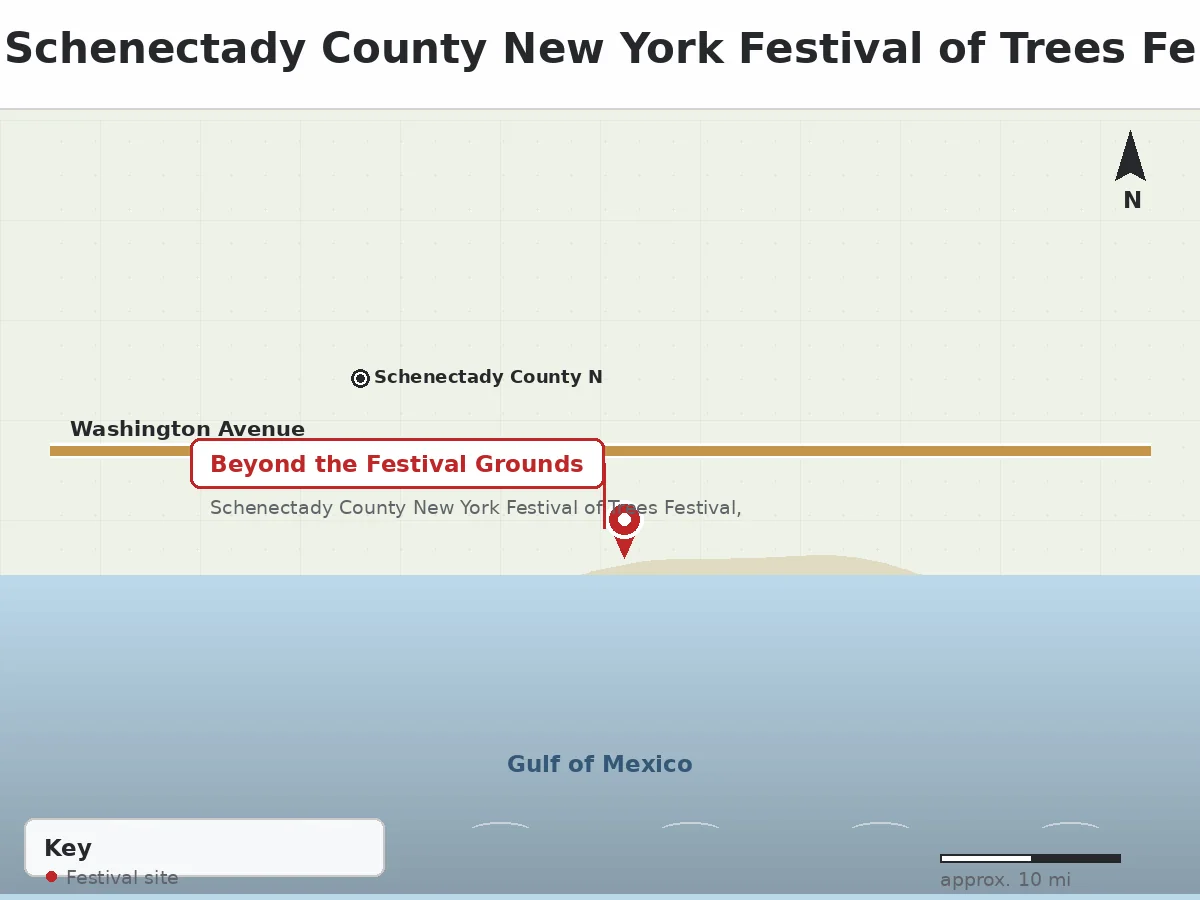
At the Society’s museum at 32 Washington Avenue in the city of Schenectady, the county seat, in the Stockade historic district. The Society runs it, and its recent layers present it as the Society’s event alone; the YWCA shared the hosting in the earlier years, which is history rather than the current arrangement.
What does admission cost?
Only by year. The Society’s release priced 2025 at eight dollars, free for children under twelve in that wording, while the county tourism layer for the same year described eight dollars for adults of thirteen and up, so a twelve-year-old’s position differs between layers. Earlier prices were six dollars across 2017, 2023 and 2024, and five dollars in 2013 and 2016, each with its own child terms. No price for the next edition is published.
How many trees will there be?
The count belongs to its year as well. The 2025 layers speak of more than seventy trees and more than seventy sponsors. For 2023 the layers conflict, one speaking of more than sixty trees and another of more than one hundred, and neither is preferred here.
What to Expect From the Next Schenectady County New York Festival of Trees Festival
How often is the Schenectady County New York Festival of Trees Festival held?
It is held once a year, as a December festival running roughly three weeks through the Christmas season. The Society’s own billing carries it since 2007, and its documented editions have kept that annual shape.
When is the next Schenectady County New York Festival of Trees Festival?
The next edition falls in December, following the pattern of opening in the first part of the month and closing between Christmas and the New Year. As of the record behind this article, no dates, hours or admission price for a 2026 edition had been published on the Society’s calendar, so watch for the Society’s own announcement rather than assuming the previous year’s details. No edition number is assigned to it here, because no organiser layer publishes one.
Will the dates change?
They have shifted modestly across the documented years, from a mid-November start in 2007 to December runs opening in the month’s first week, with closing days on either side of Christmas. Small movements of that kind should be expected, and each year’s own listing is the only reliable guide.
The Festival of Trees asks little of its visitors: a December day, a modest ticket and an hour among other people’s imagination. In return it offers a county museum turned into a winter woodland, a friendly argument over the cutest tree in Schenectady, and the knowledge that the ticket money keeps a small historical society’s work going. That is not a county fair’s bargain, and it was never meant to be.

One Comment