Saratoga County New York Fair Festival
The Saratoga County New York Fair Festival is the Saratoga County Fair, the county fair of Saratoga County, held each July at the Saratoga County Fairgrounds in Ballston Spa. Ballston Spa is the county seat of Saratoga County, and the seat itself hosts the fair, which runs for six days, Tuesday through Sunday, in the third full week of July. The presenting body is the Saratoga County Agricultural Society, a volunteer-run nonprofit that states in its own published words that it is not an agency of the County of Saratoga. Its centre of gravity is competitive exhibiting, with a midway, grandstand pulls, live music and fair food around it. One caution matters first: this fair is not in Saratoga Springs and has nothing to do with the race course there.
A Volunteer Society’s Fair in the County Seat
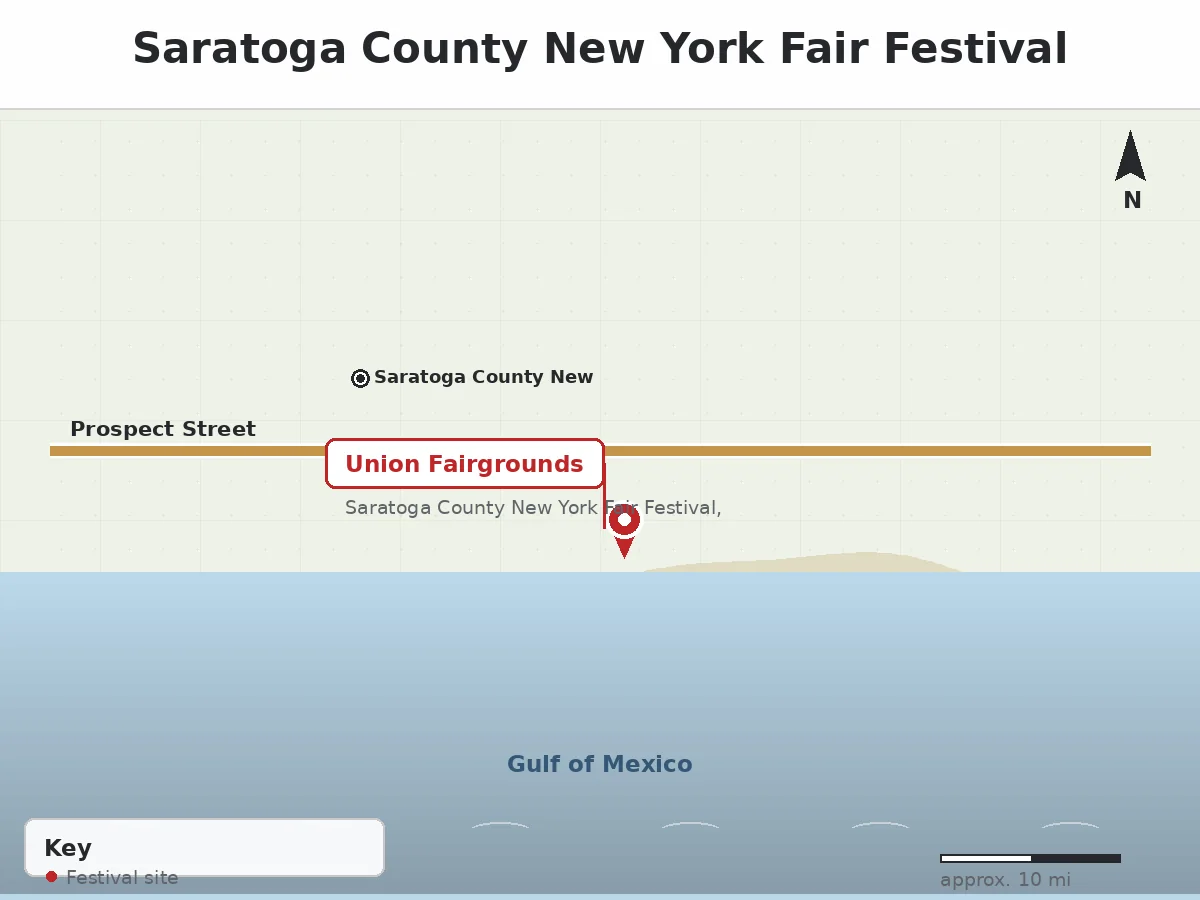
The Saratoga County Agricultural Society presents the fair on grounds it owns at 162 Prospect Street in Ballston Spa, and the same land works year-round as a fairgrounds and expo centre. The Society describes itself as a recognised nonprofit guided by a twenty-one member volunteer board, helped by ad-hoc volunteers and a small staff, and it is explicit that county government is not the organiser. The Society states that it owns and maintains almost eighty acres of exposition and parking facilities; a 2016 resolution layer gives smaller acreage, and the two are not merged into one size. It also sells a twenty-dollar annual membership carrying one vote at its October annual meeting; membership is never an admission price.
Quick Facts
| Item | Detail |
| Event | Saratoga County Fair |
| Presented by | Saratoga County Agricultural Society, an independent nonprofit |
| Fairgrounds | Saratoga County Fairgrounds, 162 Prospect Street, Ballston Spa |
| County seat | Ballston Spa, which hosts the fair |
| Admission | Published layers for the current fair disagree; see Planning Your Visit |
| Midway | Rides are a separate purchase; the unlimited-ride wristband is thirty dollars in the guide layers |
| Camping | Exhibitor and vendor camping by written request only; no public campground offer |
| Harness racing | None; the state directory records no harness racing at this fair |
Born in 1841, by the Society’s Own Account
The Society’s own history page tells the origin plainly: in 1841 the Saratoga County Fair was also born, and the Society was formed in Ballston Spa that year. Other layers reach further back: earlier fairs from 1819 to 1825 at the Ballston Spa courthouse, a gap from 1825 to 1840 when funding was cut and no fair was held, then a reorganised fair from 1841. That gap, inside the record itself, rules out any claim of an unbroken run from 1819 or from 1841.
The fair has had seven homes, among them Ballston Spa, Mechanicville and Saratoga Springs. The present grounds opened in 1871 as the Union Fairgrounds, were taken over by the Society in 1882, and the fair settled high above the village in the late eighteen eighties.
Anniversary numbers need care. The Society marked its own 175th Anniversary in 2016, the last organiser-side milestone in the record, while press layers numbered other years, the 174th in 2015 through a 184th season in 2025. Each number belongs to its own year. No fair-side source numbers the current edition, so none is printed here or computed from 1841.
For a useful comparison, see the Rockland County New York Rockland Fall Festival for another county festival.
What to Expect
Departments Before Everything
Exhibiting is the fair’s documented spine. The livestock entry forms name departments for cattle, draft horses across two departments, goats, sheep and saddle horses, while the general entry form covers farm produce, flowers, culinary entries, home arts, fine arts, antiques, Grange exhibits and conservation. Entries are received by department in the days just before opening, and premiums are paid under the Society’s own rules, which warn that nothing unlisted in the exhibitor handbook earns prize money. On the fair’s own paperwork, the barns and halls are the fair itself.
Grandstand Power and a Separate Midway
The fair’s own current programme places four wheel drive truck pulls at the grandstand on the Saturday evening of fair week. Regional guide layers name tractor pulls and a demolition derby among the fair’s standing traditions, as guide description rather than fair-published scheduling, and a carnival midway operated by Amusements of America. The money boundary is firm: rides are not included in admission in any documented layer, and the unlimited-ride wristband, thirty dollars in both the previous year’s press layer and the current guide layer, is always a separate purchase. One current guide layer adds that grandstand entertainment, live music and special events are included with standard admission.
Stages, Food and the Guide-Only Attractions
Live music, food vendors and fair food run through every layer as standing elements. A library newsletter’s opening-day listing for the current fair names a horse show, a mobile dairy experience, a potter demonstration and a Saratoga 250 tent. Regional guides list a high-wire family act, a giant foam party, an immersive butterfly experience, a fibre celebration, living-history demonstrations in a conservation village, pig races, kangaroo encounters and a magic show. Those attractions rest on guide layers only, absent from the fair’s own published programme in the record fetched.
A Quieter Morning, Documented for Last Year
In the previous year the fair hosted a sensory-sensitive morning with reduced noise and no flashing lights, presented in the Assembly layer as the eighth annual observance of its kind, hosted by a state assembly member, on the Thursday of fair week. No date or edition for it was found for the current fair in any fair-side or Assembly source, so none is asserted here; visitors who need it should ask the fair office whether it returns.
Planning Your Visit
Admission: Three Published Layers That Do Not Agree
This fair’s current admission cannot be stated as one settled ladder, because the published layers contradict each other and the fair’s own ticket pages yielded no price text. The state tourism listing gives fifteen dollars for adults of thirteen and over, ten dollars for veterans, and children free in that layer’s exact wording, under twelve. A local library newsletter linking the fair’s own ticket sale gives general admission as sixteen dollars and thirteen cents, free for kids twelve and under. A national family-travel guide gives fifteen dollars at the gate or sixteen dollars bought online with the processing fee included, children twelve and under free, active military with a valid identity card at no charge, veterans at ten dollars, seniors of sixty-five and older at five dollars on Wednesday only, and a season ticket for the whole week at fifty dollars. The conflict is precise: the online total is sixteen dollars in one layer and sixteen dollars and thirteen cents in another, and the free-child cut-off is under twelve in the tourism listing but twelve and under in the newsletter and the guide. The veteran figure of ten dollars is the one point where two layers agree. Nothing here chooses between the figures or averages them; a family with a twelve-year-old should expect the answer at the gate.
Last Year’s Figures Belong to Last Year
The tidy numbers quoted for this fair are last year’s. The previous year’s fair-week press layer published a complete fee-inclusive ladder: daily tickets at sixteen dollars and forty-three cents including fees, a weeklong pass at fifty-two dollars and forty-four cents, veterans at eleven dollars and twenty-eight cents, seniors of sixty-five and over at six dollars and fourteen cents, active military with identification and children twelve and under free, the ride wristband at thirty dollars and parking free in Lots A and D. Its hours, Tuesday to Saturday ten in the morning to eleven at night and Sunday ten to eight, governed that year only, as did every price above. For the current fair, only an opening-day listing, ten in the morning to eleven at night, was found; the full week remains unpublished.
Parking, Shuttles and Gate Practicalities
Parking is the calmest part of the record: the published layers agree that Lots A and D are free, and the current guide layer adds a shuttle from Lot D. Paid yard parking by neighbours near the grounds is a local practice, not a fair price, and the hang-tag rules in the exhibitor rulebook govern exhibitors, not gate visitors.
A Sample Saturday at the Fair
Begin mid-morning in the livestock barns while judging is active, then cross to the general exhibit halls for flowers, culinary and fine arts. Take lunch from the food vendors and spend the early afternoon between the conservation and fibre demonstrations and the stages. Walk the midway in the late afternoon only if rides are the point of the day, and buy the wristband then, since admission never covers a ride. Finish at the grandstand for the evening truck pulls, set by the fair’s own programme on Saturday.
Camping Is an Exhibitor System, Not a Campground
There is no public campsite to book: no public camping offer or nightly public rate appears in any fair-side source found, tent camping is offered in none, and camping runs instead through a request system for the fair’s own people. Under the Society’s current rules, exhibitors in the cattle, draft horse, sheep and goat departments who want camper space must ask the fair office in writing by a mid-June deadline; space is limited, a committee of the livestock superintendents decides by need, and successful applicants are told by the start of July at an exhibitor camping rate the rules text does not state. Spaces are not transferable and are tied to paid entries. The previous year’s handbook adds that year’s mechanics: limited fifty-amp and thirty-amp sites at form figures of one hundred fifty, two hundred twenty-five and two hundred fifty dollars by class, every figure that year’s and none a current rate. Visiting families should book lodging nearby and treat the fair as a day trip.
The Fair, the Race Course and the Wrong-Town Listings
Three confusions follow this fair around. The first is Saratoga Springs: the famous thoroughbred race course there is a separate operation in a different town, and none of its dates, prices or programme has any place in a visit to this fair; Saratoga Springs survives here only as one of the fair’s earlier homes. The second is a listing that relocates the fair to Schuylerville, which hosts no part of it in any fair-side source; that is template error, corrected by the fair’s own address. The third is gentler: expos, rentals and other festivals at the same grounds are tenant events, not fair programme.
Checklist
- Navigate to 162 Prospect Street, Ballston Spa; ignore listings placing the fair in Saratoga Springs or Schuylerville.
- Check the fair’s own ticket page first; published prices for the current fair disagree.
- Carry identification for the veteran, senior or active military terms in the guide layers.
- Treat a twelve-year-old’s free entry as unconfirmed, since the published cut-offs conflict.
- Park free in Lot A or Lot D; use the Lot D shuttle where it runs.
- Buy the thirty-dollar wristband only as a ride purchase, never as part of admission.
- Exhibitors needing camper space must write to the fair office before the mid-June deadline.
- Book ordinary lodging for overnight stays, because no public camping is offered.
Beyond the Fairgrounds
Ballston Spa rewards the visitor who gives it an hour beyond the fair. It is a working county seat, with the county’s offices in the village, its streets carrying ordinary small-town administrative life rather than resort polish. Saratoga Springs lies a short drive north, with its own separate summer scene, and pairs naturally with a longer stay; enjoy it as itself, never as the fair’s home. The same grounds turn over to expos and rentals all year: the Society’s land works in every month, not only July.
Why This Fair Holds Its Place
The fair’s significance is written into its structure. A county of farms, horse country and growing suburbs keeps one midsummer week in which its produce, livestock and handwork are judged side by side under rules a volunteer society has maintained, on its own account, since 1841. That continuity is civic rather than commercial: a membership nonprofit runs it, not a promoter and not a county department. Its sensory-sensitive morning, conservation department and Grange exhibits point the same way, toward a fair that sees itself as the county gathered in one place, the spirit the previous year’s opening theme named outright: Where Saratoga County Comes Together.
Frequently Asked Questions
Is the fair held in Saratoga Springs?
No. The fair is held at the Saratoga County Fairgrounds, 162 Prospect Street, Ballston Spa, the county seat, in every current layer. Saratoga Springs appears only among the fair’s earlier homes, and its race course is a separate operation whose dates, prices and programme never belong to this fair.
What does a ticket cost this year?
There is no single settled figure in the published record. The current layers put the adult gate at fifteen dollars, disagree over whether the online total is sixteen dollars or sixteen dollars and thirteen cents, and disagree over whether free entry for children stops under twelve or at twelve and under. Veterans stand at ten dollars in two layers; one guide adds seniors at five dollars on Wednesday only and a fifty-dollar season ticket.
Are the carnival rides included in admission?
No. In every documented layer the midway is a separate purchase, and the unlimited-ride wristband stands at thirty dollars in both the previous year’s press layer and the current guide layer.
Is camping at the fairgrounds open to the public?
No. Camper space runs through a written-request system for livestock exhibitors, vendors and entertainers, and no public campground or nightly rate is published anywhere in the fair-side record, so overnight visitors need ordinary lodging.
What to Expect From the Next Saratoga County New York Fair Festival
How often is the Saratoga County New York Fair Festival held?
It is held once a year, as a six-day fair running Tuesday through Sunday in July.
When is the next Saratoga County New York Fair Festival?
The next edition falls in July of the coming year, following the established pattern of six days from Tuesday to Sunday in the month’s third full week. The fair announces its own dates on its own site and in the state directories; plan around those announcements.
Will the dates change?
The July timing has been steady in every documented layer, and the Tuesday-to-Sunday shape held in both recent years on record. Organisers can still move a fair for reasons no article can foresee, so confirm the dates with the fair itself before booking travel.
A Fair That Keeps Its Own Books
The Saratoga County Fair asks a little more of its visitors than most: check the ticket page because the printed layers quarrel, arrive in Ballston Spa rather than Saratoga Springs, and leave the camper behind unless you are exhibiting livestock. What it gives back is the genuine article: a department-by-department county fair run by the Society’s own volunteers.