Kings County New York Atlantic Antic Festival
Some county names on a festival list promise barns, livestock rings and a gated fairground. Kings County promises none of those things, and honesty requires saying so at once. The event behind this title is the Atlantic Antic, a one-day street festival that closes ten blocks of Atlantic Avenue in Brooklyn for one Sunday afternoon each early fall, produced by the Atlantic Avenue Local Development Corporation, the merchant-and-community body that looks after the avenue. It has no fairground, no midway, no livestock and no gate.
Kings County holds a distinction no upstate county can copy: the county and the borough of Brooklyn are exactly the same territory, so no county-seat town stands apart from the festival. The Antic belongs to Brooklyn itself, running ten blocks from Hicks Street to Fourth Avenue through Brooklyn Heights, Cobble Hill, Boerum Hill and Downtown Brooklyn. The organiser bills it as Brooklyn’s oldest and largest street festival — its own wording — and billed the 2026 edition as the 51st. In 2026 it warned visitors too: announced for Sunday, September 27, the edition was postponed a week and held on Sunday, October 4.
About a Festival Run by the Avenue It Closes
The Atlantic Antic is not run by a county, a city agency or an agricultural society. Its producer, the Atlantic Avenue Local Development Corporation, describes itself as a Section 501(c)(3) not-for-profit organisation committed to the economic development, cultural enrichment and historic preservation of the Atlantic Avenue area from Fourth Avenue to the waterfront. Founded by local merchants and community activists, it treats the festival as its flagship draw for diners and shoppers.
That purpose shapes the day. The traders are not travelling showmen but hundreds of vendors set alongside the avenue’s own restaurants and shopfronts, which trade through the festival. Sponsors and partners support individual stages and children’s areas — a medical centre lends its name to the Community Stage, a schools organisation powers one children’s zone — but partners are never the organiser. Other events the corporation stages on the avenue are separate occasions, and nothing from their programmes belongs here.
Quick Facts
| Question | Answer |
| Event | The Atlantic Antic, a one-day street festival |
| County and borough | Kings County, which is the borough of Brooklyn |
| Setting | Atlantic Avenue, closed from Hicks Street to Fourth Avenue |
| Neighbourhoods crossed | Brooklyn Heights, Cobble Hill, Boerum Hill and Downtown Brooklyn |
| Organiser | Atlantic Avenue Local Development Corporation |
| Usual timing | One Sunday in early fall, noon to six |
| The 2026 edition | Billed the 51st; announced for September 27, held October 4 after postponement |
| Admission | Free, with no tickets of any kind |
| Children’s areas | Three in 2026 — two free, one charging per attraction |
| Camping | None of any kind |
A First Antic in 1974, and Billings That Refuse to Become a Founding
The organiser’s own story page tells the beginning this way: in the 1970s the corporation sought a way to promote Brooklyn and welcome visitors to dine, shop and enjoy the historic Atlantic Avenue areas, and the resulting event was the first annual Atlantic Antic in 1974, the first edition in its own account.
For a useful comparison, see the Jefferson County New York Fair Festival for another county festival.
The corporation’s paperwork refuses to line up behind one founding year. The story page says the corporation was formed as a 501(c)(3) organisation in 1986 to support the Atlantic Antic; a state tourism release for the fiftieth anniversary instead described it as founded in 1974. The layers stand unblended: neither may date the other.
Edition numbers need care. The organiser billed the 2023 festival as the 48th, the 2025 festival as the 50th and the 2026 festival as the 51st — billings only. Secondary accounts record that the festival did not run in 2001 or 2002, precisely why counting backwards cannot yield a founding year. The golden-anniversary trimmings of 2025 — a seventies fashion show, a dance party, balloons honouring long-standing merchants — belonged to that edition alone. Older guide layers circulate grand figures, attendance past a million and some six hundred vendors, but those are old estimates; the organiser’s recent wording says only hundreds of vendors in 2026 and over three hundred in 2025.
What to Expect on the Avenue
Ten Blocks of Stalls Between Two Cross Streets
The whole festival is the avenue. From Hicks Street to Fourth Avenue, the closed roadway and its pavements carry hundreds of vendors and businesses selling food, crafts, clothing, jewellery and vintage and handmade goods, while long-standing restaurants and shops stay open. There is no entrance to find: the geography is one straight line, and walking it end to end is the festival. The organiser’s own descriptions keep the span at ten blocks, or a little over a mile of food, crafts and fun. A longer mileage sometimes attached to the day belongs, in the corporation’s telling, to its whole stretch of the avenue, not to the festival span, which stops at Hicks Street.
Music and Circus on the Corners
Entertainment stands on named corners, not in an arena. The Middle Eastern Stage at Clinton Street presents Middle Eastern musicians and belly dancers. Between Third and Fourth Avenues, the Community Stage carries rock bands, rhythm-and-blues and jazz singers and dance acts. At Nevins Street, Kids Rock for Kids puts youth rock bands on stage. Between Henry and Court Streets, the Bindlestiff Family Cirkus performs with clowns and jugglers, its 2026 sets running at one, three and five in the afternoon. All of it is free street entertainment in the organiser’s billing.
Three Children’s Areas With Two Different Rules
Families get three dedicated areas, and in 2026 they were these. The Mommy Poppins Kid Fest offered free family activities under sponsorship from Woom; the organiser’s own release placed it at Henry Street, while the state tourism release for the same edition placed the Mommy Poppins area at Hicks Street; this article settles nothing between those two layers. Playtopia, presented by a Brooklyn parents’ organisation and powered by Prospect Schools at Boerum Place, promised a dozen free activities, timed noon to four by the partner. The neighbouring Kids Zone — bounce houses, pony rides, face painting — charges per attraction, and no price for any attraction appears in any layer of the record, so none can be quoted. Two cost nothing; the third costs whatever its operators set on the day.
Contests, Honours and Small Ceremonies
The 2026 edition layered set pieces over the street pattern, recorded as that year’s programme only. The second annual Antic Sing! competition took the Community Stage from two o’clock for forty-five minutes, contestants performing hits from the nineteen-seventies through the two-thousands, with prizes of three hundred, two hundred and one hundred dollars — prize money for winners, never a charge on the audience. At half past one the thirteenth Atlantic Avenue Ambassador Award went to READ 718 on the same stage. Booths near Clinton Street and Third Avenue sold new festival shirts.
Planning Your Visit
Getting There Without a Gate to Aim For
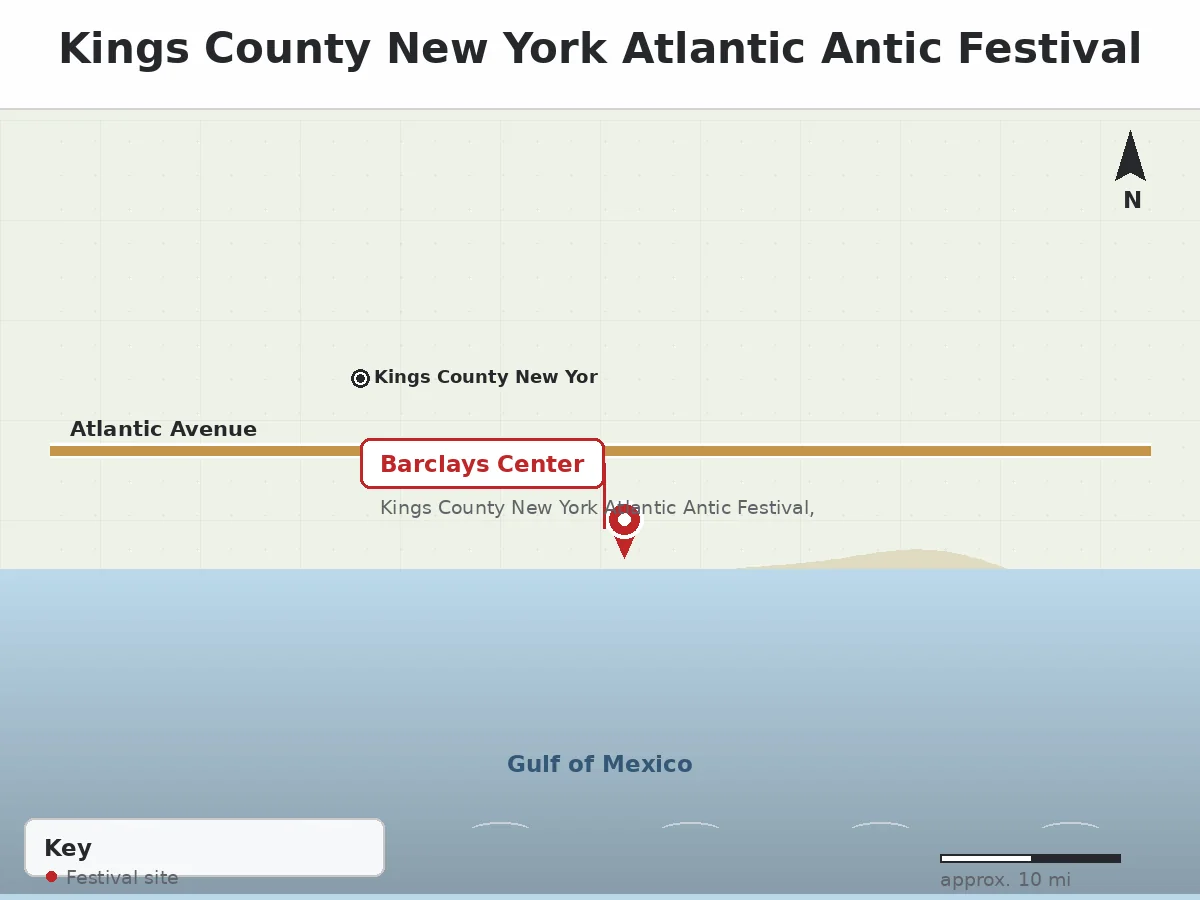
The organiser’s own directions lean toward public transport, and rightly so. Subway stations at Hoyt Street and at Atlantic Avenue–Barclays Center serve the avenue; the B63 and B61 buses run locally; the Long Island Rail Road terminates at Atlantic Terminal beside the eastern end; the city ferry’s South Brooklyn route lands at Pier 6; eight bike-share stations stand nearby. The arena at the Fourth Avenue end gives the station its name and makes a useful landmark, but it is a neighbour, never the venue. Drivers face ordinary city conditions: the organiser lists commercial car parks at 200, 255 and 301 Atlantic Avenue and at 333 Schermerhorn Street, publishes no price for any, and notes that street parking rules apply.
What the Day Costs, Honestly Stated
Admission costs nothing. There is no ticket, no gate price, no wristband and no advance sale, and any listing that dresses the day up as a ticketed event describes something that does not exist. Free entry — stated plainly in the 2026 plan published by the festival’s own children’s-area partner, and echoed in the organiser’s wording about lots of free entertainment — covers the avenue, the stages and the circus. Money changes hands only where the record says so: per attraction in the Kids Zone, at unpublished prices; at food stalls and shop counters, at each seller’s prices; and at commercial car parks, at unpublished rates. No free parking is promised anywhere, and no camping of any kind exists at or for this festival.
A Sample Sunday Afternoon
On the 2026 pattern, a family might do it this way. Arrive by subway before noon and start at the Hicks Street end, walking east as the avenue fills. Spend the first hour on the western blocks and near the Boerum Place children’s areas, catching the one o’clock circus set between Henry and Court Streets. Drift east for the Ambassador Award at half past one and stay for the singing competition at two. Graze back through the food stalls, take the five o’clock circus set or the Nevins Street youth bands, and leave from the Fourth Avenue end when the avenue reopens at six. Future editions will rearrange the set pieces; the durable spine is a noon start, a six o’clock close and stages on corners.
How the Antic Differs From the Fairs on This List
Most titles in this queue describe agricultural fairs with owned fairgrounds, exhibit barns, a midway and a paying gate. The Antic inverts nearly every term. Its ground is borrowed from traffic for six hours and handed back the same evening, with no exhibits to judge, no animals to show and no grandstand to fill. The absence of any Kings County entry in the state’s own fair schedule and fairs directory underlines the point: there is no Kings County fair to describe. Real county fairs exist elsewhere in New York City — Staten Island’s Richmond County Fair and the Queens County Fair at the Queens County Farm Museum — but those are other counties’ events, named only to keep the map straight. What it offers instead of agriculture is the avenue itself: a merchant street showing off its food, music and four neighbourhoods in one afternoon.
A Visitor’s Checklist
- Recheck the date in the final week; the 2026 edition moved back seven days at short notice.
- Choose a subway, rail or ferry route in advance and leave the car at home if you can.
- Carry a way to pay at stalls and shopfronts; eating and shopping are the day’s main expense.
- Decide which children’s areas your family wants: two are free; the third charges per attraction at prices published nowhere.
- Arrive close to noon so the full six hours belong to you.
- Dress for standing and walking on asphalt in early-fall weather.
- If you must drive, expect commercial car parks with unpublished rates.
- Book ordinary city accommodation if staying over; no camping of any kind exists for this event.
Beyond the Festival Grounds
When the barriers come down at six, the four neighbourhoods remain. Brooklyn Heights, Cobble Hill, Boerum Hill and Downtown Brooklyn are the corporation’s own description of the territory its avenue knits, and their brownstone streets, cafés and small shops continue the day naturally. The avenue’s regular life resumes at once: restaurants and storefronts that traded through the festival stay open into the evening, the New York Transit Museum sits nearby as a year-round neighbour, and Pier 6 at the western end marks the ferry landing. None of this is festival programme; it is where a visitor already is when the music stops.
Why a Borrowed Avenue Matters
The Antic’s significance is written into its organiser’s charter. A development corporation founded by the avenue’s own merchants devised the festival to draw people to a street history had left handsome but overlooked, and decades of billed editions later it remains the avenue’s act of self-advertisement. The organiser calls it a New York institution — its own billing — but plainer facts carry weight too: hundreds of local businesses trading on their own doorsteps, stages given to neighbourhood musicians and school-age bands, a children’s offer built by parent and school organisations rather than a travelling midway. For a county with no agricultural fair at all, this merchant street party is the closest thing its festival calendar holds.
Frequently Asked Questions
Is the Atlantic Antic a county fair?
No — Kings County has no county fair, and the state’s own fair schedule and fairs directory carry no Kings County entry. The Atlantic Antic is a one-day street festival on Atlantic Avenue in Brooklyn, produced by a local development corporation — no fairgrounds, livestock, midway or gate.
What does a day at the Antic actually cost?
Walking the festival costs nothing, and there are no tickets of any kind. Two of the three children’s areas in 2026 were free; the third, the Kids Zone, charges per attraction at prices published nowhere. Everything else is ordinary spending — food, crafts, goods, parking — at each seller’s or operator’s own prices.
When did the 2026 festival take place?
It was announced for Sunday, September 27, 2026, and did not happen that day. A local account blamed the rainy Sunday; the organiser recorded the edition as postponed, and it was held a week later, on Sunday, October 4, 2026, from noon to six, billed as the 51st. September 27 was the announced date, never the day it ran.
How should visitors get there, and can they camp?
Go by public transport: the Hoyt Street and Atlantic Avenue–Barclays Center subway stations, local buses, the Long Island Rail Road at Atlantic Terminal and the ferry to Pier 6 all serve the avenue. Commercial car parks exist nearby at unpublished rates. Camping does not exist here — no campground, exhibitor camping or vendor camping attaches to a six-hour street festival.
What to Expect From the Next Kings County New York Atlantic Antic Festival
How often is the Kings County New York Atlantic Antic Festival held?
Once a year. Each edition occupies a single Sunday — six hours, noon to six — in early fall, and then the avenue returns to traffic until the following year.
When is the next Kings County New York Atlantic Antic Festival?
None appears in the record behind this article. On the established pattern, watch for a late-September or early-October Sunday announced by the organiser, and treat any announced date as provisional until it is confirmed close to the time.
Will the dates change?
They demonstrably can: the 2026 edition was announced for one Sunday, postponed at short notice and held on the next, making a date change a documented part of this festival’s recent history rather than a remote possibility. Checking the organiser’s announcements in the final week is the only reliable protection.
The trade the Antic offers is simple: no gate to walk through, no ground to explore, no headline act to build a day around — and in return, an avenue being itself at full stretch, its kitchens, craftspeople, corner stages and four neighbourhoods sharing ten closed blocks for six hours. Come by train, check the date twice, and let the street do the rest.