Broome County New York Fair Festival
Anyone searching for this fair under the county seat will aim at the wrong town, so the geography deserves the first words. The Broome County Fair takes place in Whitney Point, a village in the north of the county, while Binghamton, the county seat, hosts no part of it. Its home is the Broome County Fairgrounds on Route 11 in Whitney Point, and the event has belonged to that village, in the Legislature’s own anniversary record, since 1891. Six days in late July bring a kickoff parade, three opening-day pageants, a full week of youth and open livestock showing, a midway from a family operator with decades on this ground, and a grandstand programme heavy with tractor pulls and demolition derbies. The Broome County Agricultural Society runs the whole enterprise. Prices stay remarkably modest here, yet every figure in this article is tied to its year, because this gate has changed often enough that an undated price is a wrong price.

About a Fair That Belongs to Whitney Point
Whitney Point is a small village on Route 11, and for one week each summer its fairgrounds become the county’s busiest address. The fair is conducted by the Broome County Agricultural Society, the only organiser name in the fair-side record; no second form appears anywhere in it. Cornell Cooperative Extension of Broome County handles the 4-H machinery that feeds into the week, its livestock programme ending with the auction at the fair, yet Extension is a programme partner and never the organiser. Exhibitors work through the Franklin Building, where entries are dropped off and exhibitor tickets collected, while spectators drift between the barns, the Livestock Pavilion and the grandstand.
Quick Facts
| Item | Detail |
| Fair | Broome County Fair |
| Fair town | Whitney Point, a village in northern Broome County |
| County seat | Binghamton, which does not host the fair |
| Venue | Broome County Fairgrounds, 2923 Route 11, Whitney Point |
| Organiser | Broome County Agricultural Society |
| 2026 dates | Tuesday, July 28 to Sunday, August 2, billed as the 151st fair |
| 2026 gate | Eight dollars for ages thirteen and older; two dollars for ages five to twelve; under five free |
| Parking | Free on the grounds and at the village intermediate and high schools |
| Midway | Carnival and rides by Gillette Family Shows |
| Fair-week camping | None published by the fair for the general public |
History Written in Moves, Weddings and Aeroplanes
The anniversary history published by the State Legislature gives this fair an unusually colourful paper trail, and it is history only, never a licence to compute a founding year. The Broome County Agricultural Society was incorporated in 1858, and in 1871 its board convened to arrange the first county fair, two separate facts that must never be melted into one founding claim. For its first three years the fair stood at the Johnson Fairgrounds, then spent a decade in Binghamton, then returned to Whitney Point in 1891, which the resolution calls its home ever since. Land followed paperwork in 1909, when a thirty-one-acre parcel was bought at one hundred dollars an acre and the old annual lease of three hundred fifty dollars ended; that figure is a purchase parcel, never a measure of today’s grounds, whose size the fair nowhere publishes. Spectacle arrived early: a balloonist made parachute ascensions in 1908, a barnstorming aeroplane carried passengers in 1915, and the 1934 opening baseball game matched the Brooklyn Royal Giants against the House of David with Grover Cleveland Alexander pitching. Night attractions joined in 1929, and the Gillette Shows were introduced in 1981 by the resolution’s account. Edition billings run 147th in 2022, 148th in 2023, 150th in 2025 and 151st in 2026, with a pandemic cancellation breaking the sequence in between, so no founding year may be squeezed out of the arithmetic.
What to Expect Across Six Days
A Parade That Opens the Week
The fullest published day-by-day belongs to 2025, and its shape is the best guide to how a Whitney Point fair week breathes. Gates opened at five in the evening on Tuesday, and an hour later the Kickoff Parade rolled from Main Street to the fairgrounds, with antique tractor pulls following in the grandstand and a baked goods auction after the parade. Three pageants filled opening day itself, Little Miss in the morning, Junior Miss at noon and Miss Broome County in the afternoon, and that parade-first architecture is the fair’s signature opening.
Livestock Judged From Tuesday to Saturday
Youth showing supplies the week’s backbone, again on the documented 2025 pattern. The dog show came first on Tuesday, Wednesday stacked alpaca, swine, beef and sheep judging beside a horse fun show, and Thursday paired the dairy and goat shows with an open beef show. Friday belonged largely to horses, from showmanship through English, Western, mini-in-hand and gymkhana classes, with an open dairy show the same day, and Saturday closed with rabbits. The 4-H livestock and pie auction that afternoon turned a week of feeding and fitting into a sale ring.
For a useful comparison, see the Bronx County New York Bronx Week Festival for another county festival.
A Grandstand Built on Pulls and Demolition
Power events anchor the evenings, and the 2025 card spreads them deliberately. Wednesday brought the first demolition derby, Thursday the hot farm tractor and diesel truck pulls, Friday the Broken B Rodeo with its team roping, breakaway roping, bull riding and saddle bronc riding, and Saturday layered a semi-truck parade at noon, semi-truck pulls in the afternoon and super stock and modified tractor pulls at night. Sunday answered with a second demolition derby. Two derbies, four pulling programmes and a full rodeo make the grandstand a week-long bill rather than one loud afternoon.
The Midway and the Quieter Corners
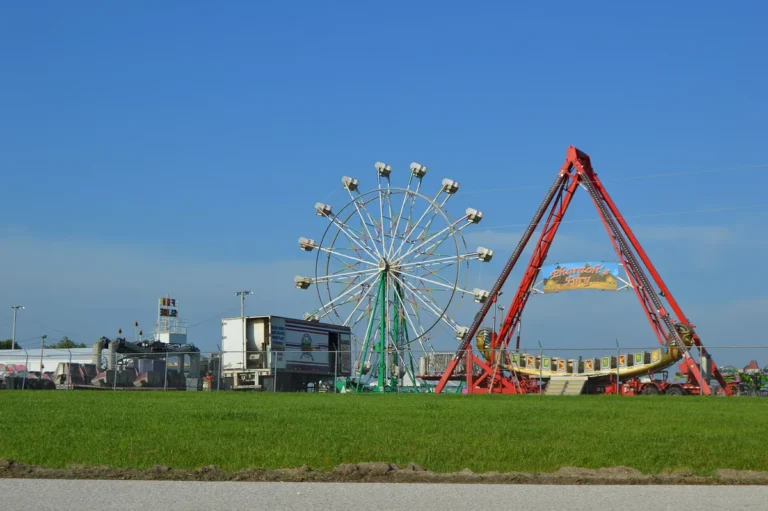
Gillette Family Shows supplies the carnival, midway and ride attractions, billed in fair copy as the operator for over thirty-five years. One honest gap needs stating plainly: the fair’s own questions page leaves the 2026 carnival ride prices unpublished until the operator’s season opens, so any ride figure attached to 2026 elsewhere has not come from the fair. Grounds entertainment rotates by edition: acts introduced in 2025, a pirate troupe, two magic acts and two named music bills, belong to 2025 alone, and a dog act plus a rodeo-clown billing from 2023 belong to that year instead. Thursday holds the week’s gentlest distinction: Celebrating Abilities Day, the fair’s special-needs day, whose ancestor event began in 1982 before roughly a thousand guests.
Planning Your Visit
Getting to Route 11 and Parking Free
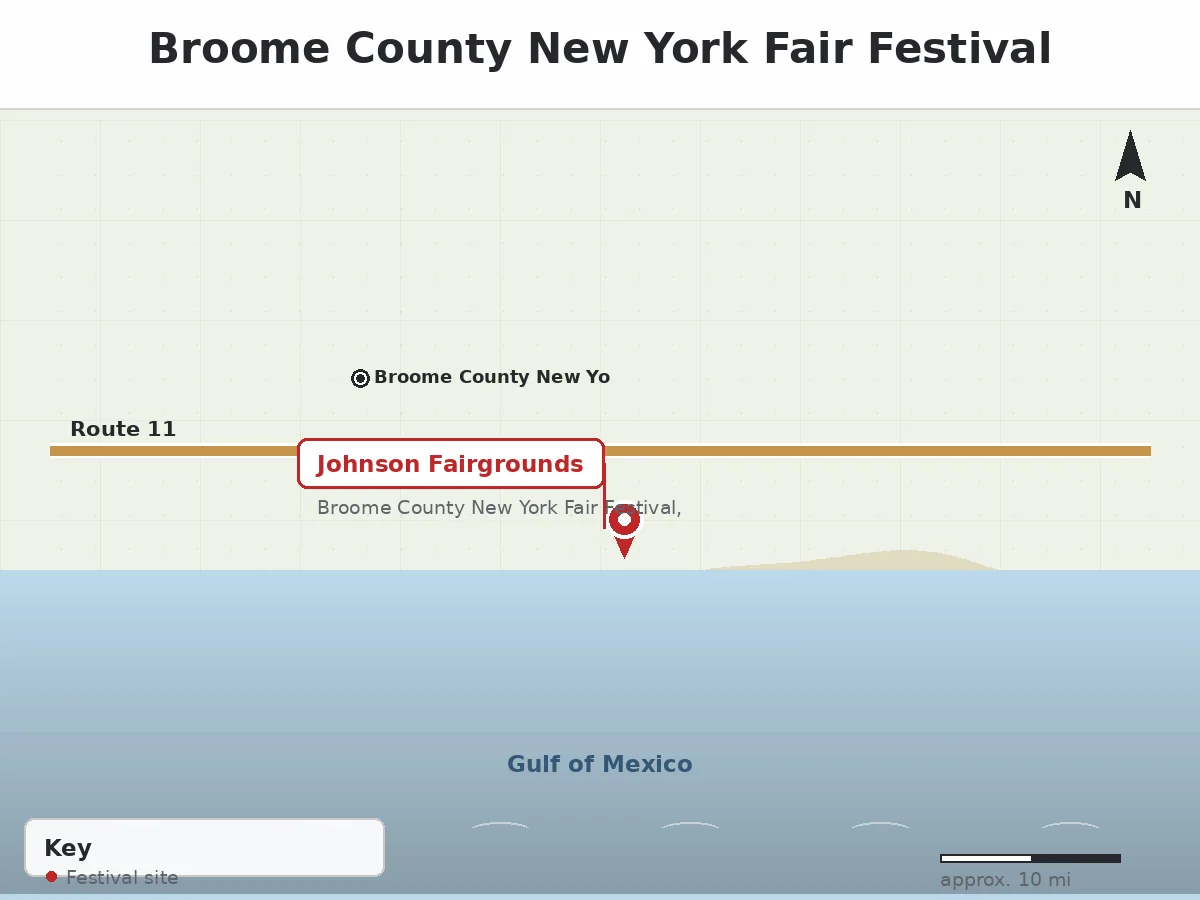
Aim for Whitney Point, not Binghamton, and allow for village streets never built for fair-week volume. Published parking is free, split between the grounds and the lots at the village intermediate school and high school, all first come, first served, so arriving early protects both a space and an unhurried barn walk. Admission is non-refundable and the fair runs rain or shine, with grandstand refunds unavailable once a show has started, so a forecast check before a derby night is simple prudence.
What the Gate Costs, Year by Year
The governing figures are the fair’s own for 2026: eight dollars for visitors aged thirteen and older, two dollars for children from five to twelve, and nothing for children under five, with youngsters required to be accompanied by an adult. A state tourism listing prints slightly higher figures for the same summer, but the fair’s own page outranks it and the two ladders must never be averaged. Older ladders belong to older fairs: the 2023 gate stood at seven dollars and one dollar, and a 2019 layer charged six dollars with every child of twelve and under free, a child rule that must not be quoted as current. In the 2025 pattern, generosity came by the clock: admission and grandstands were free all day Tuesday, free until noon on Wednesday and Friday, and free after five on Sunday, while pay-one-price ride windows cost twenty-five dollars on their set hours. No season-pass or wristband figure circulating in roundups has been published by the fair itself.
A Sample Saturday on the Grounds
Begin a Saturday the slow way, with the rabbit judging and the exhibit entries in the Franklin Building while the barns are still cool. Late morning suits the midway before its lines thicken, followed by an early lunch from the fair food stands. Give the noon hour to the semi-truck parade, then settle in for the semi-truck pulls from half past one. The four o’clock livestock and pie auction is the week’s commercial climax and the loudest encouragement young exhibitors will hear all summer. Evening belongs to the super stock and modified tractor pulls, so pace the day backwards from that session.
Beds Without a Fair Campground
No public fair-week camping exists in the fair’s own record, and nothing here should be read as quietly inventing one. Camping terms that surface for this address belong to a tenant festival renting the grounds in another season, and county parks campground rules govern county parks rather than this fairground, so neither describes a fair stay. Visitors should book ordinary lodging in Whitney Point or the Binghamton area.
A Cheap Gate Beside a Dear One
Set this fair beside the modern pay-one-price county fair and the contrast explains its loyalty. Many fairs now bundle gate and rides into a single steep ticket whether a visitor rides or not, whereas Whitney Point still sells a simple eight-dollar gate, charges two dollars for a school-age child, admits the youngest free and parks everyone for nothing. The trade is transparency: ride prices arrive separately and, for 2026, had not been published by the fair at all when the record was compiled. A family coming for livestock, pulls and derbies gets one of the least expensive fair days in the state, while a midway-minded family must wait for the operator’s own price list.
Checklist
- Navigate to Whitney Point and the Route 11 fairgrounds, never to Binghamton, the county seat that does not host this fair.
- Carry the 2026 ladder in mind: eight dollars from age thirteen, two dollars for ages five to twelve, under fives free with an adult.
- Check the fair’s own page before travelling for 2026 ride prices, which the fair leaves unpublished until the carnival season opens.
- Park free at the grounds or at the village intermediate and high schools, and arrive early because every lot is first come, first served.
- Count two demolition derbies in the documented pattern, Wednesday and Sunday, instead of planning around a single derby day.
- Keep Thursday free if Celebrating Abilities Day matters to your family, since that special-needs day is a fixture of the week.
- Book a hotel or inn for overnight stays, because the fair publishes no public camping of its own.
- Leave Binghamton’s balloon festival, held the following week at Otsiningo Park, as the separate event it is when sketching a longer trip.
Beyond the Fairgrounds
Whitney Point outside fair week is a quiet river village, and that quiet is part of the grounds’ other life. The fairgrounds rent out across the year to horse shows and gymkhana events, and to festivals whose crowds, rules and camping arrangements are entirely their own. None of that tenant calendar belongs to the fair’s programme, and a poster at this address in another month should never be read as fair news. Reservoir country lies a short drive away, while Binghamton down Route 11 holds museums, a ballpark and restaurants for visitors who want a city evening after a village fair day, the seat being a different and separate place from the fair.
Why This Fair Matters to Its County
A fair that charges eight dollars in 2026 is making an argument about who a county fair is for. This one keeps its centre of gravity on exhibitors: the pageants that open the week, the 4-H shows that fill its middle, the auction that pays its young farmers and the abilities day that widens its welcome all point the same direction. Continuity reinforces the claim: one society has conducted the fair across every documented era, one village has held it since 1891, and one midway family has worked its ground for over three decades by the fair’s own billing. In a county whose name usually travels with its city, the fair insists the rural north sets the summer calendar.
Frequently Asked Questions
Which town actually hosts the Broome County Fair?
Whitney Point hosts it, at the Broome County Fairgrounds on Route 11 in the village. Binghamton is the county seat and the region’s city, but the fair has been held in Whitney Point since 1891 in the Legislature’s anniversary record, and no Binghamton venue belongs to this fair.
How much does admission cost in 2026?
The fair’s own ladder for 2026 charges eight dollars for ages thirteen and older and two dollars for ages five to twelve, with children under five admitted free alongside an adult, and parking is free. Ride prices for 2026 are separate, and the fair expressly leaves them unpublished until its carnival operator’s season opens.
How many demolition derbies does the fair run?
The documented 2025 pattern ran two, one on Wednesday evening and a second on Sunday afternoon, under the fair’s own two-derbies billing. The pair sits inside a wider grandstand week of antique, hot farm, semi-truck and super stock pulling programmes plus a Friday rodeo.
Is camping available to fair visitors at the grounds?
No fair camping offer appears anywhere in the fair’s own publications, and camping rules attached to this address belong to a tenant festival or to county parks rather than to the fair. Overnight visitors should use hotels and inns nearby instead.
What to Expect From the Next Broome County New York Fair Festival
How often is the Broome County New York Fair Festival held?
It is held once a year, across six days in late July. The documented modern shape runs from a Tuesday opening to a Sunday close, a rhythm held across the 2022, 2023, 2025 and 2026 editions alike.
When is the next Broome County New York Fair Festival?
Following the 2026 edition of July 28 to August 2, the next fair falls due in late July of the following summer. The fair publishes each edition’s exact span itself, and one state directory’s extra day at the tail of the 2026 span shows why the fair’s own announcement is the date to trust.
Will the dates change?
Small movements are always possible, since a Tuesday-to-Sunday frame slides against the calendar even when the season stays fixed. What the record supports is stability of season rather than identity of dates: late July in Whitney Point is the constant, and the fair’s own questions page is where a coming edition’s days will be settled.
Whitney Point asks very little of its visitors: the right village, a few dollars at the gate and a week given over to animals, engines and neighbours. In return it offers one of New York’s most honestly priced county fairs, run by the same society on ground its nineteenth-century predecessors chose. Arrive for the parade, stay for the pulls, and let the seat keep its city summer while the village keeps the fair.