McKinley County New Mexico Eastern Navajo State Fair Festival
The fair this title points to publishes its own name more carefully than the title does. In every fair-side source it is the Eastern Navajo Fair; no fair document found adds the word State to that name. It belongs not to a county fair board but to the Eastern Navajo Agency, whose headquarters town, Crownpoint, hosts it in the east of McKinley County — Gallup, the county seat, does not. Nor is it the other fair this county appears in: the Cibola–McKinley Bi-County Fair at Prewitt is a separate institution, with its own town, board and season, and nothing about it belongs here. What Crownpoint holds each late July is the first fair of the Navajo Nation’s fair season, opened by a 4-H livestock and archery show and crowned by a Saturday parade. Its record publishes programme, partners and parade in detail — and never a gate price.
The Eastern Agency’s Fair
The organiser’s name reaches print in several forms, all unmerged here. The Navajo Nation Council’s release names the Eastern Navajo Fair Board, the body that voted on its fate in 2020. The 2026 4-H rules’ liability clause shortens it to the ENF Board. The parade rules send applications to the Eastern Navajo Fair committee; the vendor paperwork names Eastern Navajo Fair itself as payee. Around it stand the partners its sponsors page documents — the Crownpoint Office of Diné Youth, the Navajo Nation’s Division of Aging and Long Term Care Support, Navajo Technical University, Gallup-McKinley County Schools and the county itself — sponsors and partners, never the organiser. The 4-H show inside the fair is sponsored by its own 4-H Jr. Livestock Committee, with New Mexico State University Tribal Extension and county Extension staff as programme partners. The grounds are the CRPT Parks & Rodeo Fairgrounds in Crownpoint — the initials are the schedule’s own abbreviation for the town — and no street address for them is published.
Quick Facts
| Item | Detail |
| Fair name | Eastern Navajo Fair, its own published form |
| Fair town | Crownpoint, in eastern McKinley County |
| County seat | Gallup (the seat does not host this fair) |
| Venue | CRPT Parks & Rodeo Fairgrounds, Crownpoint; no street address published |
| Organiser | Eastern Navajo Fair Board, also the ENF Board and the Eastern Navajo Fair committee in print |
| Season | Late July |
| 2026 edition | Billed the 48th Annual, under the theme Shine and Show From the East |
| Opening event | 4-H Junior Livestock and Archery Show, run by the 4-H Jr. Livestock Committee |
| Admission | No gate or parking price published in the fair’s own record |
| Camping | No fair camping offer is published |
A History Counted in Billings, Not in a Founding Year
The fair’s age exists in the record only as billing. Its own documents billed the 2025 edition the 47th and the 2026 edition the 48th — numbers that agree arithmetically and still license no founding year, because annual billings are not a birth certificate, and a break in this fair’s history defeats any straight line backwards. In 2020 the Eastern Navajo Fair Board voted to cancel the fair over the pandemic’s gathering risk, before Navajo Nation legislation cancelled the Nation’s fairs and rodeos for the year. The billings thus run across a year with no fair at Crownpoint. What the record supports is continuity of institution: a Crownpoint health-services layer describes the fair as the town’s summer fixture of rodeo, pow wow, live music and dancing, and its parade rules carry its proudest claim — that its parade is the first parade to kick off the Navajo Nation fair season. No founding year or origin account is published in any fair-side source found.
What to Expect at Crownpoint
The 4-H Show Opens the Fair
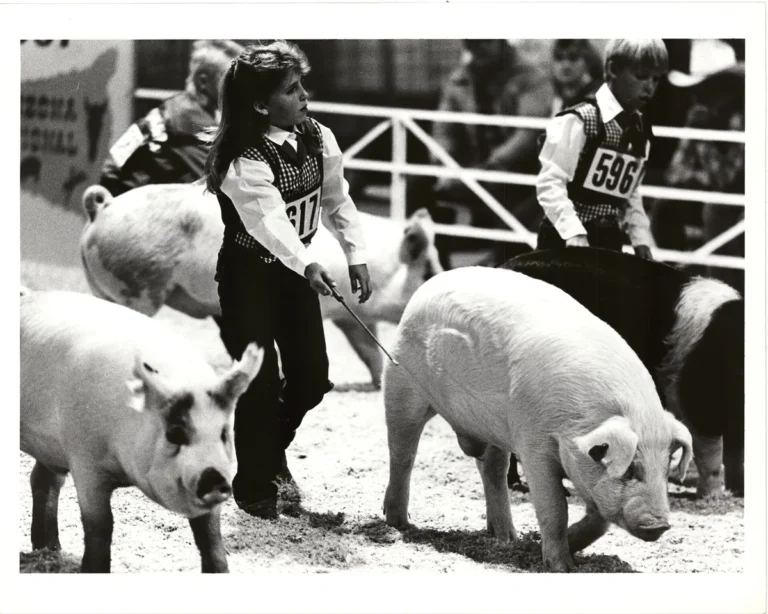
In 2026 the fair’s documented opening belonged to its young exhibitors: the 48th Eastern Navajo Fair 4-H Junior Livestock & Archery Show, sponsored by the 4-H Jr. Livestock Committee, filled the first days at the Larry Lantana 4-H Pavilion. Judging covered market lamb, swine, goat and beef with showmanship and a round robin, plus rabbits and poultry in the small-animal classes; indoor exhibits were judged alongside, the Parade of Champions filled the rodeo arena, and an archery target shoot completed it. The 2026 Extension rules set exhibitor entry fees — ten dollars for a large animal, five for a small animal, ten each for showmanship and archery, five for administration per exhibitor — fees young competitors pay to exhibit, never a price for walking through a gate.
Saturday Morning Belongs to the Parade
The 2026 parade carried the theme Shine and Show From the East through Crownpoint on fair week’s Saturday morning. Its grand marshals, representing the Eastern Navajo Agency, were two artisans: Mary Jane Garcia, a silversmith, and Virginia Yazzie Ballenger, whose field is fashion. Entries lined up from six in the morning at the Crownpoint junior and senior high school, at Eagle Drive and Chaco Boulevard, and stepped off at eight for Chapter Drive and Explorer Loop at the Crownpoint Chapter, with Navajo Nation Police assistance along the way. The fair’s parade page anticipated over nine thousand attendees — the organiser’s anticipation, not a counted crowd.
For a useful comparison, see the Luna County New Mexico Southwestern New Mexico State Fair Festival for another county festival.
ElderFest and the Fry-Bread Ladder
The fullest published programme is the 2025 schedule, and everything in this section and the next is fenced to that year. One anchor was Elder Day, carried as ElderFest with the Division of Aging and Long Term Care Support as working partner: a fun walk, a senior rodeo, and the senior divisions of the fair’s signature competition. That competition is the fry-bread contest ladder, run across the week in division after division — senior hen’s, senior women’s, youth girls’, youth boys’ and adult hen’s — and closed with an All Winners Fry Bread Finale. The same programme carried Miss Eastern Navajo through fashion show, pageant contest and coronation.
Pow Wow, Song and Dance, and the Arena
The pow wow held its Grand Entry on the Friday and again on the Sunday; song and dance registered on the Saturday and held roll call on the Sunday. The arena layered rodeo upon rodeo: a Senior Rodeo, the LJRA Open Jr. Rodeo, youth rodeo and bull riding, a team roping jackpot, and the CNRA Invite Open Rodeo closing the weekend. Country-western dances ran in the evenings, billed with that year’s acts only; no 2026 lineup is published to carry forward. The Office of Diné Youth ran a youth week inside the fair — youth fashion, a STEAM night, movie nights, a three-point shootout, a street dance and a comedy show — while a basketball tournament, a car show at Navajo Technical University, the Blue Mesa Run and Walk, and a golf tournament at an Albuquerque partner course filled out the week.
Planning a Crownpoint Trip
Reaching the Fairgrounds
Crownpoint sits in the east of McKinley County; Gallup, the county seat with the deeper stock of lodging and services, lies roughly forty-five minutes west. The fairgrounds publish no street address, so the journey is planned by the grounds’ name and the town. Most of the fair stands on the grounds, but the week escapes them: the parade runs through Crownpoint’s streets, and some documented events sit at partner venues in and beyond the town. The fairgrounds remain the fair’s home.
The Money Question, Answered Honestly
No admission price for the public appears in any fair-side source found — not on the fair’s site, not in its parade rules, not in the Extension’s rules — and the fair is therefore never described here as free. The single pricing trace in its own paperwork is vendor machinery from the 2024 application form: a weekend vendor paid two hundred dollars for a pitch including admission for two adults for the fair’s duration, with a refreshment tier at one hundred dollars. A pitch fee is not a gate ladder. Carry cash, settle the question at Crownpoint, and distrust any website quoting a confident gate price — several sister fairs publish their ladders openly, and their figures are the ones that travel.
A Sample Saturday at the Fair
Build the day around the parade, using the fair’s documented shape. Be in Crownpoint before the line-up gathers at the high school, in place along the route before the eight o’clock step-off. Give midday to the barns and exhibit tables, where judging and contests run their course, and the afternoon to the fairground competitions — the fry-bread divisions and the arena programme among them. Let the evening belong to the day’s closing events. Each year’s running order comes through the fair’s own pages; this shape is the standing one, and it rewards an early start.
Pinning Down the Dates
Late July is the season; the Nation’s own description of the fair is simply that it is held in July, though the week’s shape has moved within it. The documented 2025 edition ran a full week, with pre-opening days, a Wednesday opening and a Sunday close, while the 2026 edition’s published span was a compact four days, Thursday to Sunday, matching the fair-side anchors at both ends. Neither shape may be blended into the other, and at least one festival guide prints a span a day early at both ends against every other layer — work from the fair’s own site and the Extension’s rules, not from listings.
Separating the Eastern Fair From Its Neighbours
McKinley County touches two fairs, and confusing them is the commonest reader error. The Cibola–McKinley Bi-County Fair is held at Prewitt in September, around the Labor Day weekend, under its own Bi-County Fair Board. The Eastern Navajo Fair is held at Crownpoint in late July, under the Eastern Navajo Fair Board and committee, as the Eastern Agency’s fair. Different towns, organisers, seasons and communities; county exhibitors genuinely appear in both records, and the two fairs share nothing else. Beyond the county stand its sister fairs — the Navajo Nation Fair at Window Rock, the Northern Navajo Fair at Shiprock, the Central Agency Fair at Chinle, the Ramah Navajo Fair at Pine Hill and the Western Navajo Fair at Tuba City — each with its own record, from which no date, price or programme detail is borrowed. The Eastern fair’s distinctions need no borrowing: it opens the Nation’s fair season from the east, and it publishes no gate price at all.
A Crownpoint Checklist
- Plan around late July in Crownpoint, confirming the year’s dates on the fair’s own site first
- Budget without a gate price, because none is published; carry cash for the grounds
- Reach Crownpoint early on parade Saturday: line-up begins at six in the morning, step-off at eight
- Book overnight stays ahead in Crownpoint or Gallup; no fair camping is published
- Keep exhibitor money separate: 4-H entry fees are paid by young competitors, not visitors
- Hold the September Bi-County Fair at Prewitt apart: a different fair in the same county
- Distrust any page styling this event the Eastern Navajo Nation Fair: template copy, not the fair’s name
- Expect programme detail from the fair’s own pages and Extension rules, not listing sites
Beyond the Fairgrounds
Crownpoint’s life outside fair week is best met as the town’s own, not the fair’s. It is known for its rug auctions, a separate institution in no relation to the fair’s programme. Travellers pair a Crownpoint stay with the wider region, whose best-known draw is Chaco Canyon’s celebrated ancestral ruins; that heritage belongs to the region, never to the fair. Gallup serves as the larger service and lodging town, and its own gatherings — the Inter-Tribal Ceremonial among them — are Gallup events entire, fenced off from this fair in both directions.
The Fair’s Place in Agency Life
A county fair usually belongs to a county; this one belongs to an agency, and the difference explains its shape. Its competitive spine runs from the very young to the very old: a 4-H show administered with the university’s tribal Extension at one end of life, a youth week from the Office of Diné Youth in the middle, and ElderFest, built with the Nation’s elder-services division, at the other end. Its signature contest is not a demolition derby or a headline concert but a fry-bread ladder climbed division by division. Its proudest billing is positional: the East goes first, and the Nation’s whole fair season unfolds behind it. An event documented on those terms is a community institution, published in everything except a price.
Frequently Asked Questions
Where in McKinley County is this fair held?
In Crownpoint, at the CRPT Parks & Rodeo Fairgrounds in the county’s east. Gallup is the county seat but does not host this fair, and the grounds publish no street address, so Crownpoint itself is the direction to plan by.
What does the fair charge the public to enter?
No one can say from the fair’s own record, which publishes no gate or parking price anywhere, and does not describe the fair as free either. Its only published figures are vendor pitch fees and 4-H exhibitor entry fees — neither is a visitor’s admission price.
Is this the same event as the Bi-County Fair at Prewitt?
No. The Bi-County Fair is a separate two-county exhibitor fair at Prewitt in September, under its own board; the Eastern Navajo Fair is the Eastern Agency’s fair, at Crownpoint in late July, under its own board and committee. No fact from either belongs to the other.
Which parts of the programme anchor the week?
Three anchor it: the 4-H Junior Livestock and Archery Show that opens the fair, the Saturday parade carrying the year’s theme through Crownpoint, and the contest programme built around the fry-bread ladder, ElderFest, the pow wow and the rodeos.
What to Expect From the Next McKinley County New Mexico Eastern Navajo State Fair Festival
How often is the McKinley County New Mexico Eastern Navajo State Fair Festival held?
Once a year. The event published as the Eastern Navajo Fair returns to Crownpoint every late July; the Navajo Nation’s own description of it is a fair held in July.
When is the next McKinley County New Mexico Eastern Navajo State Fair Festival?
The next edition follows the annual pattern in late July, after the 2026 edition billed as the 48th. No next-edition dates appear in the record yet; watch the fair’s own site and the Extension’s rules for the announcement.
Will the dates change?
The shape has changed before: the documented 2025 edition ran a full week, while 2026 was published as four days, Thursday to Sunday. Late July is the constant. Confirm each year’s span against the fair’s own announcements, because listings have printed this fair a day early at both ends.
The Eastern Navajo Fair asks more of its readers than most fairs: its name corrected, its county neighbour kept separate, its price honestly missing. What it gives back is the first fair of a nation’s season, hosted on its own terms — exhibitors at the pavilion, elders at their festival, fry bread judged division by division, and a parade rolling out of the east before anywhere else has begun.