Curry County New Mexico Fair Festival
In Clovis, the county seat itself hosts the fair. The Curry County Fair occupies the Curry County Fairgrounds on East Brady Avenue for five days in mid-August, produced by a board that exists because state law and a county agreement say it should. This is not a rodeo weekend wearing a fair name, and not the other Curry County fair search results surface from the Oregon coast. It is one county’s midsummer accounting of its animals, kitchens, gardens and young exhibitors.

A Fair Run by a Board the Law Created
The Curry County Fair Board carries the production. Its members, up to seven in number, are appointed by the Curry County Board of Commissioners, and a commissioner liaison sits within its structure. A memorandum of understanding between the board and the commissioners states its primary function in plain language: to oversee the planning, preparation and production of the County Fair. The board is also described in that agreement as empowered by state statute for the fair, placing this event in a different category from a volunteer committee or a private carnival promotion.
That legal footing changes who holds the grounds, and when. During fair week, the Fair Board has the use and control of the Fairgrounds. Across the rest of the year, management rests with Curry County, through its Events Center manager. Those arrangements are separate: the board that runs the fair in August does not manage the venue in February.
The second producing partner works from a different direction. New Mexico State University Cooperative Extension, Curry County, runs the Home, Arts and Agriculture Division and the 4-H machinery that feeds it, publishing the fair book for the 2026 edition with its entry windows, judging order and class lists. Where the Fair Board supplies the statutory frame, Extension supplies the rulebook by which exhibits are actually judged.
Quick Facts
| Item | Detail |
| Published name | Curry County Fair |
| Organiser | Curry County Fair Board, appointed by the Board of County Commissioners |
| Exhibit partner | New Mexico State University Cooperative Extension, Curry County |
| Fair town | Clovis |
| County seat | Clovis, which also hosts the fair |
| Grounds | Curry County Fairgrounds and Curry County Events Center, 1900 East Brady Avenue, Clovis |
| Season | Five days, Tuesday to Saturday, in mid-August |
| Documented 2026 shape | Exhibits judged on the opening Tuesday and shown through the fair |
| Admission | Entry is ticketed; no 2026 amount is published in the fair-side record |
| Parking and camping | No visitor parking price and no fair-week camping offer are published |
History Without a Founding Date to Lean On
An honest history of this fair begins with an admission: the fair-side record found for it publishes no founding year. No edition number, anniversary billing or origin slogan appears in Extension’s fair book, in the county’s agreement with its board, or in the city’s listing. Any article that opens with a confident birth year for the Curry County Fair has imported that year from somewhere else, and this one declines to do so.
For a useful comparison, see the Colfax County New Mexico Fair Festival for another county festival.
What the record does document is a structure, and structures have their own history. A county that writes its fair into a formal agreement, appoints its producers and reserves fair-week control of public grounds to them is describing an institution expected to recur. The board’s agenda packets run through the 2026 season, the paper trail of a body that answers for an annual event. Continuity here is proved by governance still in motion, not by a banner counting summers.
The grounds tell a parallel story. The Events Center anchors a complex built for repeated public use: an arena, grandstands and exhibit buildings hosting rodeos, livestock shows and civic gatherings across the calendar. Those bookings show a working county asset rather than a field borrowed once a year, but they do not become part of the fair merely because they share its address. Clovis grew as a railroad and agricultural centre on the high plains, but the town’s past is county context only, never the fair’s own history.
What to Expect
The Indoor Division Judged First
The Home, Arts and Agriculture Division gives the fair its earliest deadline and its longest display. Extension’s 2026 book opens online entries at the start of July, accepts exhibits on the Monday before opening, and judges them on the Tuesday the fair begins. From Tuesday afternoon the work opens to the public and stays on view through the fair, with pickup on the Sunday after closing.
The classes reach well beyond a bake-off table: agriculture, photography in amateur, professional and junior divisions, baked products, food preservation, crafts, clothing and sewing, needlecraft and quilting, a flower and horticulture show, and art.
Livestock, 4-H and FFA in the Barns
Animals give the outdoor half of the week its rhythm. Livestock shows and the 4-H and FFA programme form the standing shape of the fair, with young exhibitors presenting animals they have raised, fed and fitted over preceding months. The judging rewards that long preparation in a few minutes of ring time.
Extension’s role is most visible here, because the 4-H machinery of enrolment, entry and eligibility runs through its office. FFA chapters bring a second youth tradition into the same barns, equally serious about stockmanship.
Midway Lights and Evening Music
The city’s record for the 2026 fair names carnival rides, food vendors and live musical performances among its draws, and those elements supply the fair’s public face after dark. The midway occupies the hours when exhibit halls thin out and families who came for supper stay for the lights, and vendors feed the crowd across days that start with morning shows and end with night performances.
Mutton Bustin and the Night Rodeo Inside Fair Week
One rodeo layer genuinely belongs to this fair. Mutton bustin, in which young children ride sheep in protective gear, is documented as running with the fair, with riders advancing into the night’s rodeo performance at the Mounted Patrol outdoor arena. The operator’s own fair form carries a revealing requirement: contestants and adults alike were still required to purchase a Curry County Fair entry ticket. That line proves the rodeo element sat inside the fair’s fence and that entry itself was sold, not waved through.
The layer is documented for the 2024 fair and recorded here as the fair-week shape in that layer, not as a guaranteed 2026 running order. Clovis also stages a professional rodeo each June at these same grounds, separate in dates, tickets and programme, and nothing from it is borrowed here.
Planning Your Visit
Working Backwards From a Mid-August Week
The fair runs Tuesday to Saturday in the middle of August, and the documented 2026 edition followed that shape in the second full week of the month. Season is the safe planning fact. Exhibitors work to a longer calendar than visitors: entries open weeks ahead, exhibits arrive the day before judging, and animals are prepared for months. Visitors should protect the evenings, because music, midway and rodeo programming concentrate after judging ends.
Saturday suits a single-day visit best, with the indoor show complete and livestock results known. A Tuesday visit offers judging day itself, when the exhibit division is decided.
The Ticket Question, Answered Honestly
Entry to this fair is ticketed, established clearly by the entry-ticket requirement written into the fair-week rodeo paperwork. What the record does not publish is the amount: no gate price appears in the Fair Board’s agreement or agendas, in Extension’s exhibitor book, or in the city’s listing. The correct statement for 2026 is narrow: a ticket is required, and its price is not published in the fair-side sources.
Two shortcuts must both be refused. The fair may not be called free, because a ticket requirement contradicts that word directly. And a low daily figure circulating on resale pages may not be printed as the fair’s price, because resale listings are not the fair speaking. Confirm the current amount through the Events Center or the Fair Board.
A Sample Day From Judging Ring to Arena
Begin in the exhibit buildings while the morning is cool, walking the Home, Arts and Agriculture display slowly enough to read the class cards. Late morning belongs to the barns, where livestock classes explain the county’s agriculture better than any panel could, and lunch comes from the vendors on the grounds.
Return through the midway in the late afternoon as the rides fill. If mutton bustin runs that evening in your edition, reach the arena early to watch the youngest riders earn their place in the night programme. Close with the live music and a final pass under the midway lights.
Parking, Addresses and a Bed for the Night
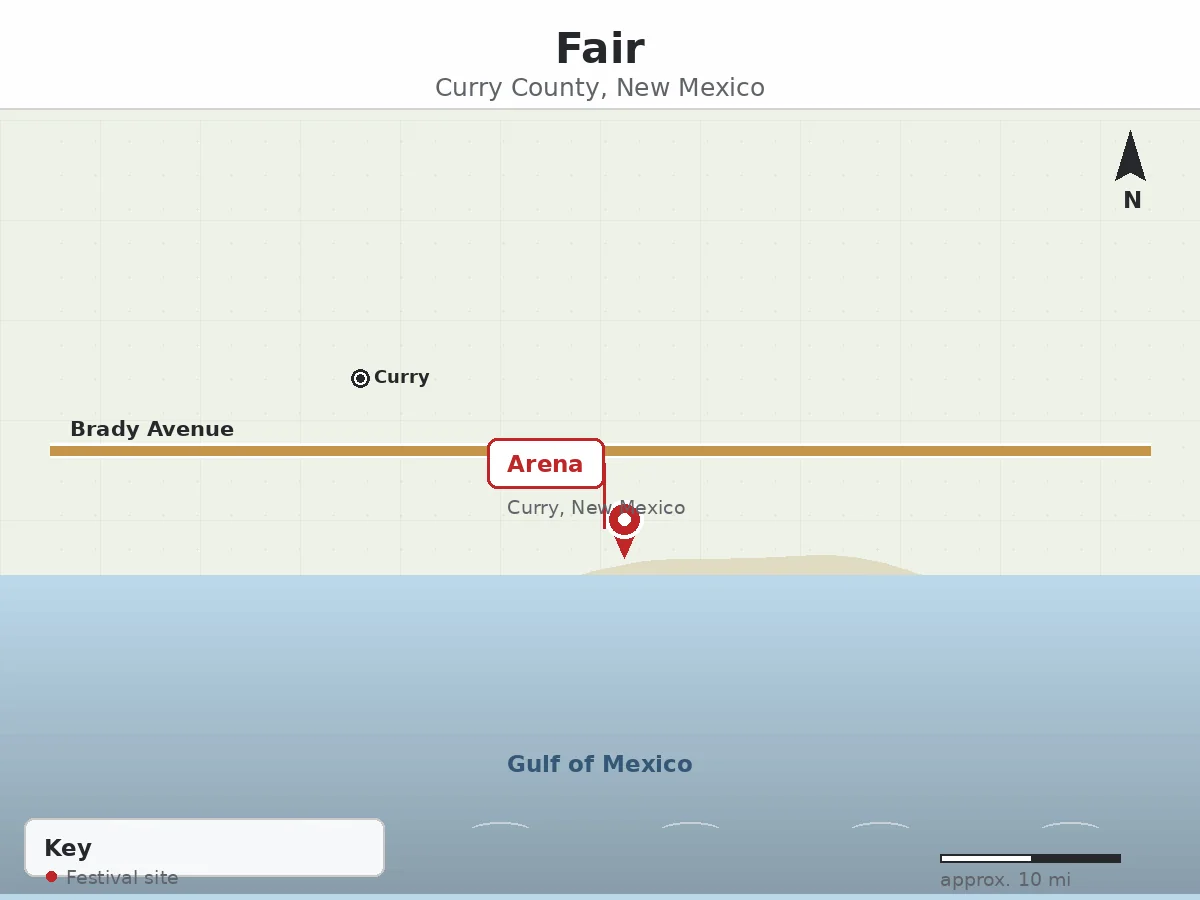
The address to carry is 1900 East Brady Avenue, Clovis. The fairgrounds and the Events Center describe the same county complex, so a search under either name lands at the same gates. No visitor parking price appears in the fair-side record, and an exhibitor parking-pass charge found in a commercial exhibits document is not a visitor parking price and is not presented as one here.
No fair-week camping offer is published, and none should be assumed from the size of the grounds. Overnight visitors should plan on Clovis lodging, booking early because fair week fills rooms quickly. Drivers from across the plains should fuel with margin.
How This Fair Compares
Set this fair beside the other Curry County fair in Oregon and the comparison collapses into a warning. That coastal county, seated at Gold Beach, has its own fair board, its own event centre on the beach and its own midsummer fair, and its board’s page dominates searches for this fair’s organiser. Nothing about it belongs in New Mexico: not its dates, not its officers, not its grounds.
Set it beside the June professional rodeo on its own grounds and the difference is scope. The rodeo is a single-sport professional production; the fair is a county-wide exhibition that happens to include a rodeo element inside its week. Livestock judging, a full indoor division, a midway and concerts answer to the fair’s name in August, while the June programme answers to its own.
Against other New Mexico county fairs, Clovis offers a governance story most cannot match in print. Few fairs can point to a published agreement stating who produces them, who appoints the producers and who controls the grounds during their week. That paper trail makes this fair easier to verify than to romanticise.
Before You Leave for Brady Avenue
- Confirm the exact August days for your edition through the Events Center or the Fair Board.
- Ask the current gate price directly rather than trusting a resale listing, because no amount is published in the fair-side record.
- Carry both cash and a payment card, and never repeat the claim that entry is free; the fair’s own paperwork requires a ticket.
- Exhibitors should note that entries open weeks ahead and exhibits arrive the Monday before judging under Extension’s fair book.
- Book Clovis lodging early, and do not plan around fairgrounds camping, because no camping offer is published.
- Keep the June professional rodeo on its own calendar; only the fair-week rodeo element belongs to this event.
- If a search result describes a fair board on an Oregon beach, close the tab.
Beyond the Fairgrounds
Clovis rewards a visitor who treats the fair as the centre of a wider stop. The city carries a notable place in recorded music history through its association with early rock and roll recording, and its downtown fills the fair’s quieter midday hours. The surrounding county opens into high plains ranch country, where the agricultural life judged in the barns is visible at working scale among the fields and pastures that supply the fair’s entries.
Why a Statutory Fair Matters Here
A fair written into county agreements might sound like bureaucracy until its opposite is imagined. Events that rest on one volunteer or one sponsor’s mood can vanish without a meeting ever being held to end them. This fair rests instead on an appointed public board, a university Extension office publishing its rulebook, and grounds the county maintains as a permanent asset, so no single retirement quietly cancels the county’s summer.
The arrangement also protects exhibitors. A published fair book means a young photographer, a quilter or a 4-H member can learn the classes and judging standards months ahead. And the fair matters because town families walk the same barns as ranch families who drove in before dawn, and a town baker’s work is judged beside a farm kitchen’s preserves.
Frequently Asked Questions
Is the Curry County Fair actually held in Clovis?
Yes. The fair takes place at the Curry County Fairgrounds in Clovis, anchored by the Curry County Events Center at 1900 East Brady Avenue. Clovis is also the county seat, so here the seat and the fair town are the same place.
How much is entry to the fair?
Entry is ticketed, and the fair-week rodeo paperwork states that contestants and adults alike had to buy a Curry County Fair entry ticket. No 2026 amount appears in the Fair Board’s documents, Extension’s book or the city’s listing, so no price can honestly be quoted here. Check with the Events Center before budgeting, and ignore resale figures.
Who runs the Curry County Fair?
The Curry County Fair Board produces it, under an agreement with the Board of County Commissioners that names planning, preparation and production as the board’s primary function. Its members are commissioner-appointed, and the board controls the grounds during fair week. Extension runs the Home, Arts and Agriculture Division and the 4-H side.
Is the June rodeo at the same grounds part of the fair?
No. The professional rodeo held at the grounds in June is a separate event with its own programme and tickets. The fair has its own rodeo element documented inside fair week, built around mutton bustin riders advancing into the night performance, and only that layer belongs to the fair.
What to Expect From the Next Curry County New Mexico Fair Festival
How often is the Curry County New Mexico Fair Festival held?
The fair is an annual event, produced each summer by the appointed Fair Board with Extension publishing its exhibit book for the edition. Its yearly rhythm is visible in the board’s continuing agenda business and in the fair book prepared for 2026.
When is the next Curry County New Mexico Fair Festival?
Expect the next edition in the middle of August, running Tuesday to Saturday across five days in Clovis. Exact calendar days belong to that edition’s own announcements, so confirm them through the Events Center or the Fair Board rather than copying one year’s dates onto the next.
Will the dates change?
The mid-August, Tuesday-to-Saturday shape is the pattern the recent record supports, and small shifts within that season are always possible. Treat the season as dependable and the precise span as provisional until the fair’s own channels publish it.
A county fair survives on paperwork as much as applause, and in Curry County the paperwork is unusually good. A statutory board, a published fair book and grounds held in public hands give Clovis an August institution that can be checked and trusted.