Merrimack County New Hampshire Market Days Festival
Every summer, downtown Concord gives its main shopping street over to a festival. The Merrimack County New Hampshire Market Days Festival fills Main Street in New Hampshire’s capital city for three days in late June, with vendor booths where traffic usually runs, music carrying into the evening, and the lawn of the State House turned into a family zone. It is organised by Intown Concord, the downtown association, and bills itself in 2026 as the fifty-second annual edition.
One point needs settling at the start, because the county name invites the wrong picture. Market Days is a downtown street festival, not a county fair. There are no livestock barns, no exhibition halls and no fairgrounds anywhere in its footprint. Merrimack County’s 4-H exhibition life belongs to a separate event elsewhere in the county, and nothing from that event’s programme belongs to this one. What Market Days offers instead is a capital city closing its principal street and inviting everyone to walk it.
A Main Street Taken Over by Its Own Downtown Association
Intown Concord, the association that promotes and supports downtown Concord, runs the Market Days Festival, and its role shows in the festival’s shape. Rather than renting a ground and filling it, the festival occupies the working centre of the city: Main Street is closed to vehicles between Centre Street and Hills Avenue, and the booths, stages and crowds spread along the blocks between those two points. Downtown merchants trade alongside visiting vendors, so the festival and the ordinary life of the street are deliberately mixed together.
A partner organisation looks after one distinct corner of the programme. The Concord Arts Market runs the arts market component, in Eagle Square on all three days and along Capitol Street on the Thursday and Friday. It is a component partner, not a joint organiser of the whole event.
Concord matters to the festival’s identity in a second way. It is both the Merrimack County seat and the capital of New Hampshire, and the festival leans on that setting. The New Hampshire State House provides the natural reference point for finding the festival, its lawn hosts the family activities, and City Plaza, a short step away, holds the information booth.
For a useful comparison, see the Hillsborough County New Hampshire Agricultural Fair Festival for another county festival.
Quick Facts
| Detail | What the record shows |
| Festival | Market Days Festival |
| Organiser | Intown Concord |
| Festival town | Concord |
| County seat | Concord (also the state capital) |
| Setting | Main Street, downtown Concord, between Centre Street and Hills Avenue |
| Season | Late June, Thursday to Saturday, three days |
| Daily hours | 10 in the morning to 10 at night |
| Admission | Free to attend |
| Vendors | More than 160 across the closed street |
| Family area | KidZone on the State House lawn |
History
The honest history of Market Days is a short one. Intown Concord bills the 2026 festival as the fifty-second annual Market Days, and that billing is the record’s anchor: a downtown festival that has returned often enough, and long enough, for its organiser to count the editions into the fifties. No earlier account accompanies the billing in the material the festival publishes about itself, so no founding year is claimed here. Counting backwards from an edition number to a first year is arithmetic, not evidence, and skipped or interrupted years would quietly break it.
What can be said without invention is what the billing implies and what the modern festival demonstrates. Market Days belongs to the generation of American downtown festivals built around a simple bargain: close the main street, fill it with sellers, food and music, and let the town centre be a destination in its own right for a few days. Concord’s version has kept that bargain at a notably large scale, and it has kept evolving within that frame: recent additions include an interpreted headline performance, a nursing and changing station in the family area, and the shuttle arrangements described later in this article, new in 2026.
What to Expect
More Than One Hundred and Sixty Vendors on a Closed Street
The commercial heart of Market Days is its vendor rows. More than one hundred and sixty vendors line the closed blocks of Main Street, a mixture of craft and artisan sellers, food vendors and the downtown merchants whose shops stand behind the booths. A dedicated Food Truck Alley gathers the mobile kitchens in one stretch, so eating becomes a destination within the festival rather than a pause between other things. Because the street stays closed for all three days, the layout is stable: a stall found on Thursday is in the same place on Saturday.
Music That Builds Toward the Night
Live music runs through the festival days, and the structure of each day bends toward the evening. Headlining performances occupy the last two hours, from eight to ten at night, when many booths have closed and the street turns from market to concert crowd. In 2026 the Friday night headliner was accompanied by an American Sign Language interpreter, a detail worth knowing for visitors planning their evening around that set.
The KidZone on the State House Lawn
Families are pointed toward the State House lawn, where the KidZone gathers bounce houses and family activities on the grass in front of the golden dome. A Fit4Mom breastfeeding and changing station joined the area as a new provision in 2026, which tells parents of babies that the festival expects them. Some KidZone items are sold through a ticket booth, payable in cash or by Venmo, so the area is best understood as mostly free activity wrapped around a few paid amusements.
Beer Tents and the Arts Market
Adults have their own landmarks. Three beer tents operate during the festival, taking cash and cards, and give the evening crowd places to settle between the stages and the food stalls. Across the street pattern, the Concord Arts Market brings a quieter, maker-focused strand: arts and crafts in Eagle Square throughout the festival and on Capitol Street for the first two days. Visitors who prefer browsing original work tend to start there.
Planning Your Visit
Getting In and Parking the Car
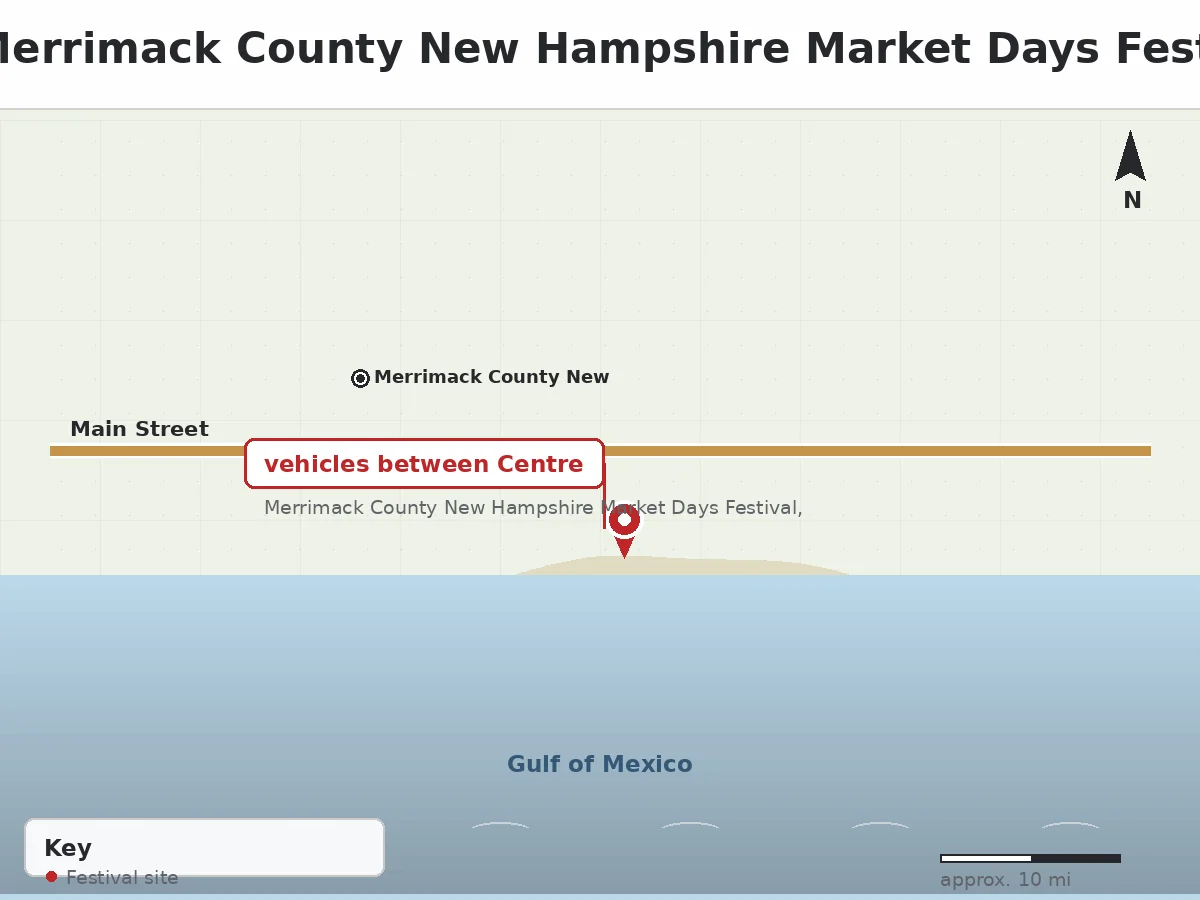
Because the festival is a street closure rather than a ground, arrival is a matter of reaching downtown Concord and walking a block or two. The State House is the reference point the festival itself suggests for navigation. Drivers use public street parking or the municipal garages on Storrs Street, State Street and School Street. Garage parking is free on Saturdays, the busiest day, while weekday garage charges belong to the city rather than the festival and are not quoted here.
A new option arrived in 2026: a free accessible shuttle from the campus of NHTI, Concord’s community college, running between ten in the morning and eight at night on all three days. Two warnings from the festival deserve repeating. The Market Basket Plaza lot and the Concord Food Co-op lot are named as places not to park, with towing as the stated consequence. Main Street itself closes early on the Thursday morning and reopens in the small hours after the festival ends.
A Sample Saturday in the Festival Streets
Start mid-morning, when the booths open and the street is at its calmest. Walk the full length of the closure once, from Centre Street to Hills Avenue, noting the stalls worth a second look, then drift into Eagle Square for the arts market while crowds are still thin. Take lunch from Food Truck Alley before the noon queues build. Spend the early afternoon on the State House lawn if children are with you, or in the downtown shops if they are not. Return later for the purchases you marked, eat early in the evening, and let the headline set from eight to ten close the day.
What a Day Costs
Market Days is, in the festival’s own words, completely free to attend. There is no gate, no wristband and no ticket for entry to the street, the stages or the lawn. The costs that do exist are the ordinary ones of any market day: food, drink, merchandise and a few activities carry their own prices, charged item by item. Registration fees exist in the festival’s paperwork, but they are what vendors pay for booth space, never a charge on the people walking past the stalls.
Weather and the Shape of the Days
The festival runs rain or shine, with no rain dates held in reserve, so a wet forecast is a reason to pack a jacket rather than cancel. Its days are long and consistent: ten in the morning until ten at night, Thursday through Saturday in late June. Visitors who dislike dense crowds aim for Thursday or the first hours of any day; those who want the full evening atmosphere accept the Saturday crowds as part of the occasion. Intown Concord bills the gathering as drawing a diverse audience of over fifty thousand attendees, which is the organiser’s own billing for its scale rather than a turnstile count, but even treated cautiously it warns you to expect a busy street.
How a Street Festival Differs From a County Fair
Readers arriving from New Hampshire’s agricultural fairs will feel the differences quickly. A county fair concentrates everything on one fenced ground, charges at a gate, and organises its days around judged animals and exhibits. Market Days inverts nearly every element of that model. Its ground is a public street that happens to be closed; its gate is imaginary, because entry is free; and its judging, where it exists at all, sits inside the arts market rather than in show rings. There is no camping because there is nothing to camp on, and no premium book because nobody is competing for ribbons.
What Market Days gives up in agricultural depth it returns in setting and access. A fair visitor pays to enter a ground set apart from ordinary life; a Market Days visitor walks into the middle of a working capital city that has rearranged itself for three days.
Visitor Checklist
- Arrive before eleven on Saturday to walk the vendor rows before the heaviest crowds form.
- Park in a municipal garage on Saturday, when garage parking is free, or ride the free shuttle from the NHTI campus.
- Never leave a car in the Market Basket Plaza or Concord Food Co-op lots, where towing is the stated outcome.
- Carry both cash and a card, since the beer tents take either while the KidZone booth takes cash or Venmo.
- Bring a rain jacket whatever the forecast says, because the festival runs rain or shine with no reserve dates.
- Plan the evening around the headline performance, which runs from eight to ten each night.
- Set a meeting point at the information booth on City Plaza in case people get lost in the crowd.
- Leave time for Eagle Square, where the arts market rewards slower browsing than the main vendor rows.
Beyond the Festival Grounds
There are no festival grounds to be beyond, so this section belongs to downtown Concord itself. The State House, whose lawn the festival borrows, rewards a closer look once the KidZone has been explored: it anchors the festival’s geography and explains why this stretch of Main Street feels ceremonial as well as commercial.
The downtown shops and restaurants that trade through the festival are the other obvious extension of a visit. Many merchants behind the booths keep ordinary premises a few steps away, and a sit-down meal on a side street offers a calmer counterpoint to the food trucks. Concord is also the natural base for anyone combining the festival with a wider Merrimack County trip.
Why Market Days Matters to Concord
A festival that closes a capital city’s main street for three days is making an argument about what a downtown is for. Market Days argues that the street belongs, at least once a year, to pedestrians, small sellers and neighbours rather than through traffic. For independent makers and food businesses, a place in the vendor rows puts them in front of the largest walk-by audience most of them will meet all year.
The festival also performs a quieter civic service: it brings county residents into their seat of government as guests rather than petitioners, and spreads families across the State House lawn. Intown Concord describes the event as among the largest of its kind in New England; the claim is billing and is treated as such here, but the point stands without the superlative.
Frequently Asked Questions
Is Market Days the Merrimack County fair?
No. It is a downtown street festival organised by Intown Concord on Main Street in Concord. The county’s 4-H exhibition activity is attached to a separate event elsewhere in Merrimack County, and Market Days has no livestock shows or fairground programme of its own.
Is there an entry charge at Market Days?
Nothing at all. The festival’s own guidance states that Market Days is completely free to attend. Food, beverages, merchandise and a handful of activities are sold individually once you are inside, but entry to the street, the music and the lawn costs nobody anything.
Where should I park, and is there a shuttle?
Use public street parking or the municipal garages on Storrs Street, State Street and School Street; garage parking is free on Saturdays. A free accessible shuttle also runs from the NHTI campus between ten in the morning and eight at night each day. Avoid the Market Basket Plaza and Concord Food Co-op lots, which the festival names as tow-away risks.
What happens if it rains during the festival?
The festival goes ahead anyway. Market Days is held rain or shine and keeps no rain dates, so wet weather changes what you wear rather than whether the event happens.
What to Expect From the Next Merrimack County New Hampshire Market Days Festival
How often is the Merrimack County New Hampshire Market Days Festival held?
Once a year. Market Days returns each summer as a three-day festival, Thursday to Saturday, organised by Intown Concord in downtown Concord, and its place in late June has become the fixed point around which the city’s early summer is arranged.
When is the next Merrimack County New Hampshire Market Days Festival?
The next edition is expected in late June, following the festival’s established pattern of three days, Thursday to Saturday, on a closed Main Street. Exact dates for a future edition are the organiser’s to publish, through Intown Concord’s own channels closer to the season; this article will not guess them in advance.
Will the dates change?
The late-June position is the festival’s settled habit, and nothing in its published material suggests a move. Small details around the anchor dates, such as shuttle hours, street closure times and which components appear on which day, are the parts most likely to be adjusted from year to year, and they are confirmed only when the organiser publishes the next edition’s guidance.
Visitors who remember one thing about Market Days should remember the simplicity of its offer. For three days each June, the capital of New Hampshire closes its main street, hangs no price on the entrance because there is no entrance, and lets a county’s worth of people wander among stalls, stages and food trucks. Come early, park smartly, and stay for the headliners.

One Comment