Cheyenne County Nebraska Fair & Rodeo Festival
Late July brings a full week of noise, dust and judged livestock to Sidney, where the Cheyenne County Fair & Rodeo takes over the county fairgrounds on the Lincoln Highway. This is the Cheyenne County Fair Board’s own production, a fair and rodeo published under one name and run Saturday to Saturday in the Nebraska panhandle summer. Its grandstand week is unusually well documented: the board prints its officers, its sponsorship package and every grandstand price, and the county paper covered the most recent edition as it happened. The barns and exhibit entries carry the daylight hours, and the evenings belong to a ticketed grandstand card running from a professional rodeo through monster trucks and concerts to lawnmower races and a closing demolition derby.
A Fair Board’s Fair, Run in the Open
The organiser here is the Cheyenne County Fair Board, and no agricultural society stands above it in the record. The board works through its own officers, alternate members and a rodeo committee, and transacts a striking amount of its business where anyone can read it: pass prices were settled at a March board meeting, sponsorships were solicited through a printed package with a mid-June deadline, and the county’s official notices place the fairboard’s meetings at its office on the fairgrounds. The 4-H and open class side runs with Nebraska Extension in Cheyenne County, whose fair book pages carry the board’s information, the entry machinery and the ticket details. The fair’s sponsor in the published record is a local towing firm, Ron’s Towing & Transport, a reminder that a panhandle fair of this size rests on hometown backing as much as on ticket sales.
Quick Facts
| Point | Detail |
| Published name | Cheyenne County Fair & Rodeo |
| Organiser | Cheyenne County Fair Board, with Nebraska Extension in Cheyenne County on the 4-H side |
| Fair town | Sidney, which is also the county seat |
| Venue | Cheyenne County Fairgrounds |
| Grounds address | 10955 Lincoln Highway, Sidney, Nebraska |
| Season | Late July, a full week running Saturday to Saturday |
| Billing for the 2026 edition | 140th annual, billed by the board as Nebraska’s longest-running Fair & Rodeo |
| How admission works | Grandstand events are ticketed individually; no separate grounds gate price is published |
| All Event Pass, 2026 | 70 dollars in the early sale window, 85 dollars afterwards |
| Fair-week camping | No camping offer is published in the fair’s own record |
A History Told in Billings, Not Birthdays
The board’s own sponsorship package for 2026 bills that edition as the 140th annual celebration and describes the fair as Nebraska’s longest-running Fair & Rodeo. Both claims are carried here exactly as what they are: the board’s billing for its own fair. No founding year is worked backwards from the number 140, because an annual count says nothing certain about years in which a fair may not have been held, and the record publishes no founding date of its own. A gentler version reached the county paper, where a board member described the event as one of the longest-running fairs in Nebraska; the two wordings sit side by side and are not merged into one settled superlative. What the recent paper trail does document is continuity of the modern shape. The edition before last brought a national country headliner to the concert stage, Hunter Hayes in 2025, and the 2026 week was covered by the Sidney Sun-Telegraph as a rodeo-to-derby week once it had been held.
What to Expect
A Professional Rodeo at the Top of the Card
The grandstand week is anchored by the PRCA Rodeo & WPRA Barrel Race, produced in the rodeo record by Cervi Championship Rodeo. In 2024 that rodeo drew more than 200 contestants, a figure carried here for that year alone, and the rodeo record describes gates and the beer garden opening at 6:00 p.m. ahead of a 7:00 p.m. performance. Mutton bustin’ for the youngest riders shares the programme, alongside the special act the rodeo record lists. For a county fair, this is a serious professional production rather than a local jackpot, and it sets the tone for the week.
Trucks, Two Concerts and Racing Mowers
The middle of the grandstand card mixes machinery with music. Monster Trucks bring their own night of noise, and two concerts are published for the documented week, one by Chancey Williams and one by TARS, each priced separately in the fair’s ticket information. The Lawnmower Races supply the week’s homegrown spectacle, their admission bundled with the demolition derby ticket in the fair’s own wording: pay for the races and stay for the derby. None of these acts is a permanent fixture; they are the documented attractions of the fair’s recent published record, and each new edition’s card is the board’s to announce.
For a useful comparison, see the Cherry County Nebraska Fair Festival for another county festival.
The Derby That Shuts the Week Down
The closing Saturday belongs to the Demolition Derby, set for 6:00 p.m. in the event record of the documented edition. The derby is the fair’s full stop: after a week of shows, races and concerts, the last grandstand crowd watches the county’s drivers reduce a field of prepared cars to a single survivor. Spectators can watch from the grandstand or, at a higher price, from the pit side, and the lawnmower racers share the bill. A single-evening visit built around the derby is the easiest way to taste the fair, though the barns and exhibit halls must be caught earlier in the day.
Barns Filling From Half Past Seven
Underneath the grandstand noise sits the working fair. The rodeo record’s description of fair week has the barns filling from 7:30 a.m. with sheep, goats, rabbits, poultry, swine, beef cattle and horses, and behind those barns sits the ordinary machinery of a Nebraska county fair: 4-H and open class entries, livestock shows through the week, and static exhibits judged under the fair book that Nebraska Extension in Cheyenne County carries. Families showing animals treat the grounds as a workplace long before the evening crowds arrive, and a visitor who only comes for the grandstand misses the half of the fair that local households organise their summers around.
Planning Your Visit
Tickets, the Published Ladder and the Pass
This fair sells its evenings, and it publishes the prices. In the ticket information printed for the 2026 edition, the PRCA Rodeo & WPRA Barrel Race cost 20 dollars, Monster Trucks cost 20 dollars, the Chancey Williams concert cost 30 dollars, the TARS concert cost 25 dollars, and the Demolition Derby cost 20 dollars for the grandstand with a 30-dollar pit pass, the lawnmower races included on the derby ticket. Children aged five and under were admitted free to grandstand events. Those figures belong to that edition’s published ladder and are not a promise about any later year. The board also priced an All Event Pass for 2026 at 70 dollars during an early sale running from late March through April, rising to 85 dollars from May into the start of July. Tickets for that edition went on sale online in March and in person at Finney’s Ace Hardware in Sidney from about the start of April. Just as important is what the ladder is not: no separate admission price for entering the grounds themselves is published anywhere in the fair’s record, so the grandstand figures should never be mistaken for a grounds gate.
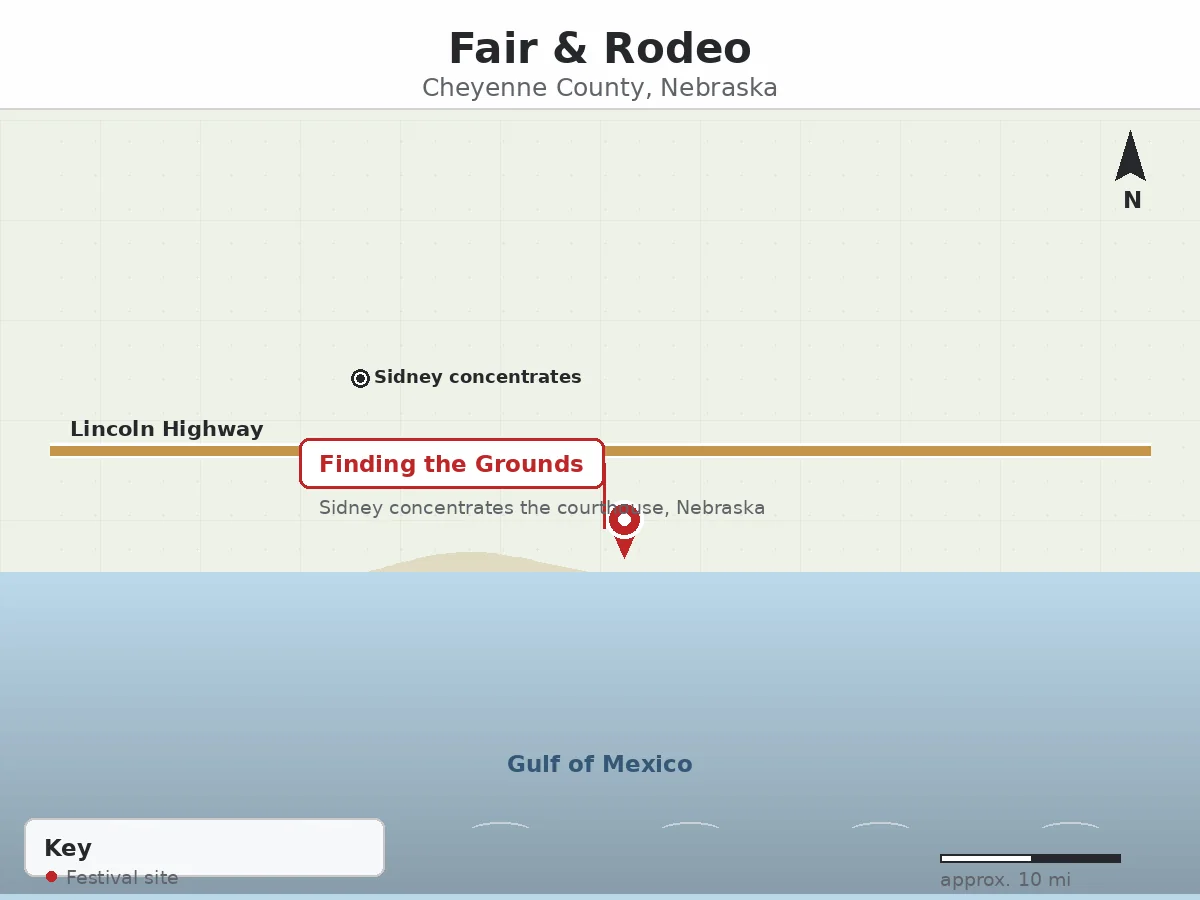
Finding the Grounds on the Lincoln Highway
The Cheyenne County Fairgrounds stand at 10955 Lincoln Highway in Sidney, on the Highway 30 corridor running the length of the town. Sidney is the county seat, so the fair sits in the county’s service centre, with fuel, food and lodging along the same corridor and the interstate just south of town. The fair board keeps its office at the grounds: a working county site that hosts the board year-round, not a showground assembled for one week and struck again.

What the Fair’s Record Does Not Offer
No fair-week camping offer appears in any fair-side record for this fair, so visitors should not arrive expecting a published pitch, hookup rate or booking route at the grounds. The honest plan is a room in Sidney or a campground found through ordinary channels, arranged before fair week rather than at the gate. The board’s published paper is equally silent on a grounds admission charge, and that silence is best read plainly: entry to the grounds carries no published price, the evenings are what cost money, and anyone quoting a gate figure for this fair is working from something other than the fair’s own record.
A Closing Saturday, Hour by Hour
Arrive at the grounds by mid-morning, while the barns are still busy and the week’s exhibits can be seen at leisure. Walk the livestock barns first, then the exhibit entries, before the afternoon heat builds. Take lunch in town along the highway, and be back in good time for the lawnmower races, which share the closing bill. As the light drops, settle into the grandstand for the Demolition Derby at 6:00 p.m., or pay the pit pass price if watching from beside the action matters more than a seat. Finish the night in Sidney, where the week’s last crowd drains away into the seat’s restaurants and motel rows.
The Other Cheyenne, and Why It Is Not This One
Search results for this fair collide with the most famous rodeo name in America, and the confusion is worth clearing away directly. Cheyenne Frontier Days belongs to the city of Cheyenne in Wyoming and to a different Cheyenne County entirely; it is a separate event in a separate state, and nothing from it — no act, price, date or claim — has any place in an account of the Sidney fair. Other states hold Cheyenne Counties with fairs of their own, whose records are likewise kept out of this one. What Sidney offers instead is scale a visitor can actually take in: one grounds, one board, one published price list, and a grandstand week whose whole programme can be seen without a map the size of a small city.
Before You Set Out
- Choose your grandstand nights early, because each evening event is priced and ticketed on its own
- Price the All Event Pass against single tickets if you plan to attend three or more grandstand events
- Recheck the current edition’s ticket information, since the published ladder belongs to its own year
- Book a Sidney room ahead of fair week, as no camping offer is published at the grounds
- Bring the children aged five and under free policy into your budget only for grandstand events
- Allow a morning for the barns and exhibit halls, not just an evening for the grandstand
- Carry cash and a card, because small fairground vendors and booths vary in what they accept
- Navigate to the fairgrounds on the Lincoln Highway, and ignore any listing that sends you to Wyoming
Beyond the Fairgrounds
Sidney rewards a visitor who treats the fair as the centre of a slightly longer stay. The grounds sit on the Lincoln Highway, the historic transcontinental route that still forms the town’s main street, and the drive in along Highway 30 is part of the occasion. As the county seat, Sidney concentrates the courthouse, county offices and services of a wide ranching county in one compact town, and its position near the interstate makes it the natural overnight stop for travellers crossing southern Nebraska. The fairgrounds work beyond fair week as a county site with year-round bookings and civic duties, worth knowing only as context: the fair is the grounds’ great week, not their only use, and the rest of the year belongs to Sidney’s own calendar.
Why This Fair Holds Its Ground
A county fair that publishes everything is making an argument about itself. The board prints its officers, sells its sponsorships in the open, sets its pass prices in a minuted meeting and lets the county paper walk its grounds during the week itself. That transparency suits a fair billing itself, in its 140th year, as the longest-running of its kind in the state: the claim is bold, and the paper behind the modern fair is there for anyone to inspect. For Cheyenne County households the week is also the annual reunion, when the barns fill before breakfast and the grandstand fills after supper. Sidney’s answer to rival panhandle fairs is a professional rodeo, a full concert and truck card, and a closing derby, all within one week.
Frequently Asked Questions
Is there a charge simply to walk onto the grounds?
No grounds admission price is published in the fair’s own record. What costs money is the grandstand programme, where each evening event carries its own ticket price, so a visitor can walk the barns and exhibit areas without buying into the night’s headline event.
How does the All Event Pass compare with single tickets?
For the 2026 edition the board priced the pass at 70 dollars in its early sale and 85 dollars afterwards, against individual grandstand prices running from 20 to 30 dollars an event. A visitor attending most of the week’s grandstand card would pay less with the pass, while a one-night visitor is better served by a single ticket.
Is this the fair connected with Frontier Days?
No. Frontier Days is Wyoming’s event in the city of Cheyenne, in another state and another Cheyenne County. The Cheyenne County Fair & Rodeo is Nebraska’s panhandle fair in Sidney, run by its own county fair board, and the two events share nothing but a name.
Where do the barns and exhibits fit into the week?
They are the fair’s daytime half. Livestock for the 4-H and open class shows fill the barns from early morning, with sheep, goats, rabbits, poultry, swine, beef cattle and horses all on the grounds, and the static exhibits are judged under the fair book carried by Nebraska Extension in Cheyenne County.
What to Expect From the Next Cheyenne County Nebraska Fair & Rodeo Festival
How often is the Cheyenne County Nebraska Fair & Rodeo Festival held?
The fair is an annual event, held once each year in late July as a full week running from Saturday to Saturday at the Cheyenne County Fairgrounds in Sidney.
When is the next Cheyenne County Nebraska Fair & Rodeo Festival?
The next edition falls in late July, following the fair’s established Saturday-to-Saturday pattern. The board announces each edition’s exact week and grandstand card in its own publications, and its sponsorship and ticket information appears in the spring before the fair.
Will the dates change?
The late-July position and the week-long shape are the fair’s settled pattern, but the precise week within that season is set edition by edition. Weather, the rodeo calendar and the board’s own planning can all move a given year’s dates, so the board’s current announcement is the only safe source.
Every fair makes one promise it has to keep in public, and Sidney’s keeps its promises in print: the officers, the prices, the pass, the programme. A visitor who reads that paper before setting out will find the week exactly where the board said it would be, at the fairgrounds on the Lincoln Highway, with the barns full by breakfast and the grandstand lit by dark.


One Comment