Cullman County Alabama Cullman Oktoberfest Festival
Few small American cities can claim a German heritage as direct as Cullman’s. The town was founded in 1873 by a German immigrant, Colonel Johann Gottfried Cullmann, who brought settlers from his homeland to the rolling hills of north-central Alabama, and that ancestry still shapes the city’s identity more than a century later. Every October, downtown Cullman makes the connection explicit with an Oktoberfest that fills Depot Park with biergartens, brass music, German food, and a parade that officially opens the celebration with the tapping of a keg.
What separates Cullman’s Oktoberfest from the many fall festivals that appear each autumn is its authenticity and its scale. This is a free, multi-day event that has become one of north Alabama’s signature cultural gatherings, drawing visitors from across the region to a city of roughly sixteen thousand people. It is a community celebration with real German roots rather than a themed carnival, and that distinction shows in everything from the food to the programming.
What Cullman Oktoberfest Is
Cullman Oktoberfest is an annual celebration of the city’s German heritage, held over several days in early October at Depot Park in downtown Cullman. Admission is free. The festival mixes traditional German elements, such as biergartens and folk music, with the competitions and family attractions that make a modern community festival work, including a 5K and 10K race, a parade, a vendor market, and glass-blowing workshops.
The event is organized with the involvement of the city and its parks and recreation department, and it has grown into one of the largest events of its kind in the region. City leaders and community figures take part each year, with a local figure serving as honorary Bürgermeister, the German term for mayor, and a young resident recently named the festival’s first Kinderbürgermeister, or children’s mayor.
| Festival name | Cullman Oktoberfest |
| Location | Depot Park, 309 1st Ave NE, Cullman, Alabama |
| Typical timing | First weekend in October |
| Format | Multi-day German heritage festival |
| Admission | Free |
| Signature events | Parade and keg tapping, biergartens, brat-eating and stein-hoisting contests, 5K/10K |
| Heritage | City founded 1873 by German immigrant Col. Johann Gottfried Cullmann |
| Organizer | City of Cullman area parks and recreation, with community partners |
History and Origins of Cullman Oktoberfest
Cullman’s German story starts with its founder. Colonel Johann Gottfried Cullmann, a native of Frankweiler in the German Rhineland, established the settlement in 1873 as a home for German immigrants seeking land and opportunity in the American South. The city and county that grew from his colony kept a distinctly German character for generations, visible in its architecture, its church life, and its farming traditions.
As the twentieth century wore on, Cullman’s German culture faded somewhat as the city embraced a broader, progressive identity. In 1939 the town adopted an agricultural celebration, the Strawberry Festival, reflecting the county’s farm economy rather than its ancestry. Interest in the German past revived around the city’s centennial in the 1970s, and in 1976 the Cullman County Museum opened in a reconstruction of Colonel Cullmann’s home, an event attended by the mayor of Frankweiler. In that atmosphere, a homegrown version of the Bavarian Oktoberfest was a natural next step.
Cullman’s Oktoberfest has since become an annual tradition, marking its forty-third edition in recent years and continuing to expand its programming. New features, from the return of a Ferris wheel to the introduction of a children’s mayor, show a festival that is still evolving while staying anchored to its purpose: celebrating the German heritage that gave the city its name.
Cullman County’s German and Agricultural Heritage
Cullman County sits in the hills of north-central Alabama, a landscape of ridges, valleys, and farmland that reminded its German settlers of home. The county was created in 1877 and grew around the city of Cullman, its seat and largest community. Agriculture has always been central to the county’s economy, from cotton and corn in the nineteenth century to poultry, cattle, and a notable specialty in sweet potatoes today. In fact, Cullman County produces a large share of Alabama’s sweet potato crop, a point of local pride that has its own separate festival each Labor Day.
The German heritage and the agricultural identity often overlap in Cullman’s calendar. Beyond Oktoberfest, the city has come to be known across the South for its Christmas market, the Christkindlmarkt, which extends the German theme into the winter months. Together, these events have given Cullman a cultural brand that few Alabama towns can match.
What to Expect at the Festival
Main attractions and activities
The festival opens with a parade through the streets and an official ceremony that includes the tapping of a keg, a nod to the Bavarian tradition that started it all. Across the weekend you can expect live German music on multiple stages, cultural displays, walking tours of Cullman’s German heritage, and a vendor market stocked with artisan crafts. Traditional competitions are a highlight, including brat-eating, stein-hoisting for adults, and costume contests. A 5K and 10K race, held on the Saturday morning, draws runners from around the region.
Biergartens anchor the festival grounds, and one of them, the Weihenstephan Festzelt, features beers tied to a Bavarian brewing tradition that reaches back nearly a thousand years. For visitors who are not there for the beer, the entertainment, the food, and the cultural programming easily fill a full day. The 2026 edition ran from Thursday evening through Sunday, with organized activities each day.
Food and vendors
German cuisine is the centerpiece. Expect bratwurst, sauerkraut, pretzels, and other traditional dishes alongside the general festival fare that Alabama crowds expect. The vendor market carries artisan crafts and specialty treats, and the biergartens serve German beers with a strong emphasis on tradition. Food vendors operate across the festival grounds, so you can graze your way through the weekend.

Family and children’s activities
Despite the biergarten culture, Cullman Oktoberfest is deliberately family-friendly. A dedicated kids’ zone, the Kinderbereich, keeps younger visitors busy with games and activities, and the Ferris wheel has returned in recent years to add a classic fairground element. The introduction of a Kinderbürgermeister gave children a formal role in the proceedings, a small but telling sign that the festival wants the next generation involved.
Planning Your Visit — Practical Information
Getting to Cullman
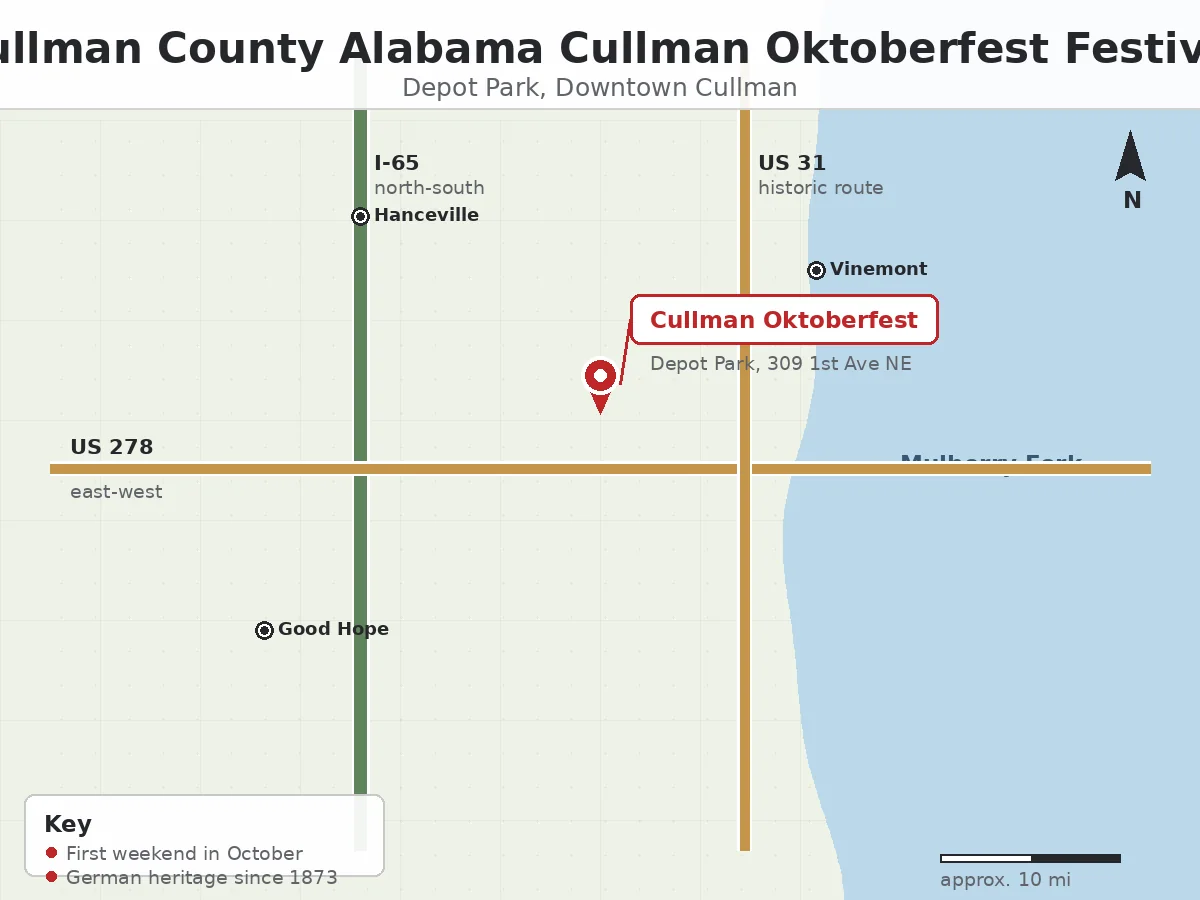
Cullman is easy to reach. Interstate 65 runs north-south through the county, with several exits serving the city, and U.S. Highways 31 and 278 also pass through the area. Birmingham is about forty-five minutes to the south, and Huntsville is roughly an hour north via I-65 and Interstate 565. Depot Park sits at 309 1st Avenue NE in downtown Cullman, within walking distance of the historic downtown blocks. The nearest major airport is Huntsville International, with Birmingham-Shuttlesworth as another option.
Where to stay
Cullman has a solid corridor of hotels and motels near the interstate, along with bed-and-breakfasts and cabins around Lewis Smith Lake to the south. Because Oktoberfest draws visitors from across north Alabama, rooms near downtown and the interstate fill quickly for the festival weekend, so booking early is wise. Camping is available at area parks and around the lake.
Parking and crowd logistics
Downtown parking fills fast, especially on Friday and Saturday evenings and during the Saturday race. Arriving earlier in the day helps, and the festival’s downtown setting makes it possible to park a few blocks out and walk in. Sunday tends to be the calmest day of the run.
Admission, costs, and tickets
General admission to Cullman Oktoberfest is free. You pay for food, drinks, merchandise, and any ticketed elements such as race registration. Because the event is free to enter, it works well for families who want to wander without committing to a full day.
Weather and what to wear
Early October in north Alabama is usually pleasant, with warm afternoons in the seventies and cooler evenings that call for a light jacket or sweater. Rain is possible, and the festival continues in most weather, so a compact umbrella is worth having. The grounds mix paved areas and grass, so comfortable walking shoes are the right choice for a day on your feet.
A Sample Festival Weekend
- Friday: arrive for the parade and keg tapping, then explore the biergartens and the vendor market.
- Saturday morning: watch or run the 5K and 10K, then catch a heritage walking tour.
- Saturday afternoon: work through the food vendors, try a competition, and visit the Kinderbereich with the kids.
- Sunday: a quieter pass through the market and the cultural displays before the closing ceremony.
Other Alabama Festivals to Compare
Cullman’s German celebration is one entry in a wider Alabama festival calendar. For a completely different flavor of community art, the Baldwin County Alabama Art in the Park Festival pairs a coastal setting with a juried fine arts show. Closer in spirit to Cullman’s heritage theme, the town of Good Hope, also in Cullman County, has staged its own community history festival, and the county’s Sweet Tater Festival celebrates the local crop each Labor Day. Taken together, they show how one county can support several distinct traditions.
Your Festival Checklist
- A light jacket for cool October evenings.
- Cash for vendors and competition entries.
- Comfortable shoes for a downtown event spread across several blocks.
- A plan for the race if you are running.
- An appetite for bratwurst and pretzels.
Beyond the Festival — Exploring Cullman County
Cullman rewards a longer stay. The Ave Maria Grotto, a remarkable miniature village of recreated religious shrines built by a Benedictine monk, sits just off I-65 and is one of the state’s most unusual attractions. The Cullman County Museum in downtown tells the German settlement story in Colonel Cullmann’s reconstructed home. To the south, Lewis Smith Lake offers boating, fishing, and shoreline parks. The Shrine of the Most Blessed Sacrament at Hanceville draws visitors from far beyond Alabama, and the surrounding countryside of farms and ridges is attractive in its own right.
The Economic and Community Significance of the Festival
Oktoberfest brings measurable traffic to downtown Cullman and supports the restaurants, shops, and vendors that line the festival grounds. It also reinforces the city’s tourism identity, working alongside the Christmas market and the county’s agricultural festivals to give visitors a reason to return. The event depends on volunteers, civic organizations, and city staff, and it gives local musicians, artisans, and food producers a sizable audience. More than a party, it is a public statement about who Cullman is and where it came from.
Festival Area Map
The festival is centered on Depot Park in downtown Cullman, just off Interstate 65 and near the junction of U.S. Highways 31 and 278.
Frequently Asked Questions
When is Cullman Oktoberfest?
Cullman Oktoberfest is traditionally held on the first weekend in October, running from Thursday evening through Sunday. Confirm the exact dates with the city or the festival before you travel, since the calendar shifts slightly each year.
Is Cullman Oktoberfest free to attend?
Yes, general admission is free. You pay only for food, drinks, merchandise, and any ticketed items such as race registration.
Where is Cullman Oktoberfest held?
The festival takes place at Depot Park in downtown Cullman, at 309 1st Avenue NE. The park is within walking distance of the historic downtown.
How long does Cullman Oktoberfest last?
The event runs over several days, typically four, beginning Thursday evening and ending Sunday. Hours vary by day, with the longest programming on Friday and Saturday.
What is Cullman, Alabama known for?
Cullman is known for its German heritage, dating to its founding in 1873 by Colonel Johann Gottfried Cullmann, and for landmarks such as the Ave Maria Grotto, the Cullman County Museum, and nearby Lewis Smith Lake. Its German-themed festivals, including Oktoberfest and the winter Christkindlmarkt, are central to its identity.
Is Cullman Oktoberfest good for kids?
Yes. The festival includes a dedicated Kinderbereich kids’ zone, family attractions such as a Ferris wheel in some years, and a children’s mayor tradition. It is a free, family-friendly event.
What should I bring to Cullman Oktoberfest?
Bring a light jacket for cool evenings, comfortable walking shoes, and cash for vendors. An umbrella is useful if rain is in the forecast, since the festival continues in most weather.
Are pets allowed at Cullman Oktoberfest?
The festival has included activities for dogs in some years, but policies vary by area and by event. Check with the organizer before bringing a pet, and keep any animal leashed.
What to Expect From the Next Cullman Oktoberfest
Cullman Oktoberfest is an annual event and has run for more than four decades, so visitors can plan on a celebration each October in most years. The timing follows the first weekend of the month, though the exact dates move a little from year to year. The format has been stable, centered on Depot Park, and recent editions have added fresh elements such as a children’s mayor and the return of the Ferris wheel.
Because the event is built around the first weekend of October, lodging in Cullman and around Lewis Smith Lake can fill as the date approaches. Confirm the dates with the city before booking, and plan to arrive earlier in the day if you want easy parking near downtown.
How often is Cullman Oktoberfest held?
It is an annual event, held every year for more than four decades. It is not an occasional or one-time festival.
When is the next Cullman Oktoberfest?
The next edition is expected on the first weekend in October, following the festival’s established pattern. Check with the city for the confirmed dates before you travel.
Will the dates change?
The festival tracks the first weekend of October, so the dates shift slightly each year. Weather and city scheduling can affect minor details, so confirm close to the date.
Last updated: October 2026
Cullman Oktoberfest is a rare thing: a festival that celebrates a genuine immigrant heritage without turning it into a costume. If you are within reach of north Alabama on the first weekend of October, make the drive, raise a stein in the biergarten, and see what a German-founded Alabama town does when it throws open its doors.



One Comment